

 Global| Nov 11 2026
The Economic Implications of the AI Data Center Buildout
|in:Viewpoints
Before the midterm elections, the buildout of AI data centers received a lot of attention and was identified as being a significant factor contributing to strong economic growth; at the same time, there were mounting worries of overinvestment and related excess indebtedness. Post midterm elections, significant discussion has turned to the downside: if newly-elected state legislatures and regulators clamp down on the AI data center buildout, commentators now fear there will be significant damage to the economy.
My assessment is the AI buildout has added to the economy--although its net impact on GDP has been relatively small--and a clampdown on the AI data center buildout would dent intermediate-term economic performance, but have a relatively modest impact on GDP growth. There are reasons to be optimistic. Here's some observations to support this view.
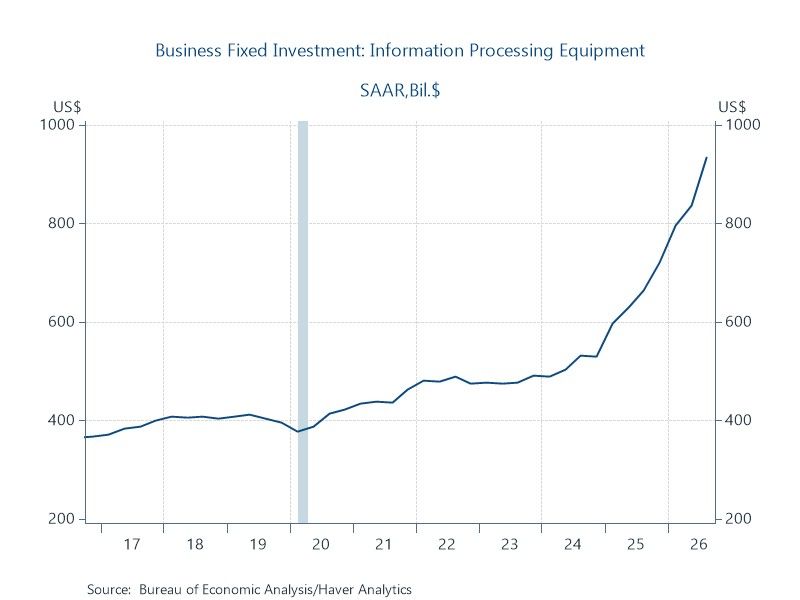
Consumption has consistently been the biggest contributor to economic growth. Consumption comprises roughly 67% of GDP, and in the last several years, its growth has contributed approximately 1.8 percentage points to the average 2.7% annualized growth in real GDP. Business fixed investment has also been strong, driven by the boom in AI data center build outs (Chart 1). The BFI share of GDP has risen to 17%, its highest since the early 1980s, and 10% of business investment is attributable to investment in AI. That means AI investment is roughly 1.7% of GDP.
Chart 1. Business Investment in Information Processing Equipment
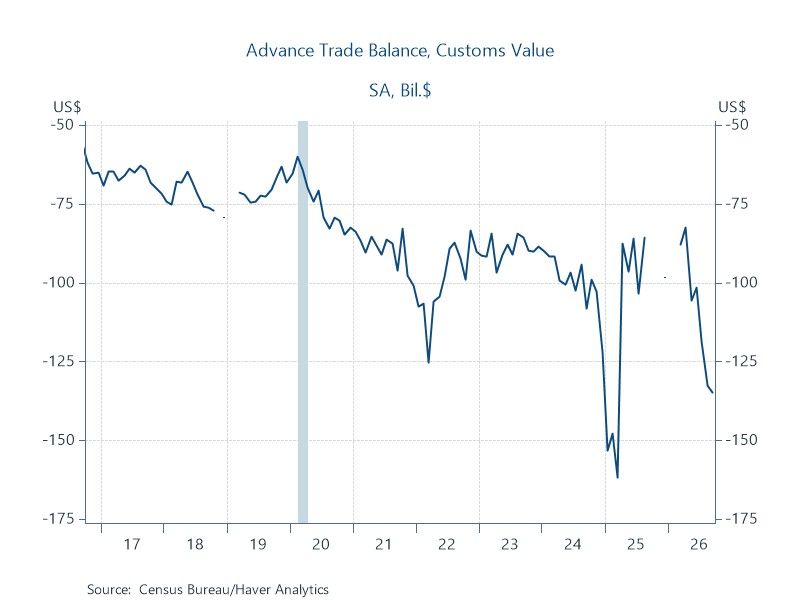
But over 70% of all of the capital spending in the AI data center buildout--including semiconductors, telecommunications equipment, and computers/peripherals--is imported (Chart 2) (Sources: World Trade Organization Global Review 2026; Jason Furman, "The AI Boom's Two Engines", the Peterson Institute for International Economics", November 2026). Those capital goods are produced overseas and as such, the largest portion of the investment in AI data centers is not domestic production and is not measured in GDP. No question, the AI data center buildout has boosted local economic activity and aggregate domestic demand, but its impact on GDP has been largely offset by a widening of the U.S. trade deficit (Chart 3).
Chart 2. U.S. Imports of Capital Goods
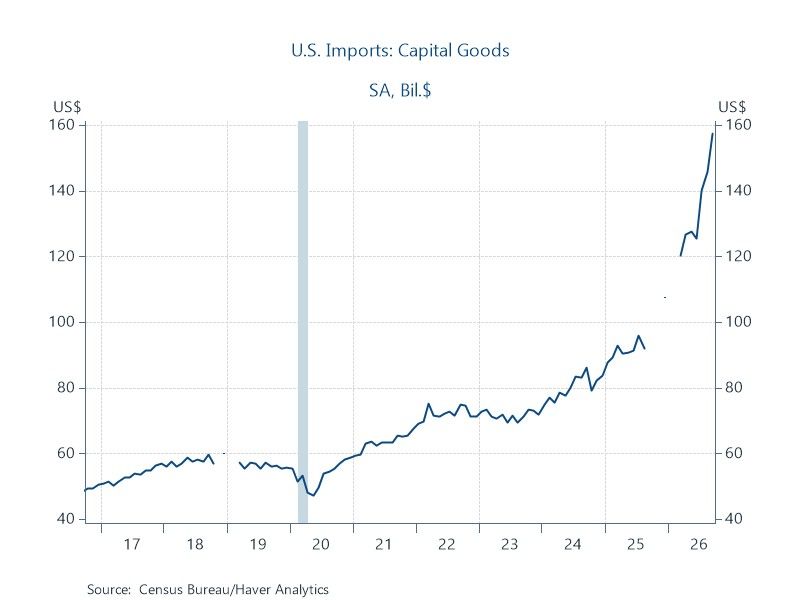
Chart 3. U.S. Net Exports of Goods and Services
Although the direct impact of the AI buildout on GDP growth has been muted, as Furman points out, the AI buildout has contributed to the ebullient stock market. The AI buildout has raised profit expectations and raised stock market expectations. This has fueled a positive wealth effect and boosted consumption growth. Accordingly, the total direct and indirect impacts of the AI buildout on economic activity has been larger than the measured impact of business investment net of the rise in the trade deficit.
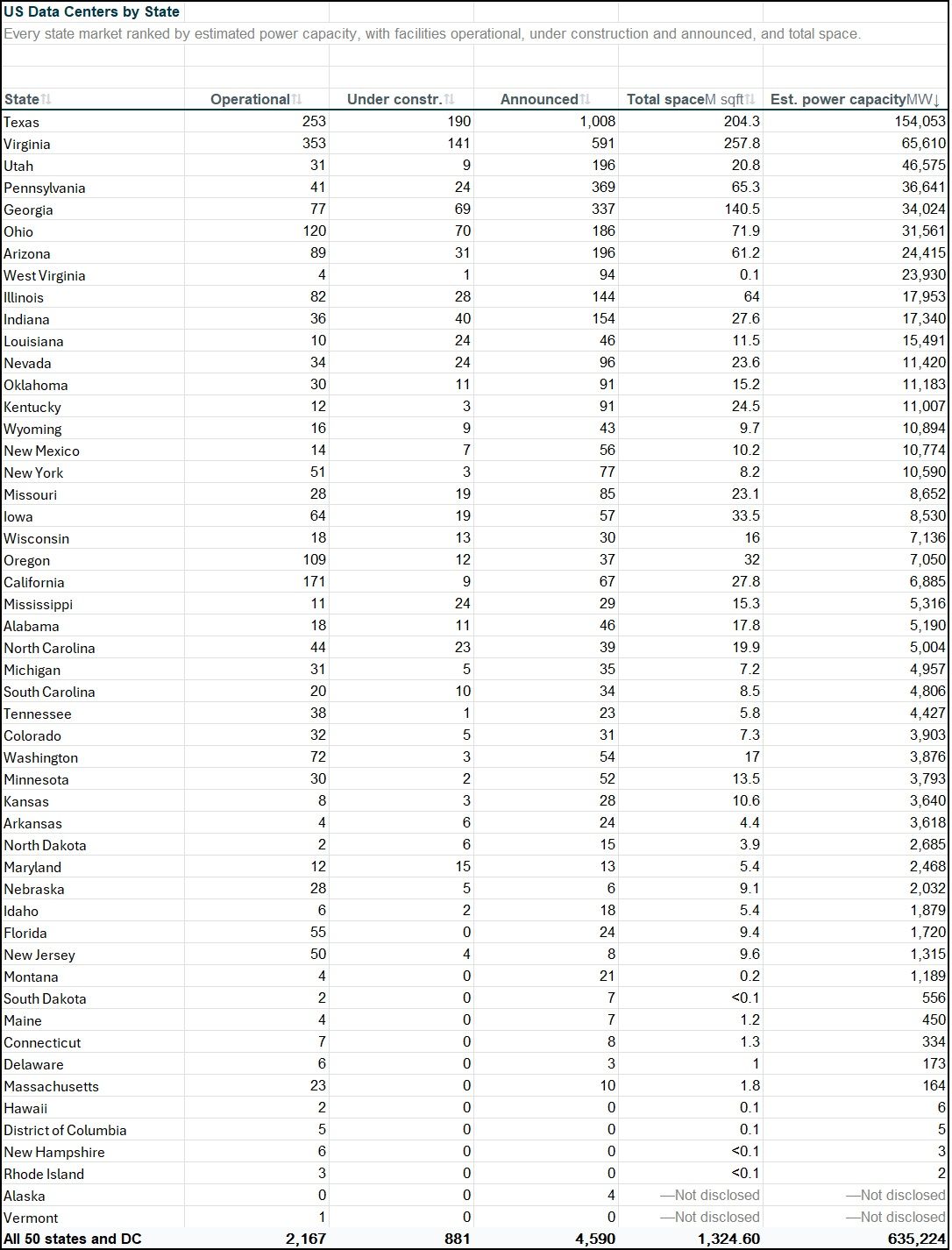
Looking forward, the AI data center buildout will likely slow, but not come to a halt. As displayed in Figure 4, a sizable number of projects are under construction (particularly in Texas, Virginia, Pennsylvania, Ohio and Indiana), and these are unlikely to be abandoned. As shown for the different states, other AI projects have already been announced or are in the planning stage. It is uncertain whether they will move ahead; most likely, some will proceed with development while some will be cancelled. In the short run, this will subtract from economic activity. At the same time, however, it will reduce the demand for imported capital goods, which will provide an offset and significantly mitigate the net economic impact.
Figure 4. U.S. Data Centers by State: Operating, Under Construction and Planned/Announced
There are negatives and positives stemming from the shift in sentiment toward investment in AI data centers. The biggest negative is it would slow the implementation of productivity-enhancing AI. This will slow advances in economic performance, even if its impact on GDP is modest. It will reduce employment in construction and dampen economic activity in the regions where data centers would be built.
Three positives seem apparent. First, credit markets were beginning to have difficulty digesting the increasingly larger bond issuances by the big cap AI firms, with potential negative spillover effects on broader bond markets. A slower AI data center buildout would involve less bond issuances and fewer concerns about credit quality, potentially providing relief to markets. Second, the high global demand for capital goods required for the AI data center buildout has been absorbing capacity and exerting upward pressures on prices of select capital goods, and those pressures may ease.
Third and perhaps most importantly, history is marked by spurts in technological innovations that have involved excessive investment with pronounced losers along with profound technical advances. Recently, concerns about excesses in AI have mounted--in valuations, in debt, and elsewhere. The shift in political leadership that seems likely to slow the AI data center buildout may avoid some of the excesses. New innovations and investments in them always involve losers as well as winners. Let's hope that newly elected government officials and regulators act reasonably with a soft tap on the brakes that results in avoiding some of the excesses that have plagued historic investment booms while allowing the innovations to enhance productivity and standards of living.

Mickey D. Levy
AuthorMore in Author Profile »Mickey Levy is a macroeconomist who uniquely analyzes economic and financial market performance and how they are affected by monetary and fiscal policies. Dr. Levy started his career conducting research at the Congressional Budget Office and American Enterprise Institute, and for many years was Chief Economist at Bank of America, followed by Berenberg Capital Markets. He is a Visiting Fellow at the Hoover Institution at Stanford University and a long-standing member of the Shadow Open Market Committee.
Dr. Levy is a leading expert on the Federal Reserve’s monetary policy, with a deep understanding of fiscal policy and how they interact. He has researched and spoken extensively on financial market behavior, and has a strong track record in forecasting. Dr. Levy’s early research was on the Fed’s debt monetization and different aspects of the government’s public finances. He has written hundreds of articles and papers for leading economic journals on U.S. and global economic conditions. He has testified frequently before the U.S. Congress on monetary and fiscal policies, banking and credit conditions, regulations, and global trade, and is a frequent contributor to the Wall Street Journal.
He is a member of the Council on Foreign Relations and the Economic Club of New York, and previously served on the Panel of Economic Advisors to the Federal Reserve of New York, as well as the Advisory Panel of the Office of Financial Research.
Dr. Levy holds a Ph.D. in Economics from University of Maryland, a Master’s in Public Policy from U.C. Berkeley, and a B.A. in Economics from U.C. Santa Barbara.