Productivity: Moderate Growth in Q2
Summary
- Productivity gains, while still respectable, have lost a bit of vigor in recent quarters.
- Unit labor costs rose moderately, suggesting little inflation pressure.
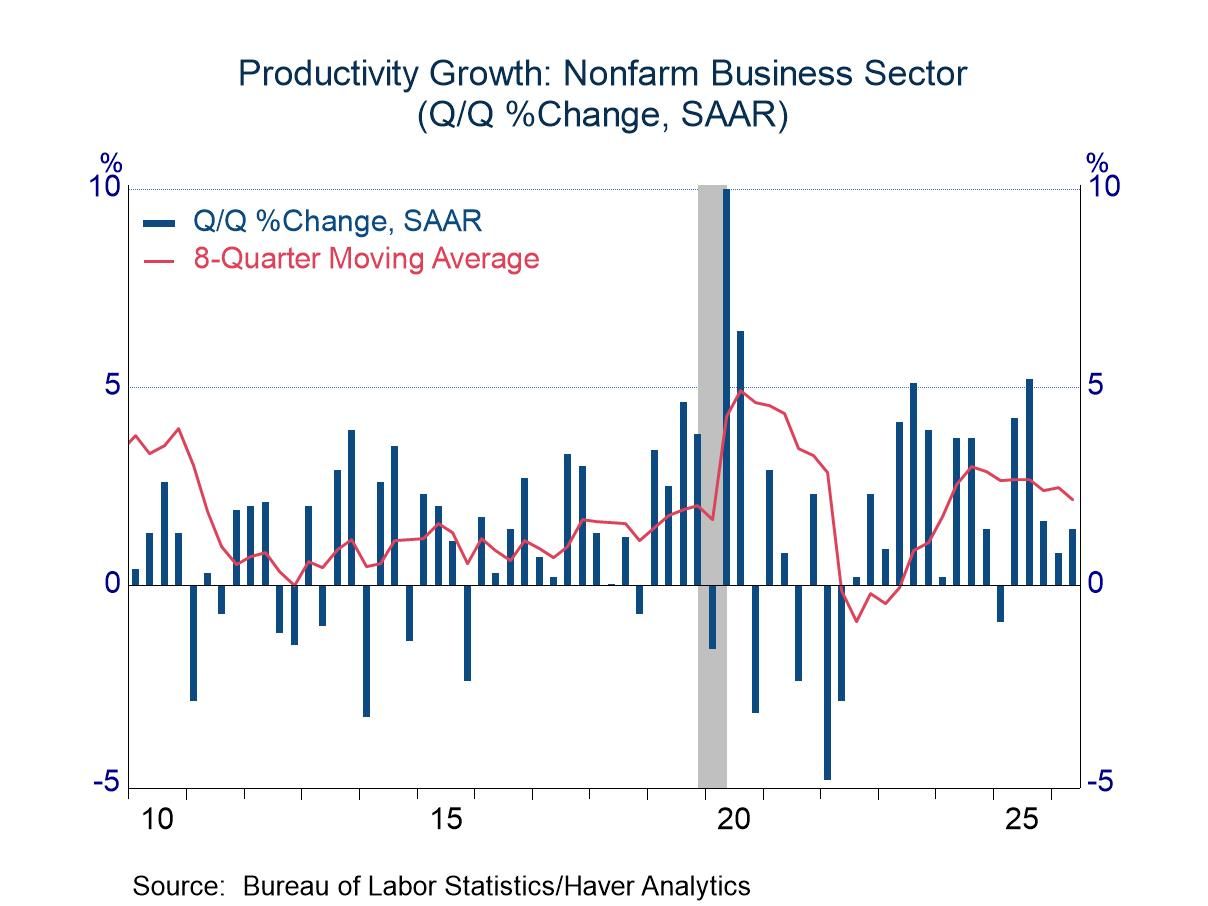
Productivity in the nonfarm business sector rose 1.4% in the second quarter, better than the expected increase of 0.7% but trailing average gains of more than 2.0% in both 2024 and 2025. Results in the prior two quarters also were below 2.0%. In all of the past three quarters, the easing in productivity growth reflected slow advances in output: 1.7% in Q2 and an average of 1.4% in the prior two quarters. Output growth in both 2024 and 2025 averaged 3.0%. Growth of labor input in recent quarters has remained comfortably within the range of recent observations. Productivity growth is approximately equal to output growth less growth of labor hours.
The slowdown in productivity growth in the past three quarters might raise concern about the underlying pace of growth. However, the recent easing is not especially alarming, as productivity often moves erratically; soft patches have occurred in the past only to revive in subsequent quarters. Still, the past three quarters have generated a downward drift in the eight-quarter moving average of growth, which is intended to smooth the random changes in productivity. Despite this drift, it is too early to conclude that productivity growth is fading. The softening in recent quarters should be viewed as disappointing only to those expecting a burst in efficiency gains from artificial intelligence. AI, thus far, does not seem to have generated miracles.
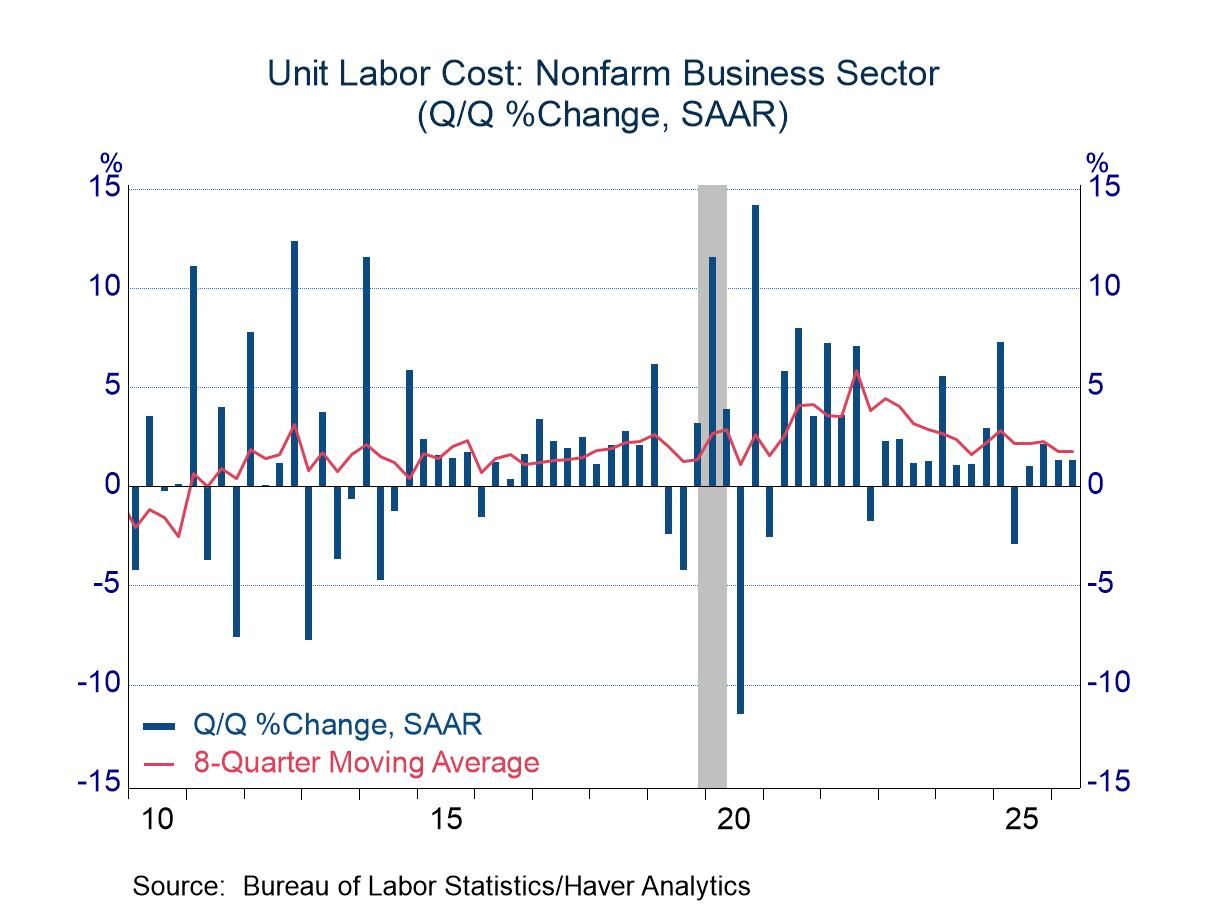
Unit labor costs—hourly labor compensation relative to productivity—rose 1.3% in Q2, matching the increase in the prior quarter and trailing the average results in the prior few years. Labor compensation grew moderately in Q2, at 2.7%, and the offset from 1.4% productivity growth left a restrained advance in unit labor costs.
Fed officials have argued in recent months that the labor market is not a factor pushing inflation above the target of 2.0%. The results on unit labor costs support this view. If labor costs were the only factor driving price changes, the 1.3% growth of unit labor costs would suggest an inflation rate below 2.0%.
The productivity and labor cost data are available in Haver’s USECON database. The Action Economics expectations figures are in the AS1REPNA database.

Michael J. Moran
AuthorMore in Author Profile »Before joining Haver Analytics in 2025, Michael J. Moran was the chief economist of Daiwa Capital Markets America Inc. He was responsible for preparing the firm’s economic forecast and interest rate outlook. He traveled frequently to visit the clients of Daiwa Capital Markets and wrote weekly economic commentary. Mr. Moran also was involved in the flux of financial markets, as he spent a portion of each day on Daiwa’s trading floor interpreting economic statistics and Federal Reserve activity for traders and salespeople. Mr. Moran is quoted frequently in the financial press, and he appears regularly on cable news shows. He also has published articles in several journals and periodicals. Before joining Daiwa Capital Markets America, Mr. Moran worked as an economist at the Federal Reserve Board in Washington, D.C. where he analyzed a broad range of issues dealing with the financial sector of the economy and regularly briefed the Board of Governors. He was on the faculty of Pennsylvania State University from 1979 to 1980 and taught on a part-time basis at George Washington University from 1980 to 1987.
Mr. Moran received his Ph.D. in economics from Pennsylvania State University in 1980 and a B.S. in business administration from the University of Bridgeport in 1975. He was a CFA charter holder from 2002 until 2016.
More Economy in Brief
U.K. Housing Surveys and Consumer Sentiment Support the View of Weak Growth
 Asia
Asia