Production in a Gradual Recovery in Europe Despite Recent Setbacks
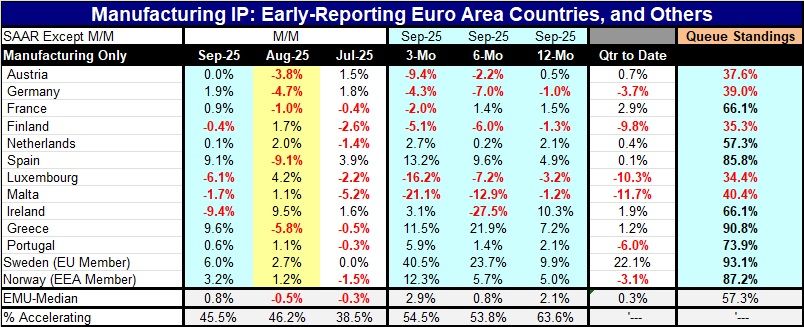
Industrial production for the European Monetary Union (EMU) is not yet available for the union as a whole; however, a number of European countries have reported production, and they give us a good sense of what's happening. In September, among the 13 European countries that reported in the table, all but four of them showed increases in industrial production. Declines were posted in Ireland where production fell by 9.4% in one month, Luxembourg where it fell by 6.1%, Malta where it fell by 1.7%, and in Finland where it fell by 0.4%. In the remaining nine countries, production increased. The median increase for monetary union members in the table was a rise of 0.8% month-to-month. 45.5% of the reporters in the monetary union showed production acceleration.
In August, there were 5 European members with production decreasing. Among European Monetary Union members, the median was a decline of 0.5% with 46.2% of the reporters showing output accelerating on the month. July had been a much worse month with 8 reporting European countries showing declines and with the monetary union median showing a decline of 0.3% and only 38.5% of the reporting EMU members showing output accelerating month-to-month.
There has been gradual moderate improvement in these monthly statistics both in terms of improvement in the median and improvement in the breadth as output has accelerated, with a step back in August.
Looking at the sequential data that compare three-month results to six-month results to 12-month results, we see a median annualized increase of 2.9% for output across monetary union members over three months; that's up from 0.8% over six months and compares to a 2.1% increase for monetary union members over twelve months. The breadth of increase over the period is above 50% on all the horizons and it's fairly steady over three months and six months at about a 54-percentile standing.
September data conclude the results for the third quarter. In this quarter-to-date calculation, 6 of the 13 reporters in the table shows output declining in the third quarter. Monetary Union members generate a median increase of 0.3% in terms of annualized quarter-to-quarter industrial output changes. The pattern and the monthly data seem to be slightly stronger than what we see in the quarter-to-date.
The final column of the table presents the queue standings that calculate the positioning of the year-over-year growth rates across country-reporters among growth rates back to late-2007. Ranked among this cluster of growth rates, only five of the current year-over-year rates stand at levels that are below their median growth rate for the period. Countries with below median growth rates (below a standing of 50%) for industrial production growth are Austria, Germany, Finland, Luxembourg, and Malta. Among these, only one belongs to the four largest economies in the monetary union—Germany, which is also the largest of them. Germany has the standing only its 39th percentile. The unweighted median ranking for the group of monetary union economies is at 57.3%, above the 50% mark and therefore above the historic median.
The industrial production data for the monetary union in September is somewhat encouraging but certainly not crystal clear. There continues to be a lot of weaknesses displayed in the data. While the aggregate ranking is above its historic median, it's not above it by very much and clearly the growth rates are still relatively weak. There still is not a clear trend of acceleration in the group. However, what's lacking in the data is any sign of real deterioration. There clearly is weakness across countries but not a sense of deterioration. The best news in the report may be that there's not any really bad news.

Robert Brusca
AuthorMore in Author Profile »Robert A. Brusca is Chief Economist of Fact and Opinion Economics, a consulting firm he founded in Manhattan. He has been an economist on Wall Street for over 25 years. He has visited central banking and large institutional clients in over 30 countries in his career as an economist. Mr. Brusca was a Divisional Research Chief at the Federal Reserve Bank of NY (Chief of the International Financial markets Division), a Fed Watcher at Irving Trust and Chief Economist at Nikko Securities International. He is widely quoted and appears in various media. Mr. Brusca holds an MA and Ph.D. in economics from Michigan State University and a BA in Economics from the University of Michigan. His research pursues his strong interests in non aligned policy economics as well as international economics. FAO Economics’ research targets investors to assist them in making better investment decisions in stocks, bonds and in a variety of international assets. The company does not manage money and has no conflicts in giving economic advice.
More Economy in Brief
 Global