

Lingering Hiccups in Shelter Cost Inflation
by:Joel Prakken
|in:Viewpoints
The Bureau of Labor Statistics was unable to sample prices during the government shutdown last October. Consequently, it assumed no change in shelter costs for that month. Given the particulars of how the BLS measures rents, the resulting understatement of the level of shelter costs was not corrected until April, when shelter costs jumped 0.6%, roughly double the true monthly increase.
As we approach the next report on consumer prices, bear this in mind. Going forward, monthly changes in shelter costs will be correct. However, because we often examine inflation over longer intervals, the legacy effect of the government shutdown on shelter costs is not yet fully in the rearview mirror. From October through March the level of shelter costs was low by one month’s increase. Therefore, after March, any change in shelter costs calculated over an interval starting from the months of October through March will overstate the increase over that interval by one month’s increase in rents. The overstatement is magnified if the change is expressed at an annual rate.
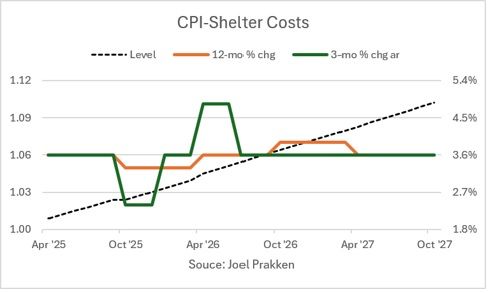
The chart shows a stylized example based on recent rates of change in rents. Suppose the level of shelter costs (black dashed line) increases at a steady rate of 0.287% per month (3.6% annually) but, for the months of October 2025 through March 2026, the level is low by that same 0.287%. The green line shows the corresponding 3-month percent change annualized. The orange line shows the 12-month percent change. At the 12-month window, we won’t be clear of this anomaly until April of 2027.

Joel Prakken
AuthorMore in Author Profile »Joel Prakken is former Chief US Economist of S&P Global and IHS Markit, co-founder of Macroeconomic Advisers, and past president and director of the National Association for Business Economics. He has served as an outside advisor to the Congressional Budget Office, on the Advisory Panel of the Bureau of Economic Analysis, and as a consultant to the Joint Committee on Taxation. He holds a BA in economics from Princeton University and a PhD in economics from Washington University in Saint Louis.
 Asia
Asia