

 Global| Jul 28 2026
An Investment Boom in a Constrained World
by:Andrew Cates
|in:Viewpoints
The world is investing on an extraordinary scale. The question is whether that investment expands productive capacity or merely offsets a more constrained world.
The global economy is entering its strongest investment cycle for a generation. Artificial intelligence, the energy transition, geopolitical fragmentation and higher defence spending are all driving capital expenditure. Unlike previous cycles, however, these forces increasingly compete for the same scarce inputs: energy, grids, critical minerals, water and skilled labour.
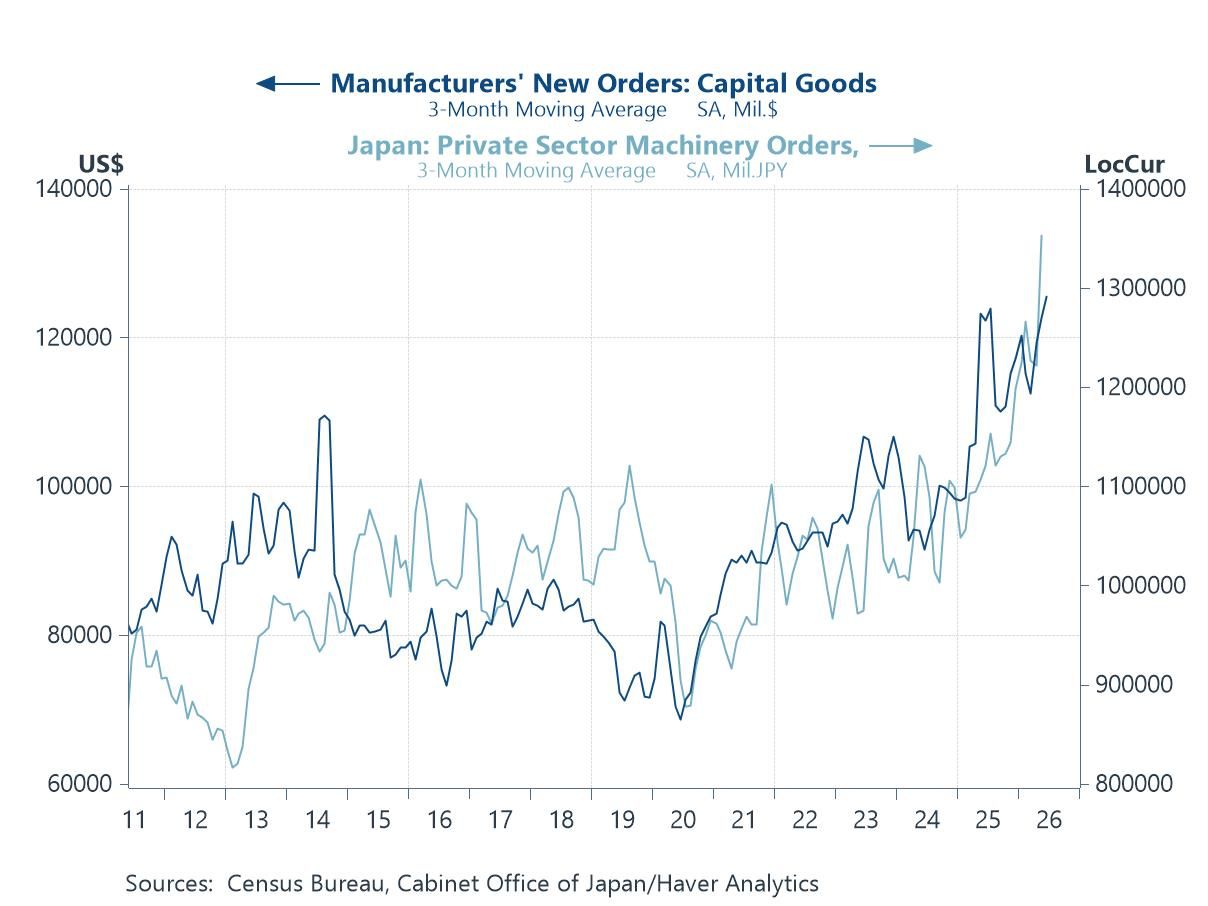
A world of constraints, forcing capital to move The distinctive feature of the current cycle is therefore not simply its scale but its supply-side character. Investment is being driven less by cyclical demand than by structural forces that converge on common physical constraints. As a result, much of today's capital spending is directed towards securing access to scarce resources rather than expanding productive capacity.
What is striking is how little these motives are truly independent of one another. Trace each to its physical requirements and they converge on the same few chokepoints. Electrification, defence manufacturing and the data-centre boom all bid for the same critical minerals — copper, lithium, the rare earths — now the object of a strategic contest that is itself spurring a wave of mining and processing investment. They all wait on the same electricity grid, where the binding constraint is increasingly the wires rather than the generation. And several — data centres and chip fabs above all — draw on the same scarce water. The disparate drivers of this boom, in other words, run into a common wall of physical scarcity: energy, power, minerals, water. Much of this investment is not expansion at all, but the world spending simply to secure the resources it can no longer take for granted.
Productive, or merely defensive? The key distinction is between productive and defensive investment. Investment in technologies such as AI may expand productive capacity, whereas spending on rearmament, resilience or duplicated supply chains may simply offset a more uncertain operating environment.
Defence illustrates the point. It supports activity in the short run but does not necessarily raise trend productivity. Financed through borrowing, it also increases demand for savings and can place upward pressure on real interest rates.
The market has already made up its mind One of the defining features of the current cycle has been the coexistence of two-decade highs in real yields with resilient equity markets. Ordinarily, higher real rates would imply a higher cost of capital and lower equity valuations. Instead, equity markets have remained resilient, suggesting that investors expect today's investment boom to generate sufficiently strong productivity gains to justify a higher cost of capital.
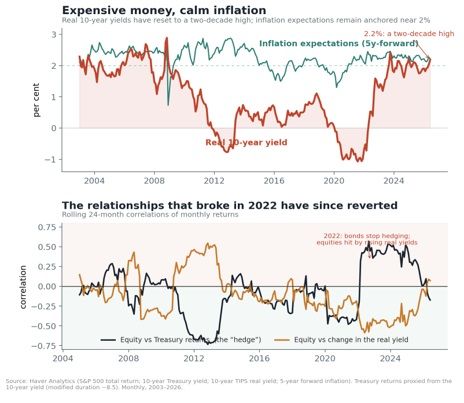
That interpretation may prove correct, but it hinges on a single proposition: that the current investment cycle raises productive capacity rather than merely increasing the cost of operating in a more constrained world.
That interpretation is internally consistent, but it depends on one assumption: that the current investment cycle delivers sustained productivity gains.
What to watch Productivity statistics will provide confirmation only with a considerable lag. More timely evidence will come from the financing of investment. As long as capital expenditure is funded largely from retained earnings, the cycle remains relatively robust. A broad shift towards debt-financed investment would suggest expected returns are weakening.
The exception is at the technological frontier, where some firms have become more reliant on debt to finance exceptionally large investment programmes. Whether this remains contained will be an important indicator to monitor.
The evidence to date remains broadly reassuring. In aggregate, the US corporate sector continues to finance most investment from retained earnings rather than borrowing, limiting balance-sheet vulnerabilities. The notable exception is at the technological frontier, where some firms have become increasingly reliant on debt to fund exceptionally large investment programmes. Whether this remains contained will be an important test of the durability of the cycle. More generally, the interaction between real yields, equity valuations and corporate financing is likely to provide an earlier indication of the outcome than the productivity statistics themselves. The central question is whether this investment cycle generates sufficient productivity growth to justify higher real interest rates, or whether it primarily reflects the rising resource cost of a more fragmented and constrained global economy.
The central question is therefore straightforward. Will this investment cycle generate sufficient productivity growth to justify higher real interest rates, or will it largely represent the rising resource cost of a more fragmented and constrained world?

Andrew Cates
AuthorMore in Author Profile »Andy Cates joined Haver Analytics as a Senior Economist in 2020. Andy has more than 25 years of experience forecasting the global economic outlook and in assessing the implications for policy settings and financial markets. He has held various senior positions in London in a number of Investment Banks including as Head of Developed Markets Economics at Nomura and as Chief Eurozone Economist at RBS. These followed a spell of 21 years as Senior International Economist at UBS, 5 of which were spent in Singapore. Prior to his time in financial services Andy was a UK economist at HM Treasury in London holding positions in the domestic forecasting and macroeconomic modelling units. He has a BA in Economics from the University of York and an MSc in Economics and Econometrics from the University of Southampton.