

AI and Labor’s Share of Income
by:Joel Prakken
|in:Viewpoints
To my thinking, the surefire marker for the adoption of artificially intelligent (AI) “agents” is a decline in labor’s share of income. Here’s the logic in terms of production theory.
When I learned Solow growth accounting, the constancy of labor’s share of income was an accepted “stylized” economic fact. Cobb and Douglas demonstrated that if inputs are paid their marginal product in competitive factor markets, the constancy of labor’s share was consistent with a unitary elasticity of substitution between capital and labor. The logic was easy to grasp. A decline in the cost of capital relative to the wage rate encouraged a proportionate increase in ratio of capital to labor. Therefore, payments made to capital, relative to payments made to labor, remained unchanged.
AI agents are near-perfect substitutes for workers in certain occupations. Hence, the introduction of AI agents raises the overall elasticity of substitution between capital and labor relative to the traditional unitary value. At the same time, the cost of AI agents, reflected in the price per “token” in LLMs, is falling rapidly. Given the high elasticity of substitution between AI agents and certain workers, the rapid decline in the relative cost of AI agents encourages an increase in the ratio of capital to labor that is more than proportionate to the decline in the relative cost of capital. Consequently, capital’s share of income rises, while labor’s share declines.
After remaining fairly constant for decades following WWII, labor’s share fell unevenly between 2000 and 2022 by approximately 8 percentage points, from 69% to 61%. A plausible explanation of that decline was the initial emergence of agentic capital as the dot-com era evolved. Today there’s a widespread expectation that surging investment in AI will perpetuate this decline, perhaps dramatically. Maybe so, but it hasn’t happened yet.
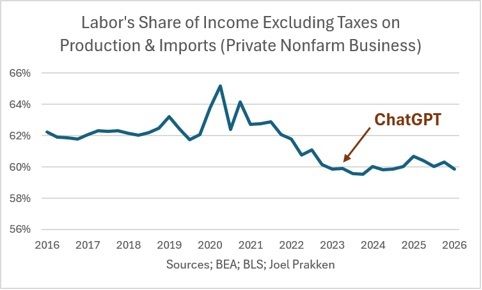
The chart shows the recent quarterly history (through 2026 Q1) of labor’s share of income in the private nonfarm business sector, adjusted to exclude sectoral taxes on production and imports from the denominator. This exclusion, required by theory, allows that revenues from “indirect” taxes are not received by producers, and therefore not allocable to either capital or labor. When calculating “labor share” for its report on productivity and costs, the Bureau of Labor Statistics doesn’t make this adjustment. However, given the recent surge in customs duties, almost all of which are levied on private nonfarm business, the correction is important.
Perhaps aggregation conceals nascent effects in vulnerable sectors. Perhaps it will take more time for the ongoing “AI buildout” to affect the distribution of income noticeably in any sector. Perhaps the data will be revised. Be that as it may, more three and one half years after the introduction of ChatGPT in November of 2022, there has been no decline in labor’s share of income when correctly measured.

Joel Prakken
AuthorMore in Author Profile »Joel Prakken is former Chief US Economist of S&P Global and IHS Markit, co-founder of Macroeconomic Advisers, and past president and director of the National Association for Business Economics. He has served as an outside advisor to the Congressional Budget Office, on the Advisory Panel of the Bureau of Economic Analysis, and as a consultant to the Joint Committee on Taxation. He holds a BA in economics from Princeton University and a PhD in economics from Washington University in Saint Louis.
 Asia
Asia