

The Trade War Escalation and the Economy
by:Ethan Harris
|in:Viewpoints
As expected, the trade war is making a comeback and will likely be as disruptive to the economy as last year.
Trump Always Tries Again (TATA)
For the last three months or so the trade war had been bumped out of the headlines. This is partly because courts reversed some of the Administration’s original tariffs, and partly due to the all-consuming focus on the Iran War. Meanwhile, behind the scenes the Administration has being doing the prep work for “Section 301” tariffs. These take time to implement because they first require an investigation to prove “unfair” practices.
Those investigations are now bearing fruit. Not surprisingly, the Administration has defined “unfair” in the broadest way possible. Brazil has been slapped with 25% tariffs due to six kinds of practices: an unfair payments system, digital and tech policies, agricultural barriers, weak protection of intellectual property, and illegal deforestation. President Trump is has threatened a 100% tariff on countries that levy a tax on U.S. companies offering digital services, and a separate 100% tariff on generic pharmaceuticals.
Several other fights have escalated. At the start of the month, the US decided not to ratify the USMCA, forcing new negotiations. The US is also threatening 50% tariffs on, Canada due to provincial bans on US alcohol, auto tariffs and quotas, and dairy restrictions. There is a bill in Congress that would give the President the power to put a tariff on any country buying Russian energy, including the EU.
However, the biggest threat is being justified by “unfair” weak enforcement of labor laws. US trade officials have drawn list of 59 countries countries that either have weak enforcement of labor laws or trade with countries that have weak enforcement. The later means that a vast majority of US imports could be impacted by this definition of “unfair “ trade practices. The list includes Australia, Brazil, Canada, the European Union, India Japan, Mexico, Norway, Singapore, South Korea, Switzerland, and the UK. The irony here is that by this definition the US should also be on this list because it trades with many of the same countries with weak labor law enforcement.
Digging in for a long fight
Not only is there a flood of actions in the pipeline, but there are three reasons to expect long, ugly fights. First, prior agreements have left a lot of unfinished business. For example, some included promises of big investment in the US, most of which hasn’t happened. Other deals are up in air due to similarly vague, hard to achieve demands or because the original US tariff threat no longer exists.
Second, some of the Administration’s demands are simply unreasonable. Why would countries unilaterally accept tariffs based on “unfair labor” enforcement when the US has the same violations? In other instances, the US is effectively asking countries to ruin their economy by out-source key domestic industries—like Canadian autos or Taiwanese chips—to the US. It is also a violation of the balance of payments identity for US trading partners to both reduce their trade surplus and increase net capital flows. The two move up and down together as the capital flows finance the deficit.
Third, leaders in other countries are under intense popular pressure to push back against US demands. They’ve seen that acceding to US demands only encourages more demands. Surveys from Pew Research show the dramatic drop in outside views of the US (chart), As the last two columns show, the median view of the US is now worse than the median view of China! Canada has taken the lead in pushing back against the US, but Europe is close behind. The upshot is that new negotiations will likely be even more intense than last Spring.
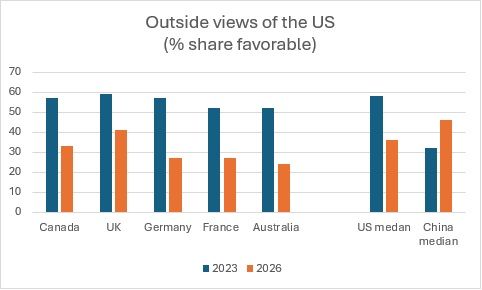
Source: PEW Research Center
A significant source of stagflation
The trade war is having two major impacts on the US economy. The direct effect is via higher costs. According to the Yale Budget Lab, as of July 21st, the average statutory tariff rate was at 12.1%. That rises to 12.8% at the end of this year if expiring tariffs go away but the threatened Section 301 tariffs go through.
Studies show that few foreign suppliers have dropped their pre-tariff prices. Instead, almost all of the cost is being absorbed first by weaker profits for US companies, and then higher prices and less disposable income for US households. Like other supply shocks that means a period of higher inflation and lower growth.
Unfortunately, this is not the end of matters: there is a second shock to the economy via weaker confidence and policy uncertainty. A constant flow of threats and on-again-off-again makes business planning and investment very difficult. Measures of policy uncertainty are very high, particularly for trade policy. This is helping cause a decline in capital spending outside of AI-related components.
Fed up?
Like any “supply-side” shock to the economy, tariffs have mixed implications for the Fed, as they raise inflation, but weaken growth. In this instance growth seems relatively resilient in the face of supply shocks from tariffs, oil, immigrant reduction policy and so on. On the other hand, both headline and core inflation have accelerated. Hence, at this stage, I think tariffs are helping nudge the Fed toward rate hikes.
My longstanding call is for one or two rate hikes this year. I expect only dissents at next week’s FOMC meeting, but think a hike is likely in September. The very soft CPI report for June bought us a one meeting delay.

Ethan Harris
AuthorMore in Author Profile »Ethan Harris has a Ph.D. in Economics from Columbia University and was the Head of the Domestic Research Division at the NY Fed. He was Chief US Economist at Lehman Brothers from 1996 to 2008 and Head of Global Economics at Bank of America from 2009 to 2023. Currently he is the author of the blog Ethan on the Economy.
 Asia
Asia