Japan’s Economy Watchers Index Backs Off
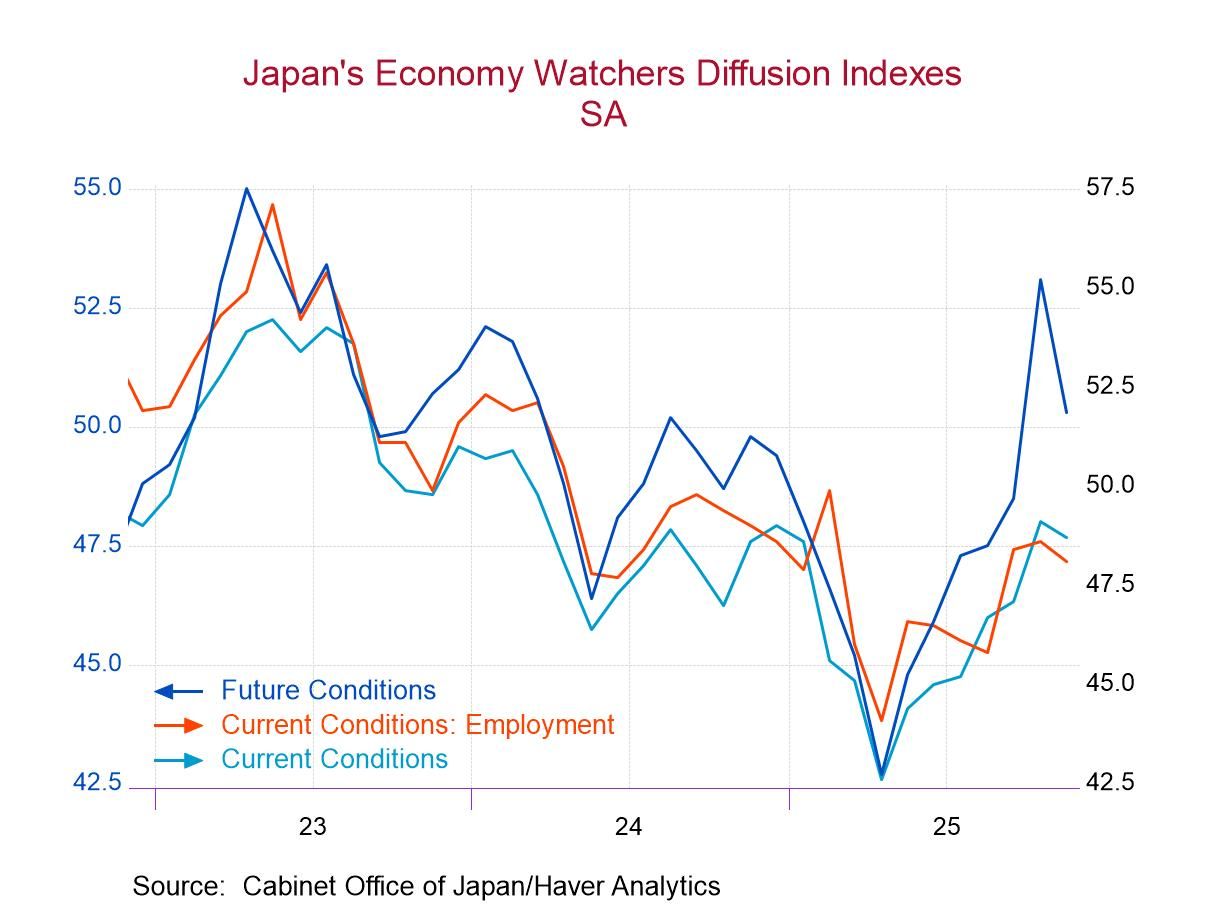
Japan's economy watchers index stepped back in November after making some strong strides in October. But the current index and the future index retained stronger values in November than in September even with the backtracking compared to October so that the October improvement actually continues to hold merit. However, there is no follow-through on the October gain.
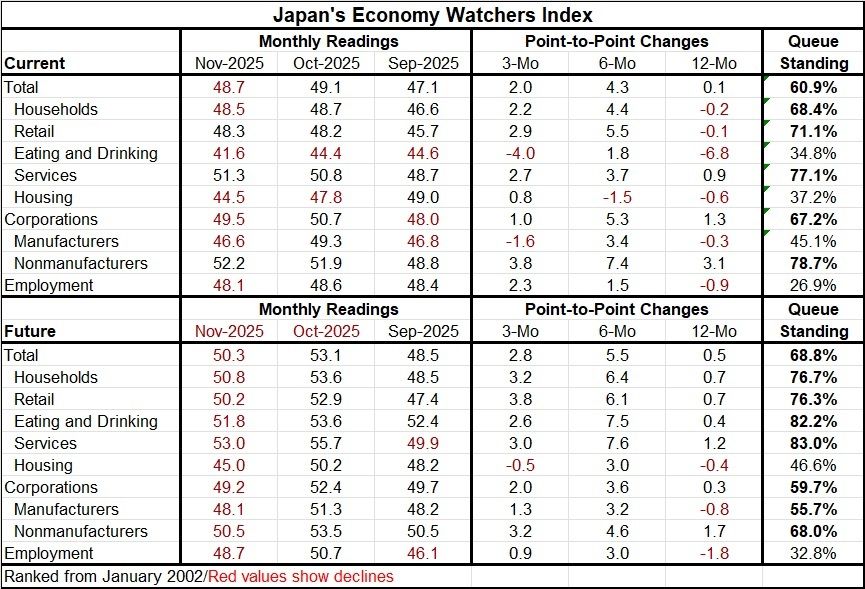
In November, the current index declined in the headline as well as in six components, with only three components showing improvement month-to-month. The three showing improvement were retailing, services, and nonmanufacturers.
Over three months and point-to-point comparison, the headline improves and seven of nine components improve. Over six months, the headline improves and 8 of 9 components improve. However over 12 months, the headline barely ticks higher and only three components improve compared to 12 months ago.
The queue standing for the current index headline is that 60.9%, leaving it above its historic median. All the components have readings above their 50th percentile except for eating and drinking establishments, housing, manufacturing, and employment. Unfortunately, the employment standing at 26.9% is the weakest of the lot. And despite the breath and other categories, that's concerning.
The future index in November showed month-to-month declines across the board for the headline as well as for all of the components. In October there were increases across the board for the headline and all components while in September there were increases in the headline and all components except two with the lagging components being services and employment. Over three months the future headline increases and all the components increase except for housing. Over six months the future index increases and all the components increase. Over 12 months the future headline increases and all the components improve except for housing, manufacturers, and employment. The standing for the future index in November is at its 68.8 percentile and all the components have standings above their 50th percentile except housing and employment. All the components that have standings above the 50th percentile have standings that are pretty much at the 60th percentile or higher except for manufacturing with a rating of 55.7 percentile.
These findings show that both the current and the future indexes are relatively strong with solid breadth. However, there's even stronger readings and breadth across the future index than for the current index. While the current index and the future index have stepped down relative to October, both show solid and strong momentum over three and six months; however, over 12 months the future index shows better momentum than the current index. This is interesting because Japan has recently installed a new Prime Minister and the Bank of Japan is being looked at more closely; it is beginning to more seriously consider rate hikes as inflation looks to be a more entrenched problem that the central bank is getting ready to turn its attention to.

Robert Brusca
AuthorMore in Author Profile »Robert A. Brusca is Chief Economist of Fact and Opinion Economics, a consulting firm he founded in Manhattan. He has been an economist on Wall Street for over 25 years. He has visited central banking and large institutional clients in over 30 countries in his career as an economist. Mr. Brusca was a Divisional Research Chief at the Federal Reserve Bank of NY (Chief of the International Financial markets Division), a Fed Watcher at Irving Trust and Chief Economist at Nikko Securities International. He is widely quoted and appears in various media. Mr. Brusca holds an MA and Ph.D. in economics from Michigan State University and a BA in Economics from the University of Michigan. His research pursues his strong interests in non aligned policy economics as well as international economics. FAO Economics’ research targets investors to assist them in making better investment decisions in stocks, bonds and in a variety of international assets. The company does not manage money and has no conflicts in giving economic advice.
More Economy in Brief
 Global