Italian Inflation Gets Prickly
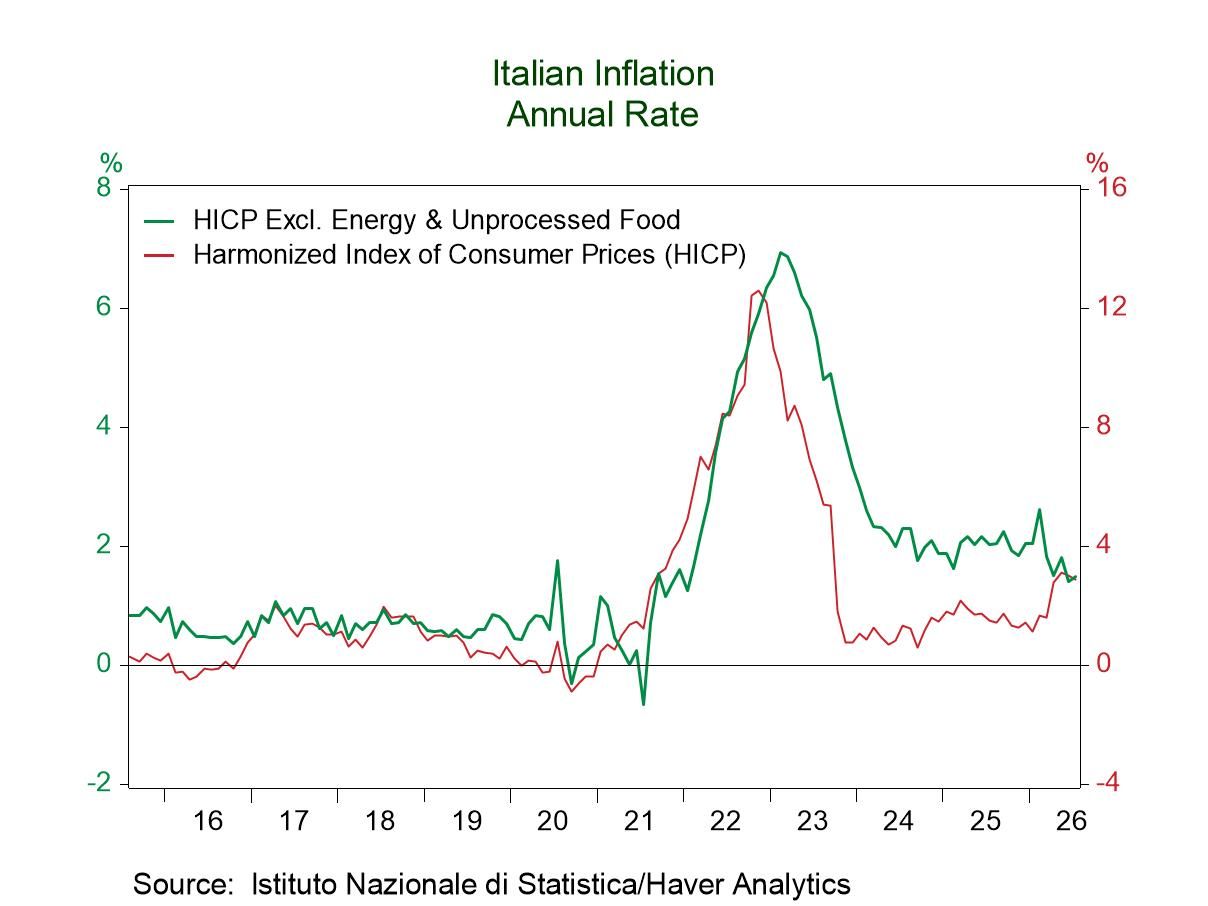
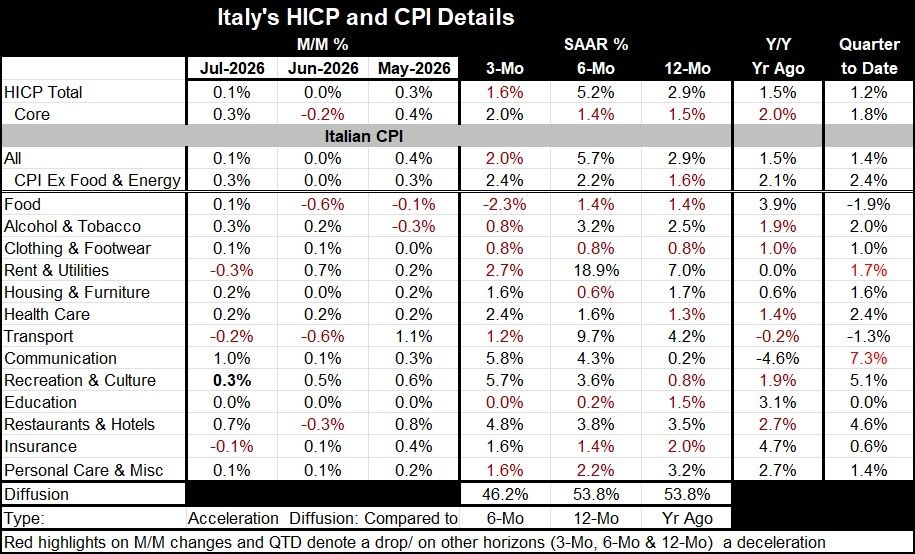
Inflation in Italy rose 0.1% in July after being flat in June and rising 0.3% in May. The core HICP was not quite so lucky, rising 0.3% in July after declining 0.2% in June and rising 0.4% in May. The domestic inflation data from Italy show the headline rising 0.1% in July, flat in June, and rising 0.4% in May. The Italian core on its domestic measure rose 0.3% in July, was flat in June, and rose 0.3% in May.
HICP inflation has gotten unruly in Italy, rising 2.9% over 12 months, accelerating to a 5.2% annual rate over six months but then rising by only 1.6% at an annual rate over three months. Core inflation remains much better behaved but has seen some increasing pressure, rising 1.5% over 12 months, posting a 1.4% annual rate over six months, and rising at a 2% annual rate over three months.
The domestic measures of inflation show the headline is quite similar to the HICP headline, rising 2.9% over 12 months, accelerating to a 5.7% annual rate over six months, and posting a 2% annual rate over three months. The Italian core rate, however, accelerates steadily from 1.6% over 12 months to 2.2% annualized over six months and to 2.4% annualized over three months. It's not a terrible ramping up, but it is an acceleration; it takes the Italian core to a level above what the ECB projects as its target for the euro area as a whole.
Inflation diffusion in Italy over three months, six months, and 12 months is relatively well behaved at 53.8% over 12 months and over six months. There's a modest tendency to have more acceleration than deceleration; however, over three months the diffusion measure falls to 46.2%, indicating net deceleration. The net deceleration over three months is reassuring, with moderate three-month inflation rates having been posted on the various metrics cited above. However, even the slight acceleration tendencies are a little more disturbing, with the high headline inflation posted over six months and uncomfortably high near a 3% pace over 12 months.
On a quarter-to-date basis, inflation in the third quarter is off to a slow start, at 1.2% for the HICP and 1.4% for the domestic measure. Both the HICP and the domestic measures show core inflation higher at 1.8% for the HICP and at a 2.4% annual rate for the domestic metric.
The inflation problem in Italy isn't simply something that comes because of oil. Year-over-year, the headline for the HICP and the domestic measure are both under 2% in the quarter to date (QTD). But both measures are running at or above 2% in most of the sequential developments of inflation from 12 months to six months to three months. Core inflation is showing pressure for both the HICP and domestic measures sequentially as well as QTD. The Italian inflation report for July by itself is not so good as the monthly headline is well-behaved, but the cores are uncomfortable in both the HICP and domestic measures. Inflation clearly is not dead. It remains something to keep an eye on even in Italy where inflation trends had been better behaved.

Robert Brusca
AuthorMore in Author Profile »Robert A. Brusca is Chief Economist of Fact and Opinion Economics, a consulting firm he founded in Manhattan. He has been an economist on Wall Street for over 25 years. He has visited central banking and large institutional clients in over 30 countries in his career as an economist. Mr. Brusca was a Divisional Research Chief at the Federal Reserve Bank of NY (Chief of the International Financial markets Division), a Fed Watcher at Irving Trust and Chief Economist at Nikko Securities International. He is widely quoted and appears in various media. Mr. Brusca holds an MA and Ph.D. in economics from Michigan State University and a BA in Economics from the University of Michigan. His research pursues his strong interests in non aligned policy economics as well as international economics. FAO Economics’ research targets investors to assist them in making better investment decisions in stocks, bonds and in a variety of international assets. The company does not manage money and has no conflicts in giving economic advice.
More Economy in Brief
 Global