Inflation Sallies Forth
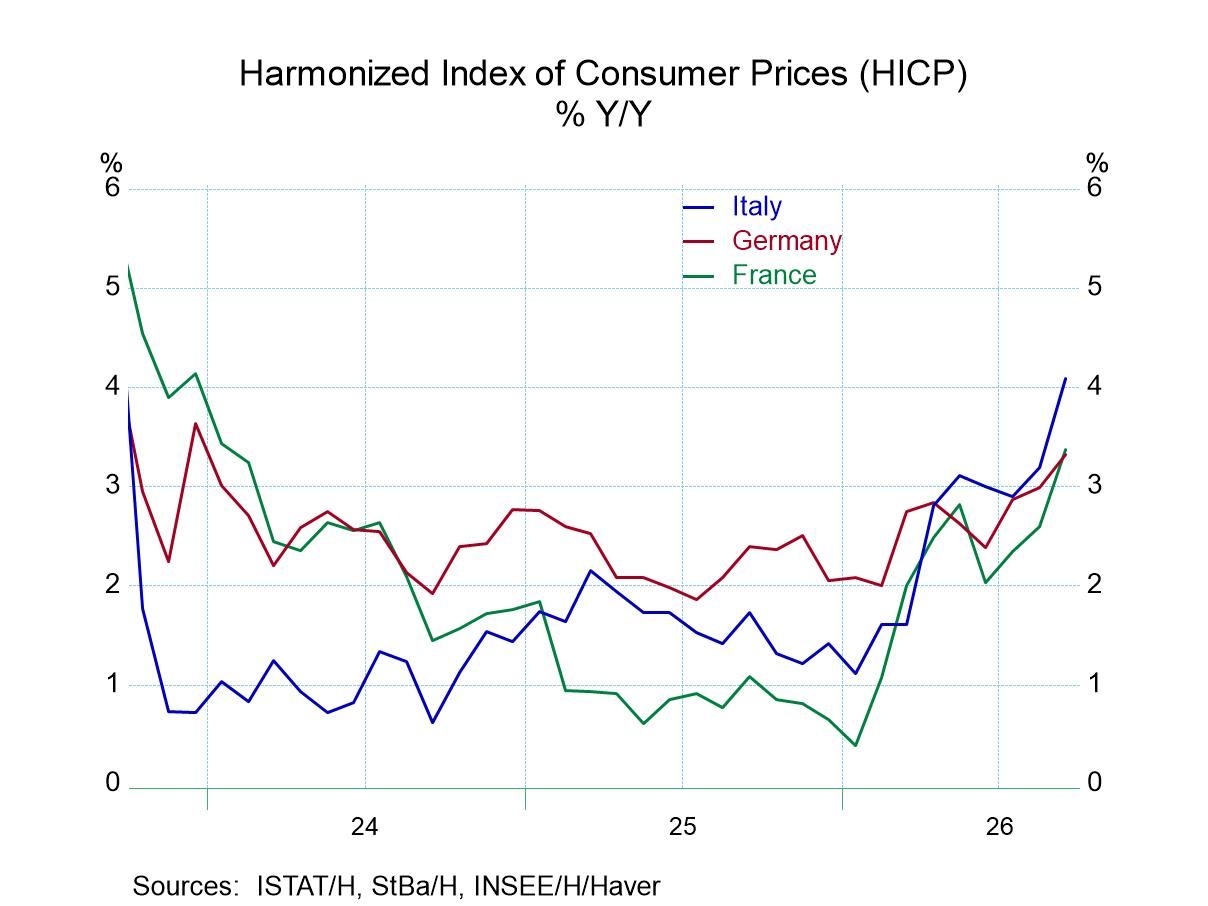
Inflation has flared across the largest economies of the monetary union. The headline boost is clear. The core or ex-energy gains also are clear but are more moderate; more moderate but nonetheless excessive in September. Largely over the last three months, inflation has been percolating.
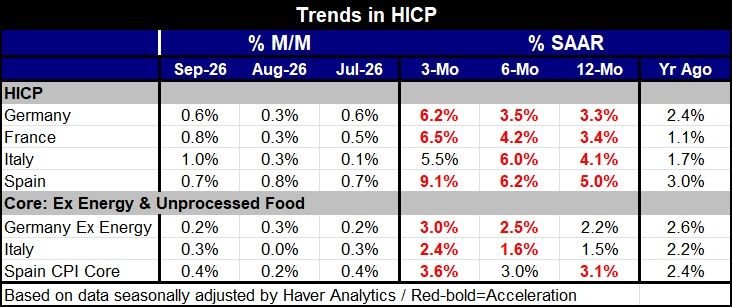
The chart shows a clear, abrupt acceleration of inflation in the three largest monetary union economies: Germany, France, and Italy. Twelve-month inflation rates for the top four economies range from 3.3% in Germany to 5.0% in Spain. Over six months, the range is 3.5% (Germany) to 6.2% (Spain). Over three months, the stakes rise sharply, with annualized inflation spurts at a high of 9.1% (Spain) vs. ‘only’ 5.5% (Italy).
Inflation accelerates from a year ago to 12 months, from 12 months to six months, and from six months to three months on all headline comparisons except for Italy from six months to three months. But even on that comparison, the downshift in the pace is minor, and three-month inflation in Italy is still stronger than 12-month inflation. The inflation pressure is rising even if the gains are not monotonic.
Core inflation is high and mostly rising as well. However, core inflation is less prone to have risen over 12 months compared to 12 months ago. On that basis, only Spain’s core inflation has risen. German ex-energy inflation steps down, and Italian core inflation drops off to a below-target 1.5% over 12 months. To restart these comparisons for the three-country inflation ranges on the core or ex-energy measures over one year, we see a range from 1.5% to 3.1%. Over six months, inflation accelerates for all three, but the low end sees Italian inflation only up to a 1.6% pace, whereas the high end at 3% is Spain. However, Spain’s strong gain marks a deceleration from its 12-month pace. Over three months, inflation kicks up its heels across the core and ex-energy measures, from a low of 2.4% in Italy to a high of 3.6% in Spain. And core inflation accelerates in all three countries over three months.
Core inflation has been slower to rise, but once it rises it tends to be more stubborn. The global push toward higher inflation is still in gear as oil prices are lingering high. Stock markets have been trying to weather the storm of high inflation and an uncertain future. All eyes are turning to the winter season even though it is only fall. Winter is cropping up to be a difficult one for Europe, with low energy stockpiles as the season approaches. There is a lot to worry about and very little we can be sure of. As aspects of the future draw nearer, we’re gaining focus on what matters, and what matters and what is under control are, increasingly, two different things.

Robert Brusca
AuthorMore in Author Profile »Robert A. Brusca is Chief Economist of Fact and Opinion Economics, a consulting firm he founded in Manhattan. He has been an economist on Wall Street for over 25 years. He has visited central banking and large institutional clients in over 30 countries in his career as an economist. Mr. Brusca was a Divisional Research Chief at the Federal Reserve Bank of NY (Chief of the International Financial markets Division), a Fed Watcher at Irving Trust and Chief Economist at Nikko Securities International. He is widely quoted and appears in various media. Mr. Brusca holds an MA and Ph.D. in economics from Michigan State University and a BA in Economics from the University of Michigan. His research pursues his strong interests in non aligned policy economics as well as international economics. FAO Economics’ research targets investors to assist them in making better investment decisions in stocks, bonds and in a variety of international assets. The company does not manage money and has no conflicts in giving economic advice.
More Economy in Brief