

GfK Confidence Eases Slightly in Germany; Major Setback for Confidence in France
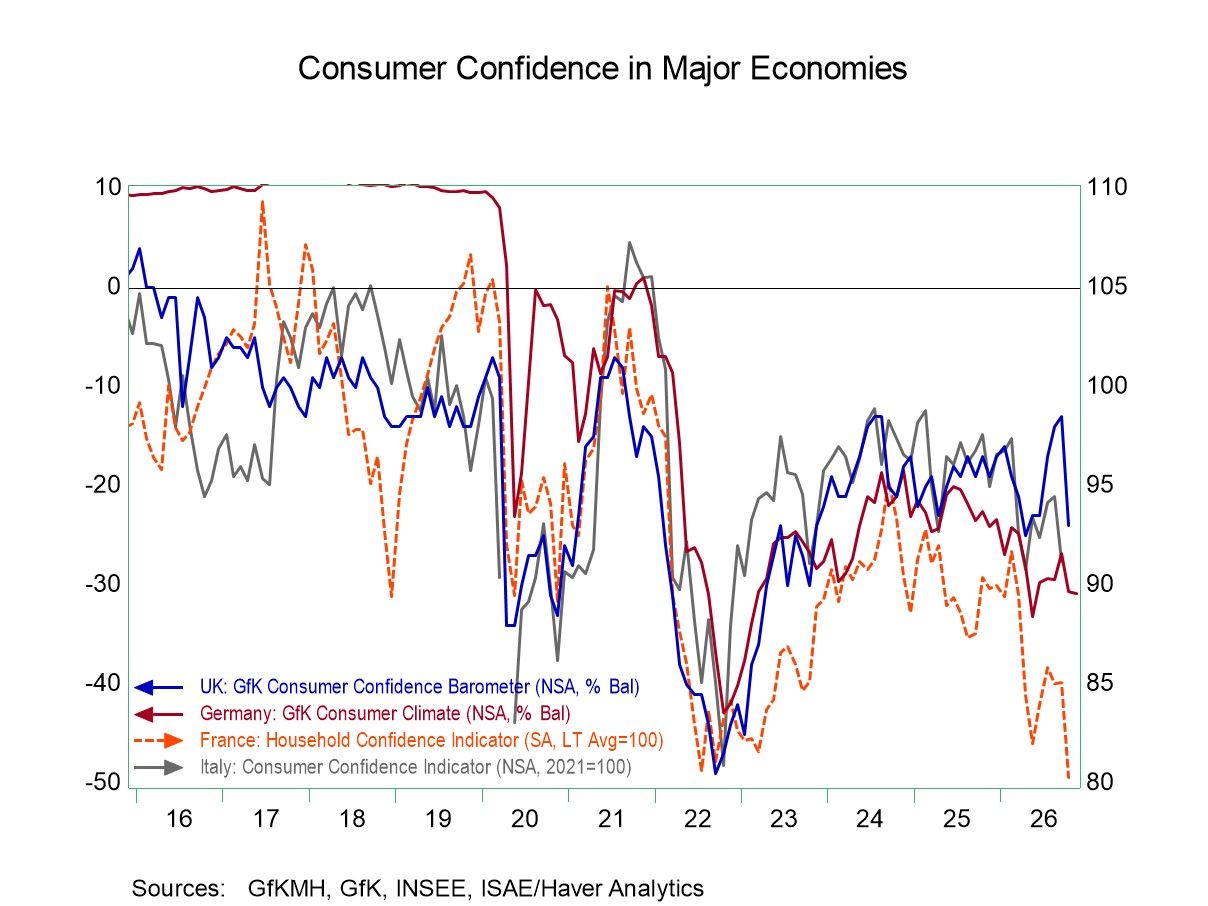
Consumer climate in the GfK readings from Germany in November edged slightly lower to -30.8 in November from -30.6 in October; the October level had dropped relatively sharply from -26.8 in September. The queue percentile standing also known as the count standing, was at a 2.7 percentile reading in November, which tells us it's been this weak or weaker only 2.7% of the time (based on data back to May 2002), an extremely weak reading.
The components of the GfK headline lag by one month; they showed an improvement in the economic expectations index to 2.1 in October from -3.4 in September, a deterioration in income expectations to -15.7 from -15.0, and for the propensity to buy there was a slippage to -11.9 in October from -10.8 in September.
The components show count rankings in their 43.9 percentile for economic expectations, in their 9.5 percentile for income expectations, an extremely low reading, and, for the propensity to buy, the standing is in its 26.5 percentile.
Readings for Italy, France, and the United Kingdom are in the far-right-hand portion of the table. France and the U.K. have October readings and are up to date on the same timeline as the components of the GfK index. The reading for Italy is a month older, in September. All of the readings, regardless of how topical they are, for Italy, France, and the U.K., dropped compared to their respective previous monthly values. In the case of Italy, the reading dropped to 91.2 in September from 94.5 in August. In the case of France, the reading for October dropped to 80.3 from 85.1 in September, and the U.K. situation showed the October reading dropped to -24.0 from -13.0.
The count percentile standings for these three countries are around the 51st percentile for Italy, the 25th percentile for the U.K., and the 0.3 percentile (yes, less than one percentile) for France, where the index is hundredths of a point away from being the lowest ever. The level of the reading is a function of how the index itself is formed, but the count percentile standings rank the current reading against the history of the index, giving us a better feel for where the current standing is compared to where it's been in the past. Clearly, France logs the weakest reading, which is not surprising given what's going on in Europe and particularly in France at the moment. Italy has also had some demonstrations, but the month-to-month drop in Italy is not as severe; Italy’s percentile standing is still above its median; however, the reading is for September so we're going to have to hold judgment until we start getting readings in October and later for Italy.
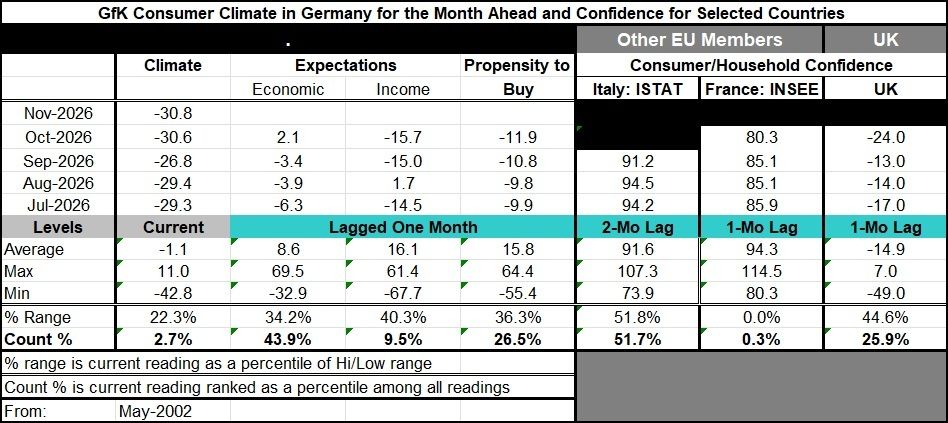
The bottom line The clear takeaway from these surveys is that conditions in Germany remain weak and they're not showing much tendency for improvement. The low standing for income expectations is particularly disturbing. Economic expectations are not that far from the historic median (the median occurs at a ranking at its 50th percentile); however, economic expectations are still some 6 percentile points below that. The ‘propensity to buy’ is looking at essentially a lower-quartile ranking, which dovetails nicely with the weak income expectations since weak income expectations should lead to a weak propensity to buy as soon as income expectations deteriorate. The big deterioration in income expectations occurred in September and the propensity to buy has been slow to deteriorate in comparison to that (the two series have a 0.8 correlation coefficient).
The other countries in the sample clearly show developing issues. France’s political circumstances and uncertainty are well reflected in the INSEE confidence index. The U.K., facing many of the same constraints as France, sees what might be a sympathetic decline in consumer confidence. While Italy shows some small deterioration in September, we have yet to get a fresh reading from the period when the demonstrations were breaking out in France and, to a lesser extent, in Italy. This survey and the accompanying data for France, Italy, and the U.K. are not a set of readings to reassure anyone. The problems that have broken out in France exist in the G5 countries even though there hasn't been any clear transmission to Japan or to the United States. Although in the U.S. bond yields have been rising relatively sharply and concerns about the U.S. fiscal position are swirling about, they haven't become pronounced market or political factors yet, even with the midterm elections on the doorstep in the U.S.

Robert Brusca
AuthorMore in Author Profile »Robert A. Brusca is Chief Economist of Fact and Opinion Economics, a consulting firm he founded in Manhattan. He has been an economist on Wall Street for over 25 years. He has visited central banking and large institutional clients in over 30 countries in his career as an economist. Mr. Brusca was a Divisional Research Chief at the Federal Reserve Bank of NY (Chief of the International Financial markets Division), a Fed Watcher at Irving Trust and Chief Economist at Nikko Securities International. He is widely quoted and appears in various media. Mr. Brusca holds an MA and Ph.D. in economics from Michigan State University and a BA in Economics from the University of Michigan. His research pursues his strong interests in non aligned policy economics as well as international economics. FAO Economics’ research targets investors to assist them in making better investment decisions in stocks, bonds and in a variety of international assets. The company does not manage money and has no conflicts in giving economic advice.
More Economy in Brief
 Global