Global| Oct 27 2026
Money Supplies Slow Except in the U.S.
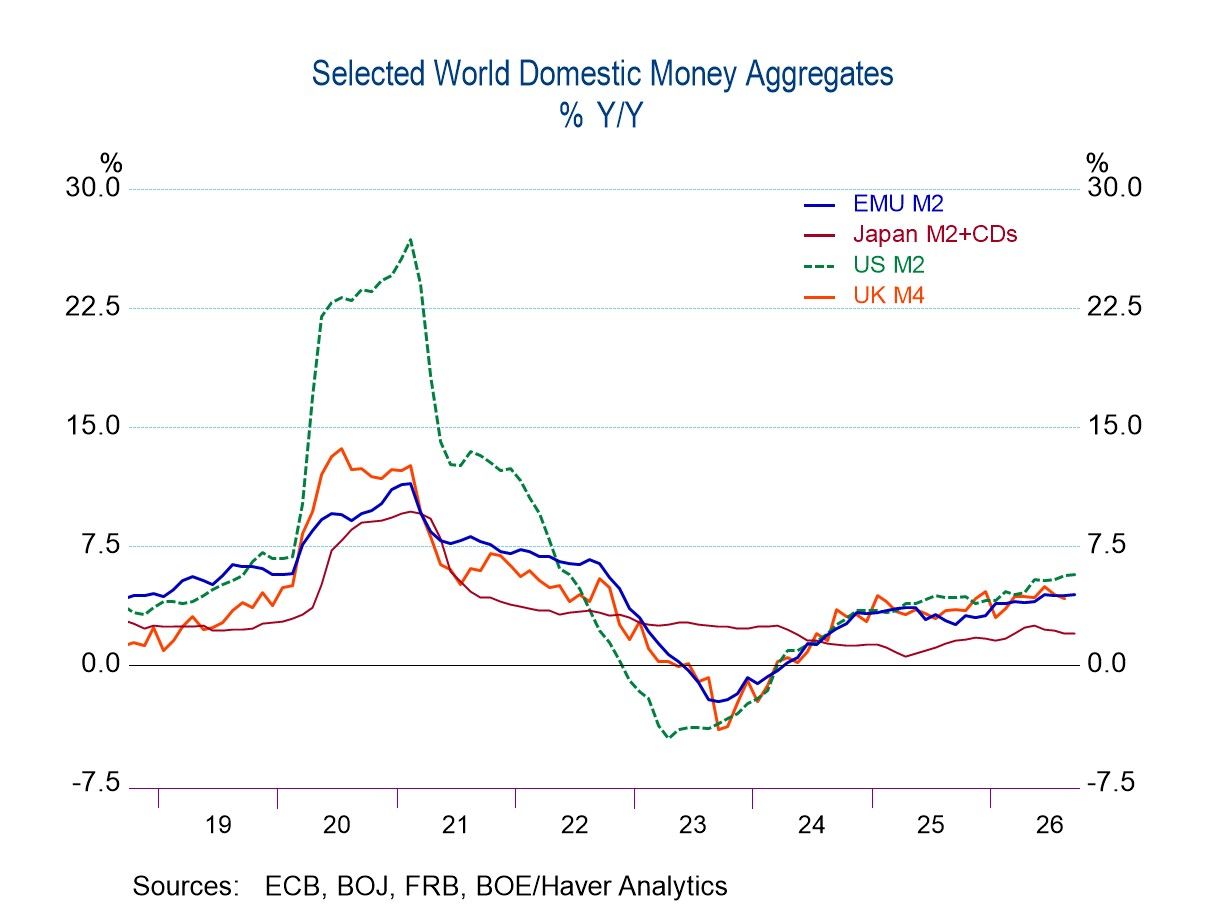
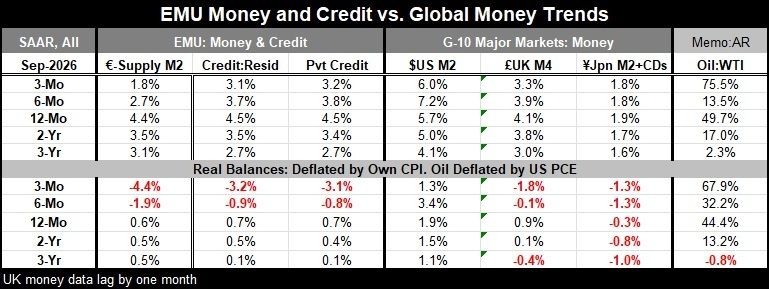
EMU Money Growth Money supply in the European Monetary Union had slowed in September as the near-term growth rates peaked at a 12-month pace of 4.4% annualized. Over six months, growth is 2.7%, annualized; over three months, M2 money supply growth is at an annualized rate of 1.8%. The EMU shows a clear slowing in nominal money growth. This has led to a decline and a contraction in real money balances in the monetary union. Real money supply growth over three years, two years, and one year is locked into a very narrow range of 0.5% to 0.6% at an annual rate. However, over six months, the annualized rate of growth is -1.9%; over three months, the annual rate of growth is -4.4%. Nominal money supply growth and the pace of real money balances are clearly pulling back in the monetary union.
Credit Growth in EMU Nominal credit growth is also slowing in the Monetary Union as nominal credit growth peaked over 12 months at 4.5% and has decelerated to a three-month growth rate annualized at 3.1%. Private sector credit peaked over 12 months at 4.5%, decelerated to a 3.8% annualized rate over six months, and then decelerated again to a 3.2% annualized rate over three months. In real terms, private credit is also slowing and contracting, with both total and private credit growth rates in the neighborhood of -3% growth, expressed at an annual rate over three months.
The U.S. - An Uneven Picture The U.S. shows only a hint of monetary slowing as nominal money growth is 4.1% over the last three years, climbing to 5.7% over 12 months and rising further to a 7.2% pace over six months. It does slow over three months but only to a pace of 6.0%, leaving it below its six-month pace and yet above all the other growth rate calculations, making the assessment of a ‘slowdown’ premature.
The U.S. monetary real balance growth rate shows a hint of slowing, but the signal is not clear. Real M2 growth is 1.1% over three years; it rises to 1.9% over 12 months, rises to 3.4% over six months, and then drifts lower to 1.3% over three months. This pace shows period-to-period deceleration but is still above its three-year pace, and the three-month decline may be too steep to take at face value.
U.K. Money Growth - Lagged Readings The U.K. is a month behind the other countries in reporting money growth for September. U.K. nominal M4 growth is in a nominal slowing mode, with the annualized growth pace down to 3.3% over three months. U.K. real money balances show monetary contraction over six months and three months, with the three-month pace at a chilling -1.8%, still not quite as steep as the money or credit slowing in the EMU.
Japanese Money Trends The last country on the table is Japan, where M2 plus CD nominal growth rates appear fairly flat. The three-year growth rate in Japan has averaged 1.6% at an annual rate; the 12-month pace stepped up to a 1.9% growth rate, which has since ticked down to a 1.8% annualized rate over both three and six months. Money growth in Japan is relatively flat in nominal terms while persistently shrinking in real terms. The growth hit to real balances in Japan shows them contracting over all periods in the table. Over 12 months, real balance growth is -0.3%; then the annual rate of decline becomes more intense over three months and six months at -1.3% for both of those tenors. The real balance slowdown is clear; however, for nominal money, the growth profile is simply flat.
Implications Having more resilient money growth in the U.S. could be a problem for the rest of the world if the U.S. takes this as a sign that it has more of an entrenched or even growing inflation problem because it will be then raising rates while other countries are experiencing weakening money growth and are going to be less able to absorb the increases in interest rates that rate hikes in the U.S. could start to impose on the global economy. All of the central banks in this table are engaged in some process of an interest-rate tightening. The Bank of Japan has been engaged in a very slow and steady process of ‘normalization.’ The ECB process has been a little bit more aggressive and preemptive, while in the U.K. the inflation numbers are starting to look a little bit worse and could motivate the Bank of England to go back on the rate hiking path after it had sought some moderation.
Summing Up The situation with money supply growth globally is uncomfortable, and it's equally as uncomfortable as the fiscal situations that all the countries in this table find themselves in. Of course, France right now is experiencing the worst blowback. It is really between a rock and a hard place, with an inability to raise taxes and demands for further spending. But the U.K. and the U.S. are also in relatively unenviable positions. In Japan, Prime Minister Sano Kaichi has been able to engineer some measured investment-led government spending despite the large deficits there and the heavy debt-to-GDP burden.
The Outlook The outlook for growth, inflation, and interest rates across these countries remains uncertain, with the price of oil high and lingering at high levels and the war in the Middle East still unresolved. It's hard to make any kind of statement about the future in which we can have confidence. Policymakers in all these countries are going to be watching global events while dealing with market pressures, political realities, economic trends, and pursuing the clear need to get inflation back down inside their monetary targets without doing economic damage. It's a tall order for the period ahead.

Robert Brusca
AuthorMore in Author Profile »Robert A. Brusca is Chief Economist of Fact and Opinion Economics, a consulting firm he founded in Manhattan. He has been an economist on Wall Street for over 25 years. He has visited central banking and large institutional clients in over 30 countries in his career as an economist. Mr. Brusca was a Divisional Research Chief at the Federal Reserve Bank of NY (Chief of the International Financial markets Division), a Fed Watcher at Irving Trust and Chief Economist at Nikko Securities International. He is widely quoted and appears in various media. Mr. Brusca holds an MA and Ph.D. in economics from Michigan State University and a BA in Economics from the University of Michigan. His research pursues his strong interests in non aligned policy economics as well as international economics. FAO Economics’ research targets investors to assist them in making better investment decisions in stocks, bonds and in a variety of international assets. The company does not manage money and has no conflicts in giving economic advice.
More Economy in Brief