

Germany’s ifo Survey: Still Weak but Improving
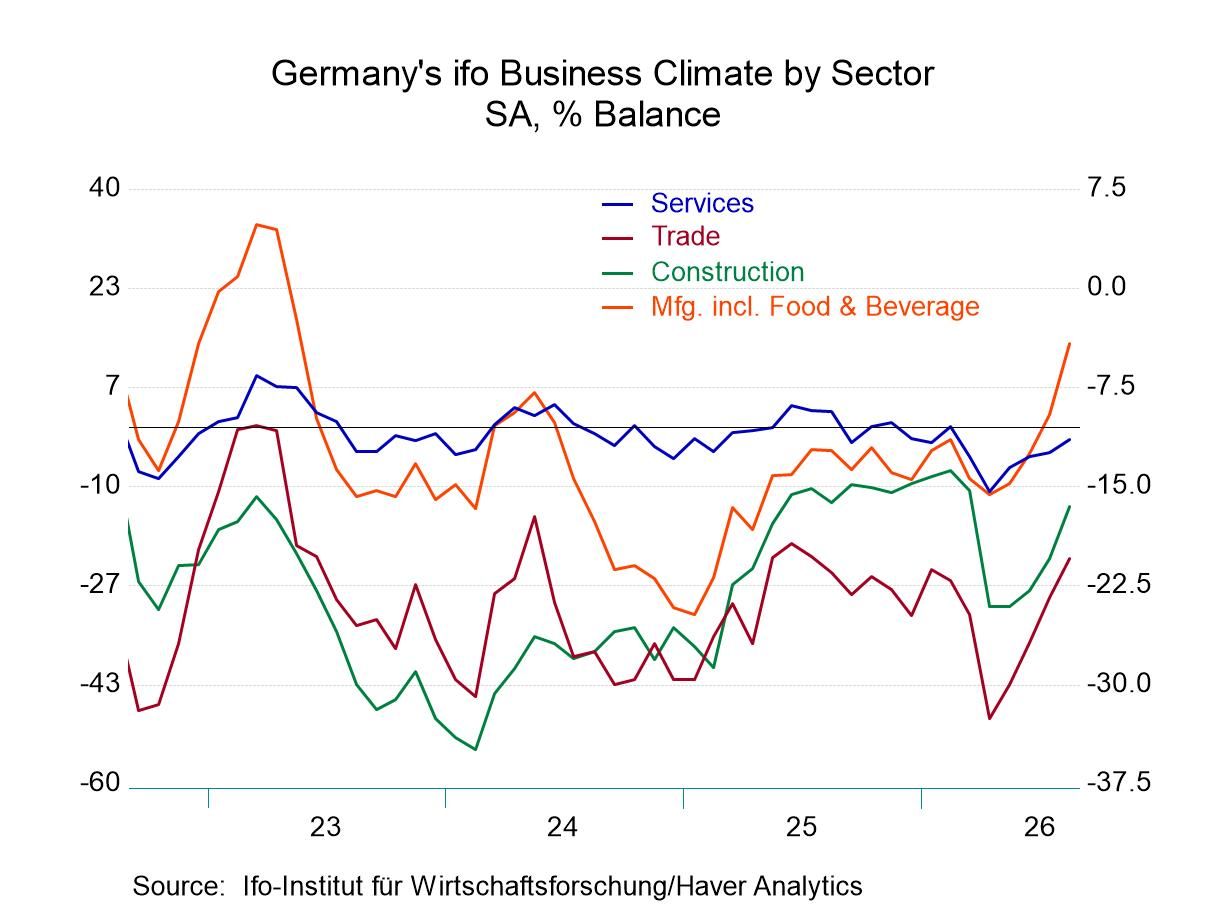
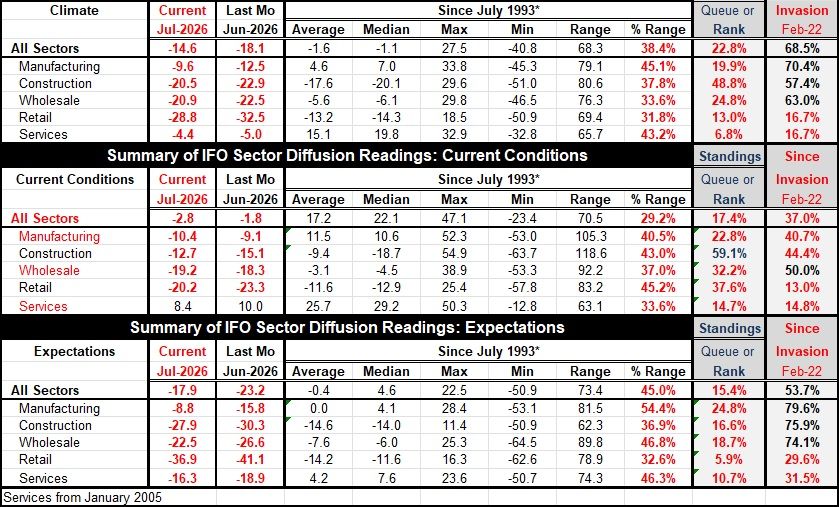
Germany's ifo survey has an improving climate index in July with the all-sector index rising to -14.6 from -18.1 in June. The all-sector current index, however, still deteriorated on the month, falling to -2.8 from -1.8 in June. There was a sharp improvement in the all-sector index for expectations for the July reading that rose to -17.9 from -23.2 in June. Even so the headline all-sector indices have very weak standings on data back to 1994, not one of these three sectors ranks above the bottom quartile of its historic range of values. However, if we look at where the sector indices rank since February of 2022, in the wake of the Russian invasion of Ukraine, we have a 68.5 percentile standing for the climate index we still have a weak 37-percentile standing for current conditions and the expectations index is above its median for this period. By a small amount, the ranking at its 53-point 7th percentile.
Climate metrics Looking across the various industries for which we get separate assessments manufacturing construction wholesaling retailing and services, we find all of them with rankings below their respective 50th percentile on climate and in fact all of the sector indexes I'm a climate manager reside in their lower 25th percentile except for construction with a 48.8 percentile reading that brings it up close to its median for the period. The construction sector emerges as the relatively healthiest consistently, although it still ranks poorly on expectations. Ranked over the shorter period since the invasion of Ukraine, manufacturing, construction, and wholesaling have rankings above their 50th percentiles buts on the shorter timelines retailing and services remained very weak, both of them with standings in the lower one-fifth of this shorter historic period.
Current Conditions Over the broad period since 1994, the five sectors have weak current standings with construction being the only sector above its 50th percentile with a 59.1 percentile standing. The remaining sectors are all below their 40th percentiles in ranking with services the weakest at a 14.7 percentile ranking. Re-ranking these sectors over the shorter period since Ukraine was invaded in February of 2022, we find wholesaling as the relative strongest reading at a 50-percentile mark, construction has a 44-percentile standing, with manufacturing at a 40.7-percentile mark. However, retailing and services both have standings and their lower 20th percentile.
Expectations – the weakest link Expectations among the all-sector indices has the lowest percentile standing. The overall reading and individual industries all have percentile standings in their lowest quartile below a 25-percentile standing over the broad period. The weakest standing is for retailing at a 5.9 percentile although services has a 10.7 percentile reading that is very weak as well. Construction and wholesaling, two sectors that fare better on the rankings above, fare very poorly on expectations with a 16-percentile standing for construction and an 18-percentile standing for wholesaling. However, on the reduced timeline, since Ukraine was invaded, the all-sector expectation rises to a 53-percentile standing manufacturing jumps to a 79-percentile standing, while construction and wholesaling are at standings near the 75th percentile. And, despite the better performance among those sectors, retailing and services still have weak standings that cluster around the 30th percentile mark. Those relative reading are higher than over the broad period by a substantial margin but are still in a very weak zone.
Summing up While there is some improvement indicated in July, and while it's good news to see a nice jump in the performance of expectations because those readings are already so low, the fact is that overall rankings of the readings on the Ifo scale remained quite weak. They correspond to an economy that's not doing very well. The ranking data suggests that on the shorter comparison, referring to looking at rankings since Ukraine was invaded, conditions are not as weak however on broader comparison that standard is seen to be substantially lacking. Germany's GDP numbers have just surprised to the upside slightly in Q2. But there's no big surprise in German data. With conditions in the Middle East still touch-and-go and with the U.S. trying to tighten the screws on Iran by motivating US allies to obey the embargo and sanctions it put in place on Iran, it's very possible that things could get worse before they get better. It's a good time to check in with markets and with data every day. We are in another one of those periods.

Robert Brusca
AuthorMore in Author Profile »Robert A. Brusca is Chief Economist of Fact and Opinion Economics, a consulting firm he founded in Manhattan. He has been an economist on Wall Street for over 25 years. He has visited central banking and large institutional clients in over 30 countries in his career as an economist. Mr. Brusca was a Divisional Research Chief at the Federal Reserve Bank of NY (Chief of the International Financial markets Division), a Fed Watcher at Irving Trust and Chief Economist at Nikko Securities International. He is widely quoted and appears in various media. Mr. Brusca holds an MA and Ph.D. in economics from Michigan State University and a BA in Economics from the University of Michigan. His research pursues his strong interests in non aligned policy economics as well as international economics. FAO Economics’ research targets investors to assist them in making better investment decisions in stocks, bonds and in a variety of international assets. The company does not manage money and has no conflicts in giving economic advice.
More Economy in Brief
 Asia
Asia