Sweden’s Housing Market Shows Signs of Life
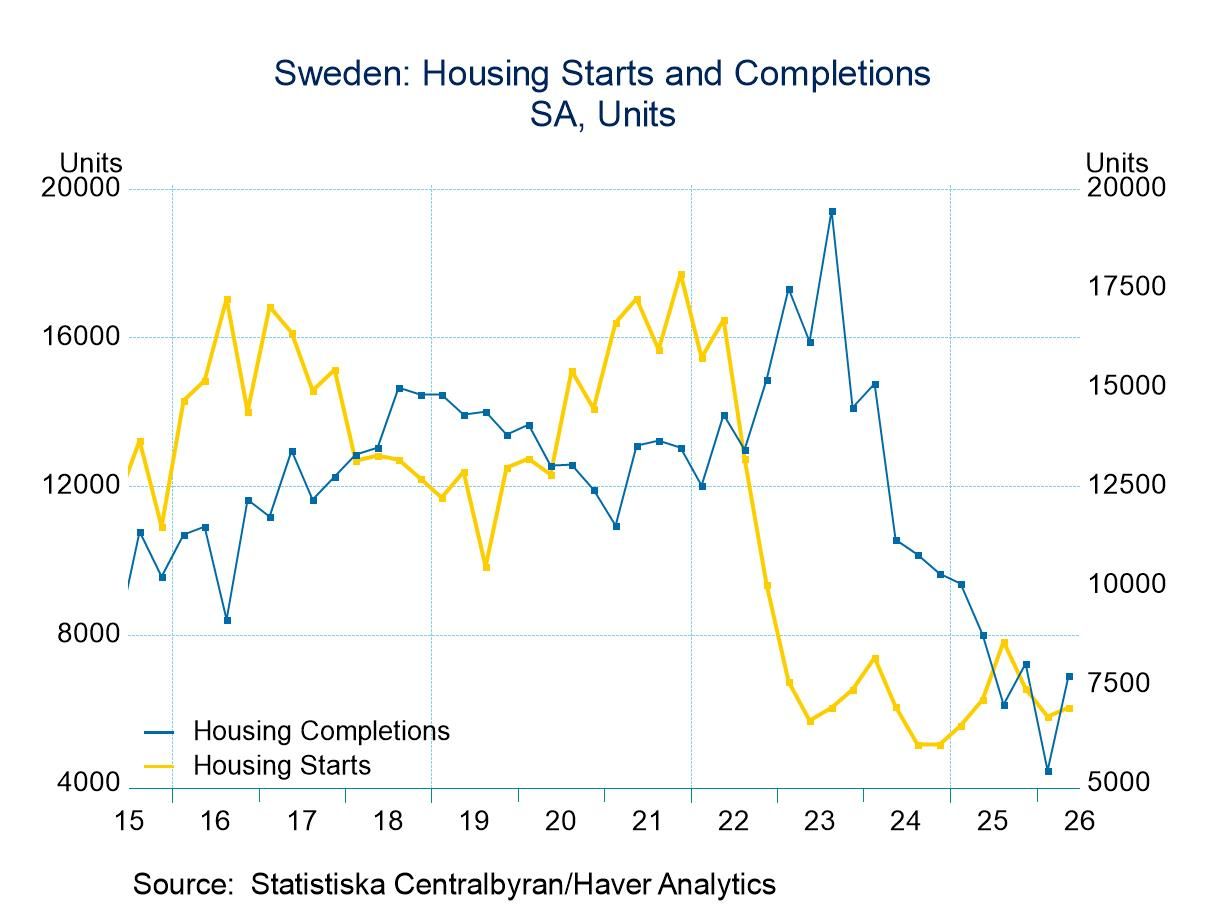
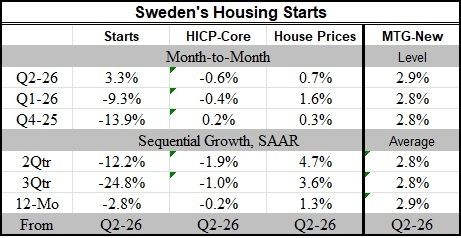
Sweden ended its rate cutting back in the third quarter of 2025. Since then, housing prices have drifted higher. However, housing activity, starts, have had a minor bounce from their lows but no real recovery. Starts are still well below their 2015-2022 levels. But the pace of decline has slowed and given way to oscillation and stability.
Sweden’s inflation rate has fallen back down to its pre-Covid pace. Inflation is no longer a problem there as the headline and core rates for two consecutive quarters are below the 2% mark and look comfortable there. House prices have stabilized. There has not been a year-on-year drop in house prices since 2024-Q1.
Housing completions in this environment have a one-quarter bounce. It’s too early to call this a bottom in completions, but we do have what looks like a spike low in completions. With housing prices creeping back up, having risen for three quarters in a row, the market is beginning to look firmer.
The economy is back in gear, with industrial production rising as of the end of 2024 and logging growth rates of over 4% year-over-year, even after slowing from its rapid recovery from mid-2024 to 2025-Q3.
Sweden shows the signs of having a soft landing in the wake of all the Covid excesses, even with the post-Covid War in Ukraine and the more recent bottlenecks for energy and other supplies in the Strait of Hormuz. Only time will tell if the authorities can continue this run of good policy results.
Monetary policy seems well positioned, with the policy interest rate less than a percentage point above the inflation rate but more than one and one-half percentage points above the core rate of inflation. Interest rates in Sweden were last dropped in late 2025.
Sweden is less affected by the complications in the Middle East and principally uses fossil fuels in its economy to fuel transportation. Apart from that, it has a rich resource of hydro, nuclear, and green energy. This helps give it a buffer against the rollicking prices in the global energy sector and to buffer it from some of that uncertainty.

Robert Brusca
AuthorMore in Author Profile »Robert A. Brusca is Chief Economist of Fact and Opinion Economics, a consulting firm he founded in Manhattan. He has been an economist on Wall Street for over 25 years. He has visited central banking and large institutional clients in over 30 countries in his career as an economist. Mr. Brusca was a Divisional Research Chief at the Federal Reserve Bank of NY (Chief of the International Financial markets Division), a Fed Watcher at Irving Trust and Chief Economist at Nikko Securities International. He is widely quoted and appears in various media. Mr. Brusca holds an MA and Ph.D. in economics from Michigan State University and a BA in Economics from the University of Michigan. His research pursues his strong interests in non aligned policy economics as well as international economics. FAO Economics’ research targets investors to assist them in making better investment decisions in stocks, bonds and in a variety of international assets. The company does not manage money and has no conflicts in giving economic advice.
More Economy in Brief
 Global