Chicago Fed National Activity Index Negative in July After June’s Upwardly Revised Positive Reading
Summary
- CFNAI down to -0.08 in July, negative for the second time in three months.
- Three of four CFNAI components down m/m; two make negative contributions.
- CFNAI-MA3 down to -0.04, second negative reading in three mths.; still above -0.70 (recession signal).
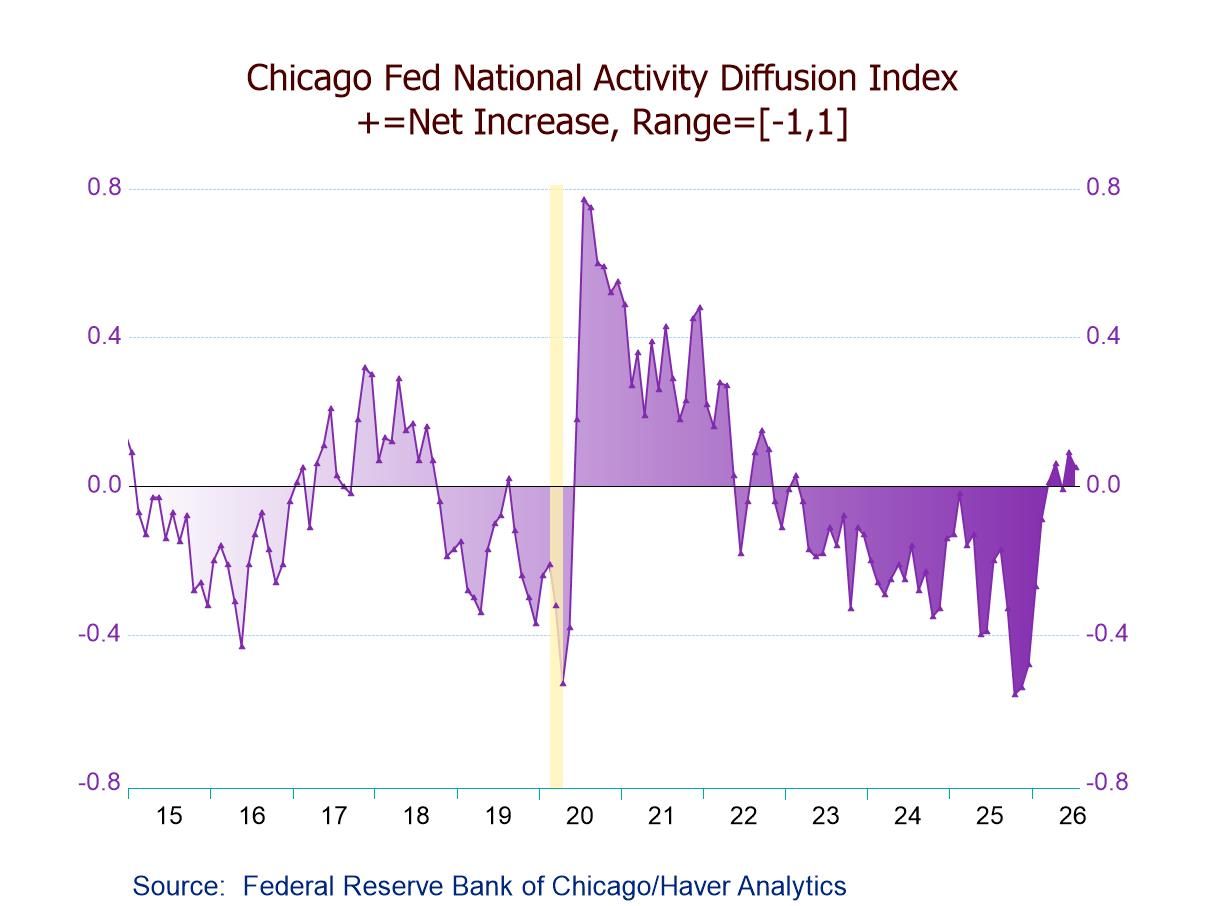
- CFNAI Diffusion Index down to +0.05, remaining positive for the fourth time in five mths.
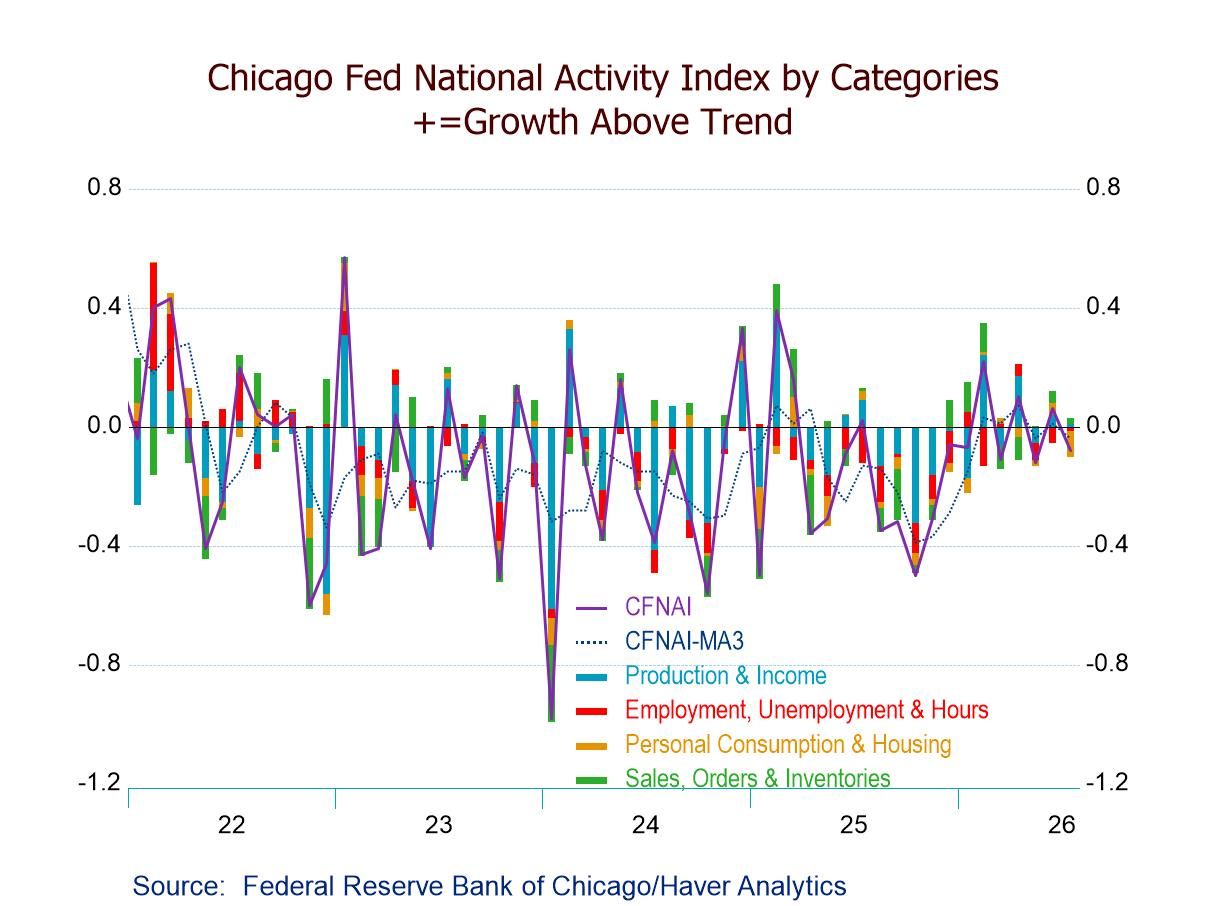
The Chicago Fed National Activity Index (CFNAI) was at -0.08 in July, down from an upwardly revised +0.06 in June (-0.02 initially) and up from -0.12 in May (-0.19 previously), today’s report from the Federal Reserve Bank of Chicago showed, indicating that economic activity was below its historical trend for the second time in three months in July after slightly above the historical trend in June. The latest CFNAI was above a low of -0.50 in October 2025 but below a reading of +0.02 in July 2025 and a high of +0.39 in February 2025.
The index's three-month moving average (CFNAI-MA3), which smooths out the m/m volatility in the index, declined to -0.04 in July from an upwardly revised +0.01 in June (-0.05 initially), registering the second negative reading in three months. It was above a low of -0.39 in October 2025 and -0.13 in July 2025 but below a high of +0.07 in February 2025. The CFNAI-MA3 is expressed in standard deviation units from zero (with a value of zero defined as trend real GDP growth). Research at the Chicago Fed indicates that an average reading of -0.70 or below is consistent with the economy being in a recession. Therefore, the July reading suggested that the U.S. economy is not currently in a recession.
The July reading reflected m/m declines in three of the four CFNAI key components and two negative contributions. The contribution of the Production & Income index to the CFNAI eased to +0.01 in July, still the third positive reading in four months, from +0.04 in June; it was below +0.09 in July 2025 and a high of +0.37 in February 2025 but above a low of -0.61 in January 2024. The contribution of the Sales, Orders & Inventories index edged down to +0.02 in July from +0.04 in June; it was above +0.01 in July 2025 and a low of -0.20 in April 2025 but below a high of +0.16 in March 2025. The Employment, Unemployment & Hours index contributed -0.01 in July, the best of three consecutive negative readings, up from -0.05 in June; it was above its recent low of -0.13 in February and -0.12 in July 2025 but below its recent high of +0.05 in January. The contribution of the Personal Consumption & Housing index fell to -0.09 in July, the third negative reading in four months and the lowest level since May 2025, from +0.04 in June; it was below +0.03 in July 2025 and a high of +0.10 in March 2025 but above a low of -0.14 in January 2025.
The CFNAI Diffusion Index—which measures the breadth of change in the component series and is also a three-month moving average—slipped to +0.05 in July, the fourth positive reading in five months, from an upwardly revised +0.09 in June (-0.03 initially). A string of negative readings was posted during the March 2023 to February 2026 period. A reading of zero indicates that all of the indicators are growing at their long-term average. The July reading was above a low of -0.56 in October 2025 and -0.20 in July 2025 but below a high of +0.15 in September 2022.
The CFNAI is a weighted average of 85 indicators of national economic activity. It is constructed to have an average value of zero and a standard deviation of one. Since economic activity tends toward trend growth rate over time, a positive index reading corresponds to growth above trend and a negative index reading corresponds to growth below trend.
These figures are available in Haver's SURVEYS database.

Winnie Tapasanun
AuthorMore in Author Profile »Winnie Tapasanun has been working for Haver Analytics since 2013. She has 20+ years of working in the financial services industry. As Vice President and Economic Analyst at Globicus International, Inc., a New York-based company specializing in macroeconomics and financial markets, Winnie oversaw the company’s business operations, managed financial and economic data, and wrote daily reports on macroeconomics and financial markets. Prior to working at Globicus, she was Investment Promotion Officer at the New York Office of the Thailand Board of Investment (BOI) where she wrote monthly reports on the U.S. economic outlook, wrote reports on the outlook of key U.S. industries, and assisted investors on doing business and investment in Thailand. Prior to joining the BOI, she was Adjunct Professor teaching International Political Economy/International Relations at the City College of New York. Prior to her teaching experience at the CCNY, Winnie successfully completed internships at the United Nations. Winnie holds an MA Degree from Long Island University, New York. She also did graduate studies at Columbia University in the City of New York and doctoral requirements at the Graduate Center of the City University of New York. Her areas of specialization are international political economy, macroeconomics, financial markets, political economy, international relations, and business development/business strategy. Her regional specialization includes, but not limited to, Southeast Asia and East Asia. Winnie is bilingual in English and Thai with competency in French. She loves to travel (~30 countries) to better understand each country’s unique economy, fascinating culture and people as well as the global economy as a whole.
More Economy in Brief
 Global