

Inflation in EMU Spikes. Yikes!
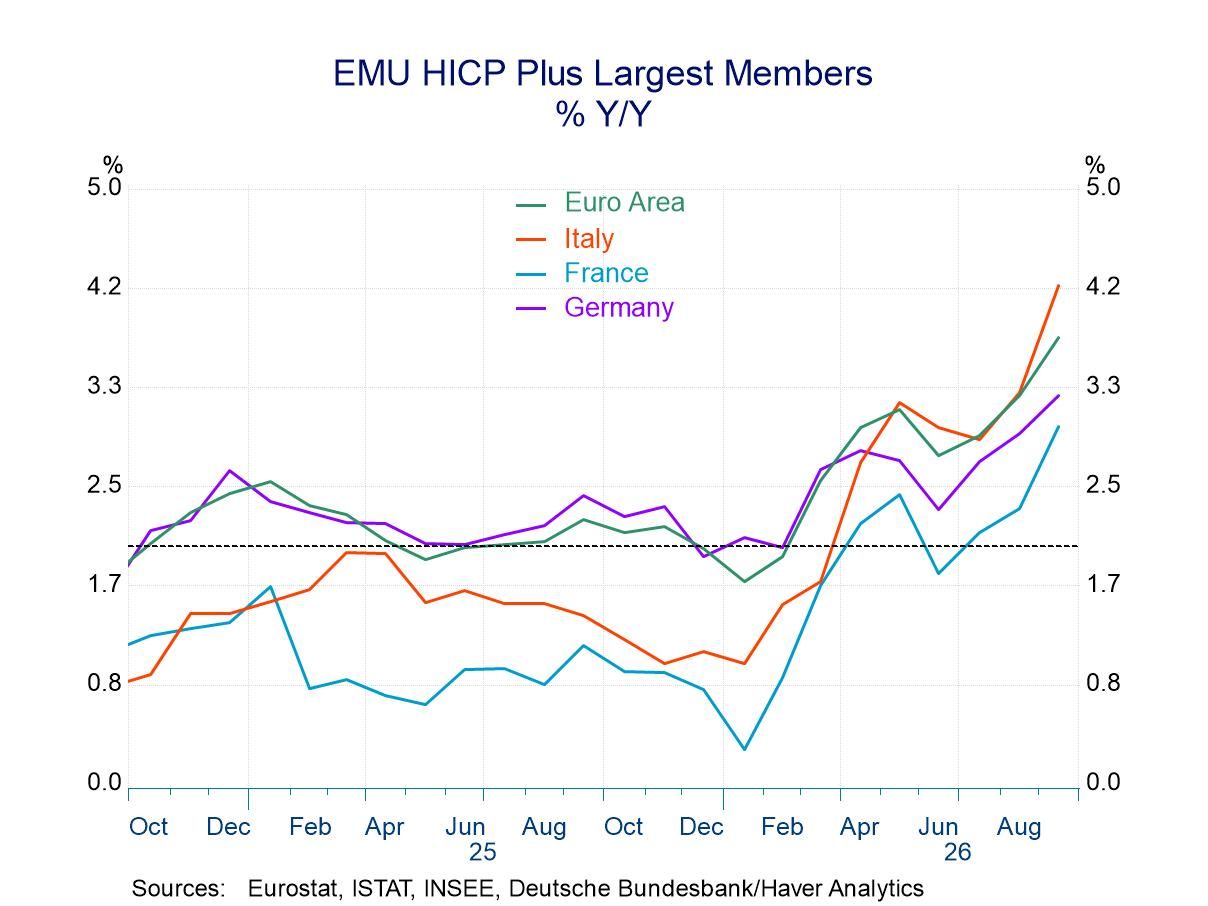
The inflation chart and the table are unanimous on the inflation verdict for the European Monetary Union in September. No matter how you twist and turn it, unless you turn the chart upside down, there's no good news here on the inflation front.
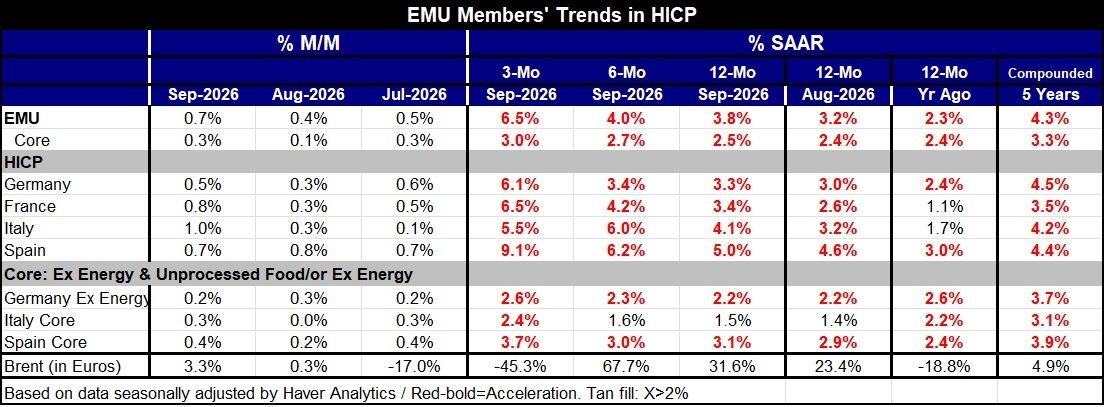
A really bad month for inflation, but not a surprise, part of a trend The monthly news is bad for the aggregate data. The monetary union inflation level, for both the headline and the core readings, looks worrying. Across the four largest economies, the monthly data are quite bad for the headline figures and not very good for the core or the ex-energy readings either.
Trending higher The chart just sticks to year-over-year percentage changes. It doesn't get knee-deep in different sequential measures, but it's clear from the chart that year-over-year inflation is once again engaged in an upswing, and the year-over-year gains for each of the four largest countries are above the 2% mark that the European Central Bank has set for the community. While the ECB target is for the whole community, not for any individual country, with all four of the largest economies showing this kind of an excess, it clearly indicates bad news for the community at large.
Sequential pressure The data in the table provide information on the sequential development of inflation. There we see the headline from 12 months to six months to three months, as we shorten the horizon, with accelerating trends from 3.8% over 12 months to 4% over six months to 6.5% over three months, all annualized rates. The core is better behaved but still shows acceleration from 2.5% over 12 months to 2.7% over six months to 3% over three months. Acceleration is the watchword.
Large economies adverse trends Looking at individual members, the four largest economies show us excessive increases in September month to month, ranging from a 1% gain in Italy to a 0.5% gain in Germany. Sequential inflation shows acceleration for each of the large foreign economies, which is by itself rather disturbing, but the year-over-year rates are as low as 3.3% for Germany and as high as 5% for Spain, and with the three-month rates as low as, and let me repeat this–as low as–a 5.5% annual rate over three months in Italy and as high as a 9.1% annual rate for Spain. This is a very painful habitat for inflation over three months to range from 5.5% to 9.1% when the target is 2%.
Inflation metrics There are three metrics for inflation: headline, core inflation, and ex-energy inflation. These numbers are a little more subdued but still over the top in terms of the ECB target of 2%. The month-to-month numbers are not as chilling, with Germany showing an ex-energy increase of just 0.2% and Spain showing 0.4% at the high end in September. But the sequential numbers show 12-month gains of 2.2% inflation in Germany ex-energy, a 1.5% gain in Italy, which leaves it below the ECB’s desired pace, and a 3.1% increase over 12 months in Spain. These core or ex-energy speeds step up over six months and then step up again over three months. Acceleration is broad-based. Over three months, we see a low pace of 2.4% for Italy, a high pace of 3.7% for Spain, with Germany at 2.6%. Progressing from 12 months to six months to three months, we lose the temperate inflation in Italy, which over three months moves up over the 2% mark, and we log inflation rates of 2.6% in Germany and 3.7% in Spain. The core inflation is lower than headline inflation by a good solid margin. In each of these cases, headline inflation over three months is at least twice the core (or ex-energy) three-month pace. However, core inflation is generally more stubborn and harder to get rid of. In the case of Germany, ex-energy inflation is at 2.6%; Italy logs a 2.4% pace. Those two are not too far above the 2% target, but Spain at 3.7% is much more troublesome.
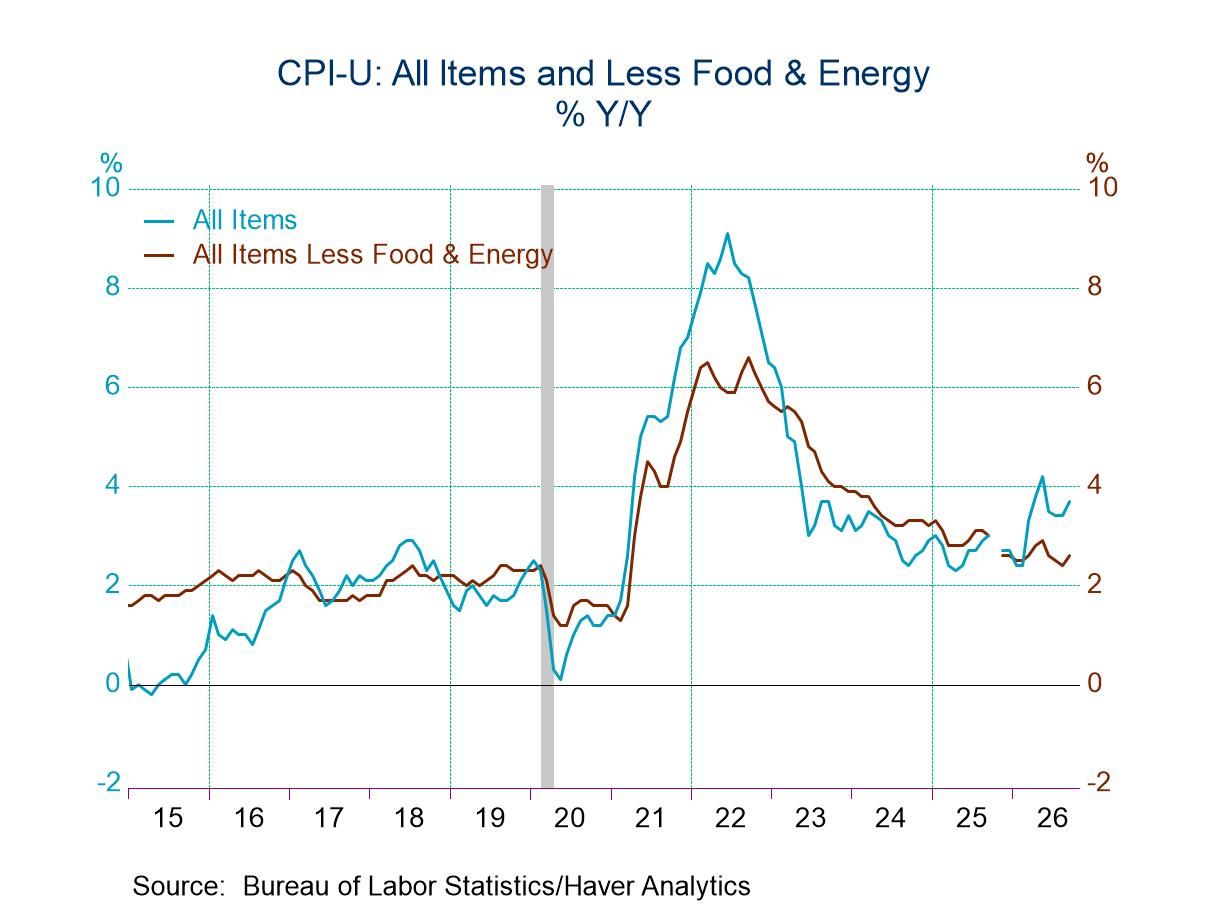
Ubiquitous inflation These figures come out at the same time that the U.S. CPI has given us another unpleasant surprise and has shown more pressure in its headline and in its core as the Federal Reserve is getting prepared to meet later this month. Inflation clearly has become a global problem, and that can't help but make us wonder what the underlying cause is.
The Blame Game The simple knee-jerk reaction is to blame it on oil prices, and that's certainly a good amount of it. Brent oil prices measured in euros rose by 3.3% in September, and year-over-year Brent oil prices are up by 31.6%. Clearly, oil has been cooking in the background. That's going to increase the headline inflation rates everywhere and in some cases by more depending on the exchange rate effect of translating oil from dollars into local currency units. But it's not just as simple as that. Unemployment rates globally are low, fiscal deficits are high, and the levels of fiscal debt are generally high and troubling. That's true in the United States, that's true in Japan, it's true in France, and it's true in the United Kingdom and other places. Germany has managed to keep its debt and deficits more restrained. But when we talk about inflation, we're talking about not just the forces that are currently at work, but we also have to talk about expectations for the future. One problem is that the oil prices relate to the war in the Middle East, and that remains as unsettled as ever. There are also some knock-on effects on the war between Ukraine and Russia where the U.S. has tried to bully Ukraine to stop attacking Russian oil facilities. Still, there's no assurance about the future or about oil prices. When are they going to transmit something more favorable to inflation in the future? There are also supply chain effects and then of course the concerns about the large fiscal deficits and not only the funding pressure that deficits put on markets and the load that places on interest rates but also the potential risk that it creates for central banks to step back to inflate their debt burdens away.
The Future It's pretty clear this month that inflation has become a problem. It's a problem with legs, and it's a problem that's severe enough, and supported by various causes and themes, enough to make us worry about the impact on expectations and therefore of inflation on future inflation. Unless central bankers or fiscal authorities do things to eradicate inflation and the factors that are raising concerns about inflation in the future, we face some difficult times ahead.

Robert Brusca
AuthorMore in Author Profile »Robert A. Brusca is Chief Economist of Fact and Opinion Economics, a consulting firm he founded in Manhattan. He has been an economist on Wall Street for over 25 years. He has visited central banking and large institutional clients in over 30 countries in his career as an economist. Mr. Brusca was a Divisional Research Chief at the Federal Reserve Bank of NY (Chief of the International Financial markets Division), a Fed Watcher at Irving Trust and Chief Economist at Nikko Securities International. He is widely quoted and appears in various media. Mr. Brusca holds an MA and Ph.D. in economics from Michigan State University and a BA in Economics from the University of Michigan. His research pursues his strong interests in non aligned policy economics as well as international economics. FAO Economics’ research targets investors to assist them in making better investment decisions in stocks, bonds and in a variety of international assets. The company does not manage money and has no conflicts in giving economic advice.
More Economy in Brief
 Asia
Asia