German Confidence Edges Up but Remains in Deep Doldrums
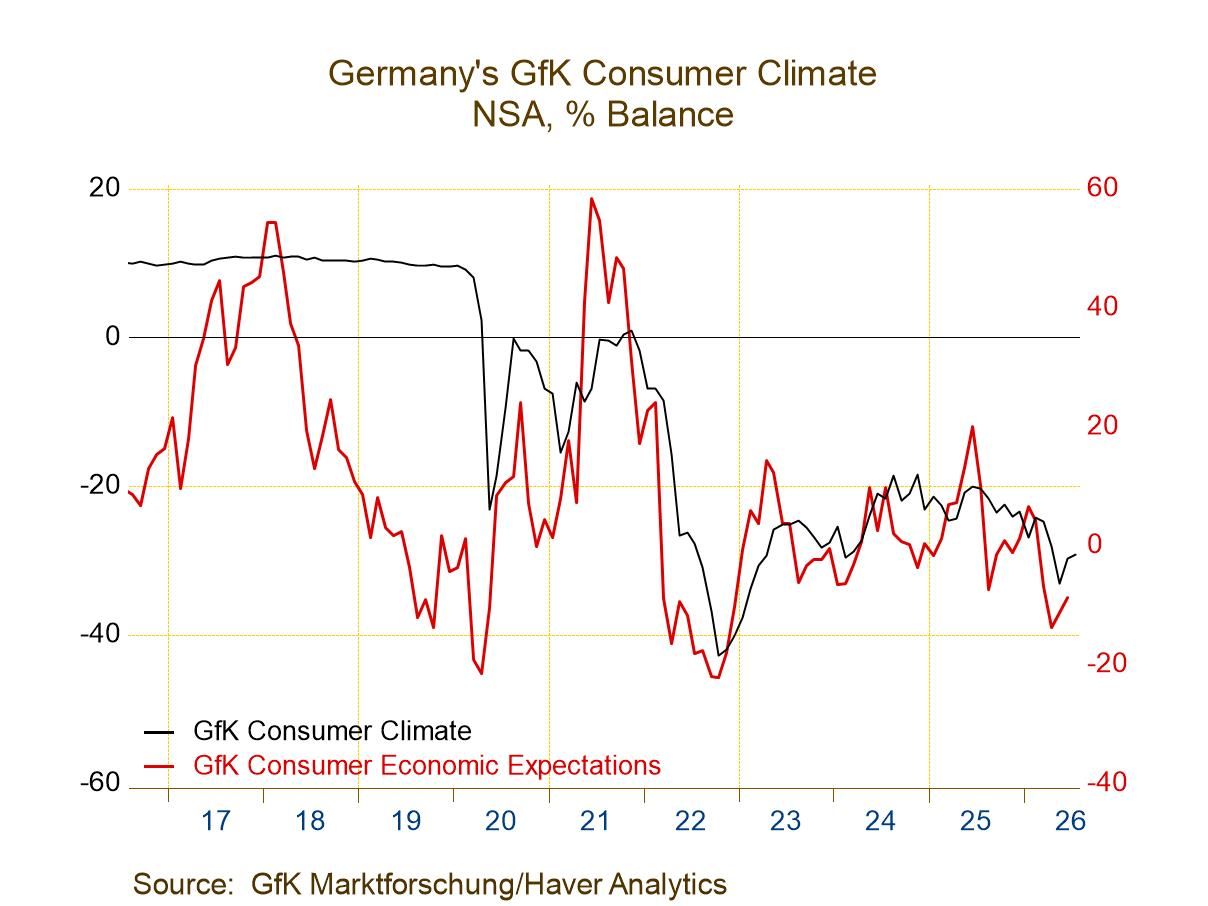
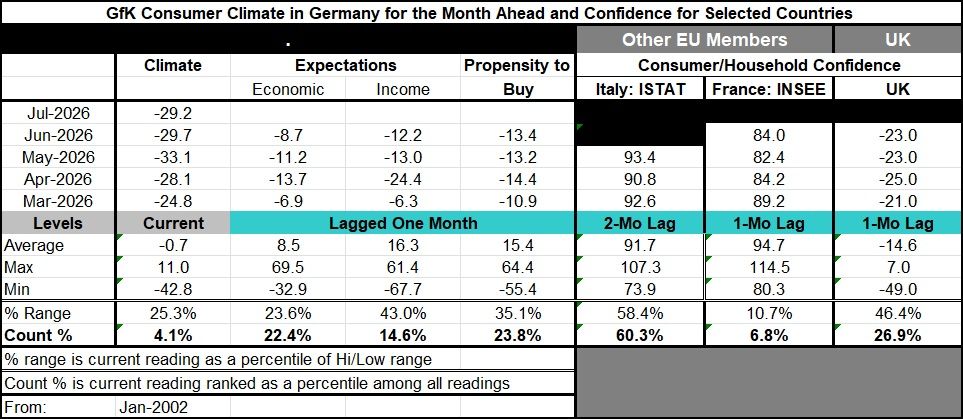
German consumer climate, as measured by the GfK survey for the month ahead of July, posted a reading of -29.2, a slight improvement from -29.7 in June. This is the second consecutive monthly improvement, slight though it may be, in the reading for climate. The ranking of this reading on data back to 2002 finds that it has been weaker only about 4% of the time on this timeline. The reading for climate remains extremely weak in Germany, despite the slight up-creep over the past couple of months.
The components for the climate index are up to date only through June. On that basis, there was a small increase in economic expectations, a small increase in income expectations, and a smaller decline in the rating for the propensity to buy, a consumer spending metric. The reading for economic expectations in June has a 22.4 percentile standing, the reading for income has a 14.6 percentile standing, and the reading for the propensity to buy has a 23.8 percentile standing. All three of these metrics have readings that are in the lower quartile of their range of readings back to 2002. The headline reading is substantially weaker in its ranking than the three components; however, these are for different timelines—the headline is for July, while the components are for June. The weaker climate standing may simply reflect the confluence of the weak readings for these three components, marking that as a more unusual event than the stand-alone rankings of each one by itself. In any event, there is little in the German survey to give much confidence that conditions in Germany are significantly improving, let alone getting better.
The table also includes consumer confidence readings for other EU members, specifically Italy and France, as well as for the nonaligned United Kingdom. Italy's reading is up to date as of May, while the French and U.K. readings are up to date as of June. The recent Italian reading ticked up slightly, from 90.8 in April to 93.4 in May. The May reading for Italy has a 60.3 percentile standing, much better than the readings for the German headline, France, or the U.K. The French reading, at 84, is improved from 82.4 in June but still has only a 6.8 percentile standing, an extremely weak standing comparable to the headline standing for German climate. The U.K. reading is stuck at -23 for two months in a row, which produces a 26.9 percentile standing, another weak reading and a near 25-percentile low reading for the U.K.
These various readings span months ending in May, June, or July; the signals they emit are consistent that consumer confidence is quite weak in Europe—extremely weak in Germany and France, quite weak in the U.K., and only Italy produces a number where the ranking is above its 50th percentile, putting it above its historic mean of readings over data back to the year 2002. Italian consumer confidence readings have tended to be more resilient than those of other countries recently.
Summing up The bottom line is that consumer confidence in these selected European countries is extremely weak. There's no evidence of a rebound and little evidence that conditions are improving in a significant way. The conditions in Ukraine haven't changed much in recent months, although there are some indications that Ukraine has been gaining somewhat of an upper hand, while in the Middle East, circumstances regarding the war with Iran and the state of the Strait of Hormuz continues to be touch-and-go. In this environment, it's not surprising that consumers remain on their back foot. However, the extreme degree of consumer unrest remains surprising.

Robert Brusca
AuthorMore in Author Profile »Robert A. Brusca is Chief Economist of Fact and Opinion Economics, a consulting firm he founded in Manhattan. He has been an economist on Wall Street for over 25 years. He has visited central banking and large institutional clients in over 30 countries in his career as an economist. Mr. Brusca was a Divisional Research Chief at the Federal Reserve Bank of NY (Chief of the International Financial markets Division), a Fed Watcher at Irving Trust and Chief Economist at Nikko Securities International. He is widely quoted and appears in various media. Mr. Brusca holds an MA and Ph.D. in economics from Michigan State University and a BA in Economics from the University of Michigan. His research pursues his strong interests in non aligned policy economics as well as international economics. FAO Economics’ research targets investors to assist them in making better investment decisions in stocks, bonds and in a variety of international assets. The company does not manage money and has no conflicts in giving economic advice.
More Economy in Brief
 Global