Dutch Inflation Picks Up
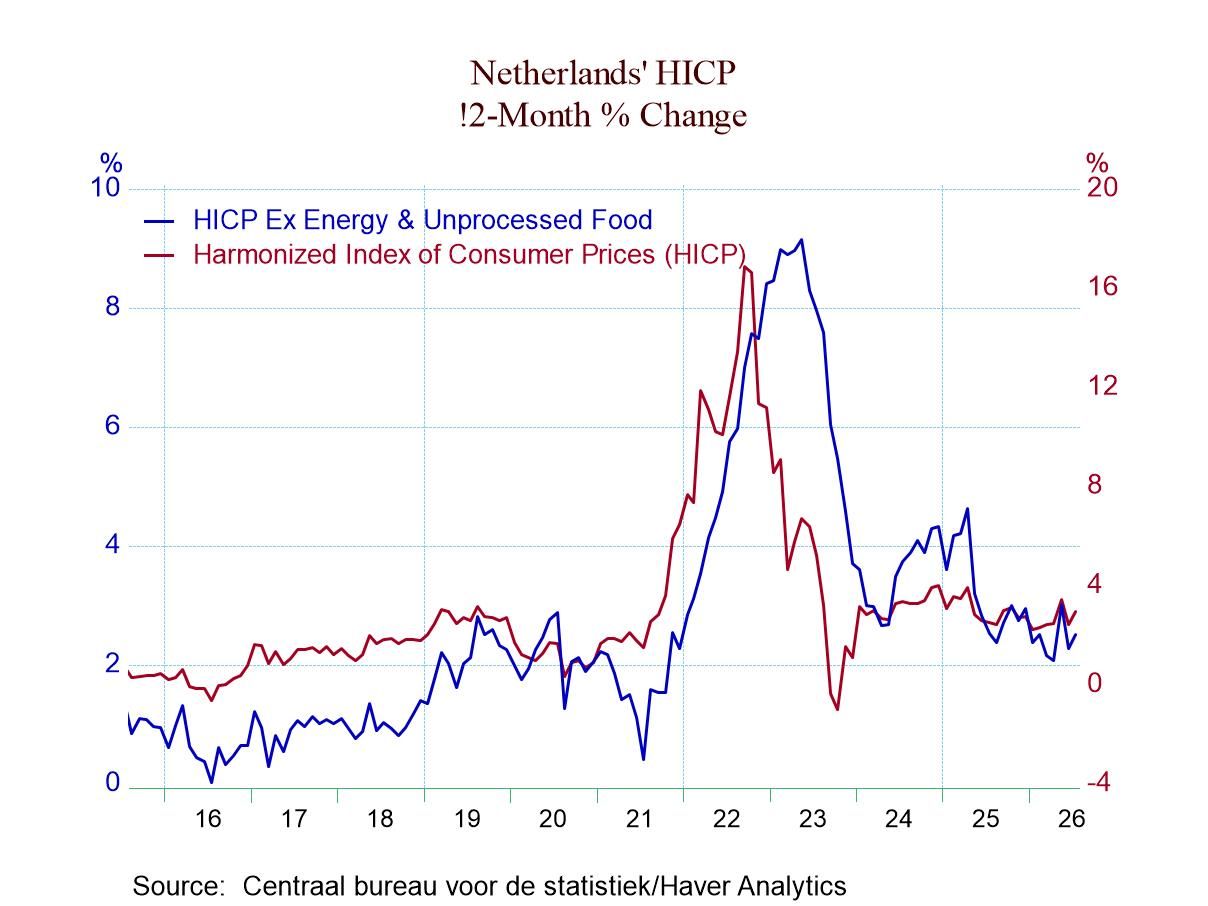
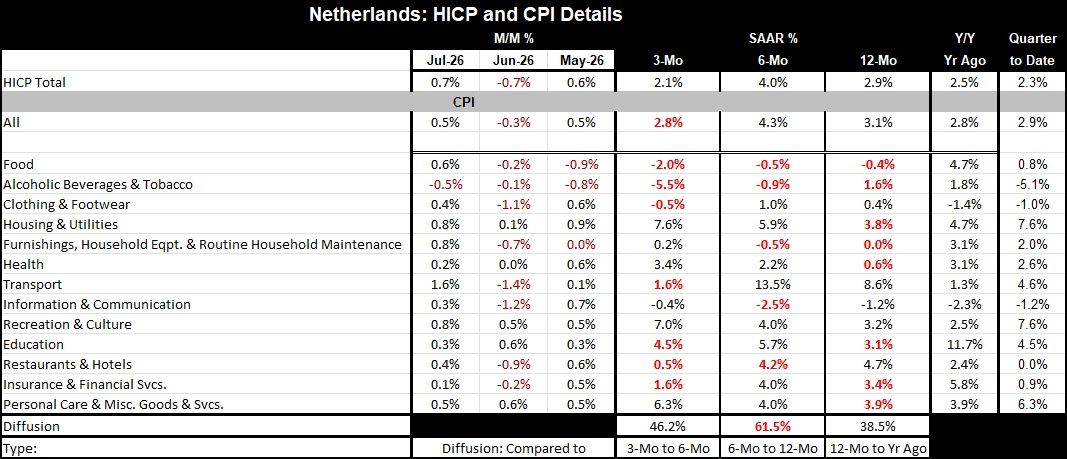
Inflation in the Netherlands picked up in July compared to June. Both the June HICP and the domestic inflation index had shown declines. In July, the HICP posted an increase of 0.7% month-to-month while the domestic CPI gained 0.5%, both easily showing accelerations compared to June. Monthly inflation rates increased in July the same or greater than previously in May.
Sequentially inflation is not exactly busting out; however, the legacy of inflation is still a bitter pill for the ECB to try to swallow even for this small European economy. The total HICP is up at a 2.9% annual rate over 12 months; that rises to a 4% annual rate over six months and settles back down to 2.1% over three months. That deflation is mostly on the strength of the weak showing in June. The domestic inflation rate rises 3.1% over 12 months; it accelerates to 4.3% annualized over six months and then only backs down to 2.8% at an annual rate over three months, largely on the back of the decline posted in June.
The domestic components show inflation accelerating in all but three categories in July; eight of thirteen showed declines in June. Only two categories showed declines in May.
Sequentially, looking at the percentage changes from 12 months to six months to three months, the components are showing mixed results. However, for food and for alcoholic beverages & tobacco, inflation steadily decelerates from 12 months to six months to three months. Only recreation & culture show inflation accelerating over 12 months, six months and three months. However, if we look at inflation trends over three months compared to six months, and six months compared to 12 months, acceleration is present for housing & utilities, for healthcare, for recreation & culture, and for personal care & miscellaneous categories. The not-named categories have more complex patterns, not necessarily good or bad, just complex. The line on the table for diffusion shows us that over 12 months inflation is accelerating in 38.5% of the categories compared to what it had done a year ago. However, over six months, the category inflation rates are higher compared to 12 months in 61.5% of the categories. Over three months compared to six months, inflation is higher in 46% of the categories. By these diffusion calculations, inflation is accelerating over six months compared to 12 months but otherwise it is decelerating over three months and over 12 months.
As an overview, the 2.1% inflation rate for the HICP over three months looks excellent; however, in context, it's result of three months, two of which were terrible, one of which was excellent, and so that's not much to go on. The HICP progressive inflation rates other than three months are all too high at 4% and 2.9%; for the domestic CPI, the same statements are true, except that the three-month rate at 2.8% is even worse than for the HICP over three months. The inflation diffusion statistics by themselves are not bad over three months, showing inflation accelerating in only 46.2% of the categories. That's a pretty good result and inflation accelerating over 12 months in only 38.5% of the categories. But the six-month pace is too high, and the question is where the three-month number is going to settle in once we move down the road; the good June inflation statistic beginning to fade and drop out is another issue. June increasing is looking like an outlier.
So that's a significant question on the outlook for inflation, and it's basically a question that we ask for every country because we had that break because of the hopeful situation that had arisen around the Strait of Hormuz and the prospect of oil prices going back down. Now that prospect appears to have passed and we're not quite sure where we stand. That puts the outlook and all the trends in a danger zone.

Robert Brusca
AuthorMore in Author Profile »Robert A. Brusca is Chief Economist of Fact and Opinion Economics, a consulting firm he founded in Manhattan. He has been an economist on Wall Street for over 25 years. He has visited central banking and large institutional clients in over 30 countries in his career as an economist. Mr. Brusca was a Divisional Research Chief at the Federal Reserve Bank of NY (Chief of the International Financial markets Division), a Fed Watcher at Irving Trust and Chief Economist at Nikko Securities International. He is widely quoted and appears in various media. Mr. Brusca holds an MA and Ph.D. in economics from Michigan State University and a BA in Economics from the University of Michigan. His research pursues his strong interests in non aligned policy economics as well as international economics. FAO Economics’ research targets investors to assist them in making better investment decisions in stocks, bonds and in a variety of international assets. The company does not manage money and has no conflicts in giving economic advice.
More Economy in Brief
 Global