GDP in EMU Is Firmer Quarter-to-Quarter, But Slowing
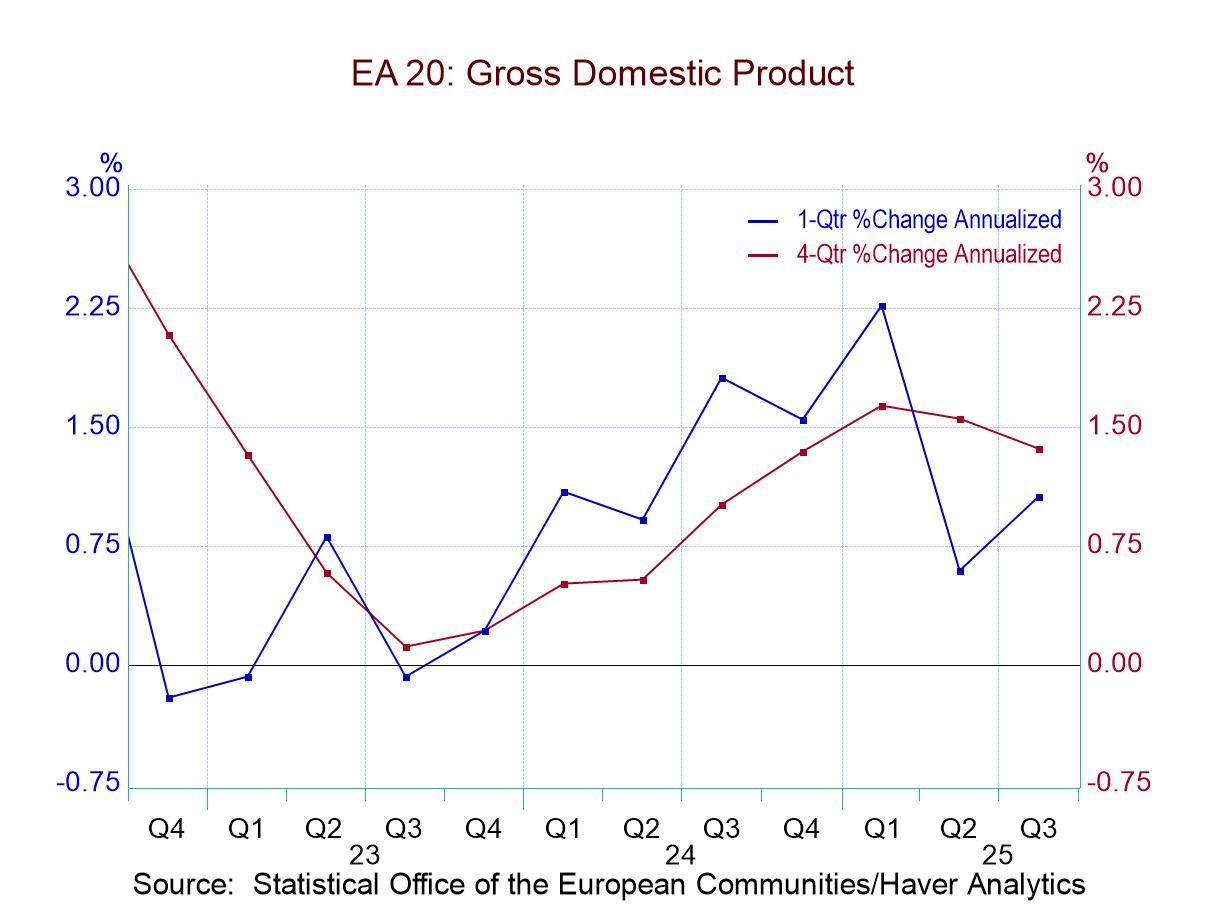
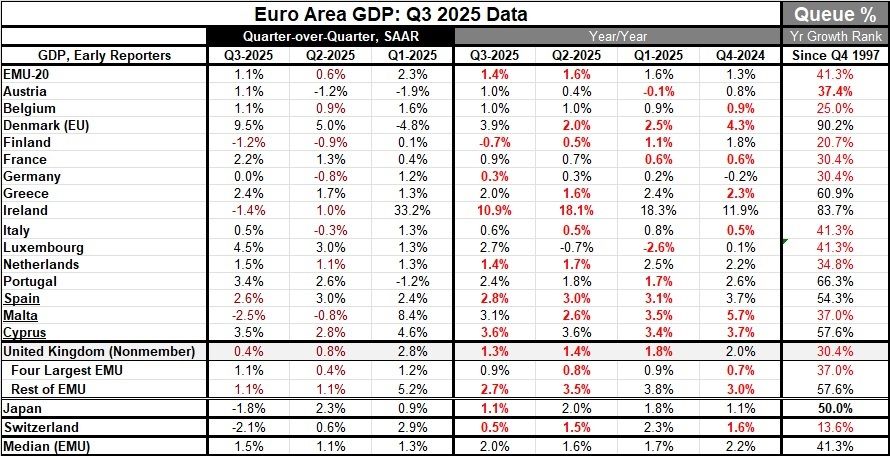
Growth in the euro area came in a little bit stronger in the third quarter as growth is up 1.1% compared to 0.6% in the second quarter and 2.3% in the first quarter. These are annualized quarter-to-quarter results. Ranked on growth rate data back to 1997, the EMU 1.4% GDP growth rate has a 41.3 percentile standing which puts it below its median growth rate for this period.
Among the countries in the table that includes 16 European countries, Japan, as well as the European Monetary Union aggregate, only 6 countries have growth rates above their medians in 2025-Q3. One of them, Denmark, is not a monetary union member; it has a standing in its 90.2 percentile. Ireland has a rank standing in its 83.7 percentile. Portugal has a growth standing in its 66.3 percentile. Greece's growth rate is in its 60.9 percentile. Cyprus’ standing is in its 57.6 percentile. The median growth rate among reporting members has year-over-year growth at 2.0% and that's a 41.3 percentile standing.
Quarterly growth in the third quarter decelerates in four of the reporting monetary union countries. This is down from 9 decelerations in the second quarter. Growth also decelerates in the third quarter in six countries when measured on a year-over-year basis. Monetary union growth decelerates year-over-year as well.
There's not a particular pattern to the median growth rate, which was at 2.2% on the fourth quarter of 2024, slipped to 1.7% in 2025-Q1 and then to 1.6% in in 2025-Q2, and it has picked up to a 2% pace in the third quarter of 2025. The monetary union overall growth rate which is weighted for the size of the underlying economies, shows 1.3% growth in the fourth quarter of 2024, stepping up to 1.6% in the first quarter, remaining at 1.6% in the second quarter, and then slipping slightly to 1.4% in the third quarter of 2025.
Growth is favored in the smaller economies in the European Monetary Union as the four largest economies have a year-on-year growth rate that is below the growth rate for the rest of the European Monetary Union in each of the last four quarters. The year-over-year growth rate for the third quarter shows the largest four EMU economies are growing at a 0.9% year-over-year pace compared with 2.7% pace for the rest of the monetary union. This strength is also reflected in the growth standings with the four largest economies having a growth rate standing at their 37th percentile, compared to a 57.6 percentile for the rest of the monetary union.
We have no comparison for the United States right now because U.S. GDP has been delayed by the U.S. shutdown dynamics. But both Japan and Switzerland are logging relatively weak growth rates in the third quarter of 2025, with Japan at 1.1% year-over-year and Switzerland at 0.5%. Japan's growth rate is still a 50th percentile ranking while Switzerland's growth rate is a 13.6 percentile ranking against its historic results.
The growth rate for the monetary union is revised lightly higher than it was; still, it shows growth slowing quarter-to-quarter on an annualized basis. Only three of the monetary union reporting countries in the third quarter show quarterly growth actually falling; German growth is dead flat at zero. The overall monetary union growth rate is still quite moderate on a quarterly as well as annual basis. However, growth is still in train; inflation remains moderate. Growth in the monetary union is generally supported more by the smaller countries than by the large countries.

Robert Brusca
AuthorMore in Author Profile »Robert A. Brusca is Chief Economist of Fact and Opinion Economics, a consulting firm he founded in Manhattan. He has been an economist on Wall Street for over 25 years. He has visited central banking and large institutional clients in over 30 countries in his career as an economist. Mr. Brusca was a Divisional Research Chief at the Federal Reserve Bank of NY (Chief of the International Financial markets Division), a Fed Watcher at Irving Trust and Chief Economist at Nikko Securities International. He is widely quoted and appears in various media. Mr. Brusca holds an MA and Ph.D. in economics from Michigan State University and a BA in Economics from the University of Michigan. His research pursues his strong interests in non aligned policy economics as well as international economics. FAO Economics’ research targets investors to assist them in making better investment decisions in stocks, bonds and in a variety of international assets. The company does not manage money and has no conflicts in giving economic advice.
More Economy in Brief
 Global