European GDP Improves in Q2
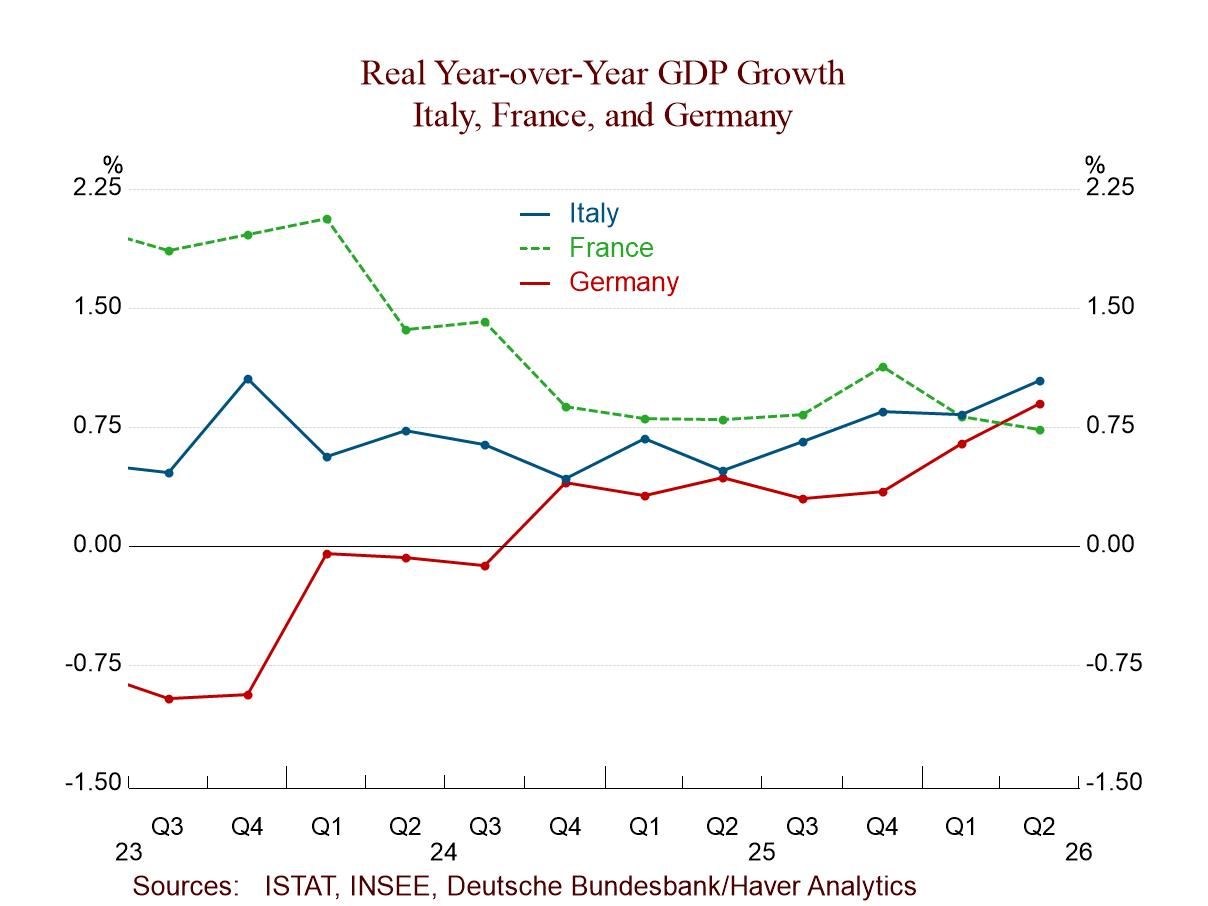
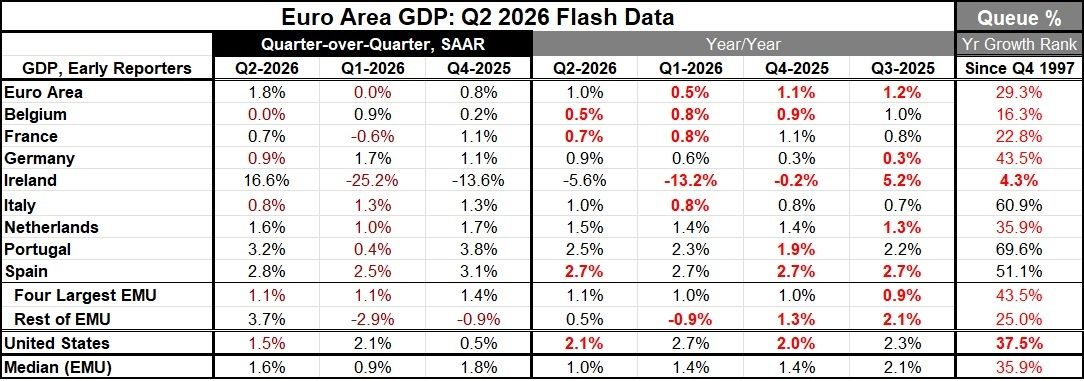
GDP in the second quarter accelerated for most of the countries in the monetary union. The overall figure for the EMU improved to 1.8% as an annualized quarter-over-quarter gain from 0% in the first quarter and 0.8% in the fourth quarter. Among the 8 early reporters of GDP, there was a deceleration in Italy, Germany, and Belgium, while the other five countries showed an increase in their growth rates in the second quarter compared to the first quarter.
The four largest monetary union economies showed a technical weakening, but at the one-digit level, growth was 1.1% in the second quarter, the same as in the first quarter. The rest of the monetary union saw an increase in growth from -2.9% annualized in the first quarter to a gain of 3.7% at an annualized rate in the second quarter, a huge shift.
On a year-over-year basis, growth rates improved for all but three countries: Belgium, France, and Spain. For Spain, the year-over-year growth rate was unchanged at 2.7% in the second quarter. For France, the growth decelerated from 0.8% in the first quarter to 0.7% in the second quarter; for Belgium, the growth rate slowed from 0.8% to 0.5%.
The overall monetary union growth rate rose to 1% in the second quarter compared to a 0.5% increase in the first quarter. The four largest economies showed stronger growth at 1.1% year-over-year compared to 1% last quarter, while the rest of the monetary union showed a GDP gain of 0.5% compared to a year-over-year decline of 0.9% in the first quarter.
Evaluating growth over a longer timeline, three early-reporting monetary union members have standings in their growth rates above their respective 50th percentiles. Those countries are Portugal at 69.6%, Italy at 60.9%, and Spain at 51.1%.
The four largest monetary union economies, pooled together, have a growth ranking year-over-year in their 43.5 percentile. The rest of the monetary union has a growth ranking at the 25th percentile. From this, we can conclude that most of the growth has come from the four large economies, even though in the current quarter it's the smaller economies that seem to be performing much better.
On these same timelines, the United States posted a weaker quarterly growth rate in the second quarter at 1.5%, compared to 2.1% in the first quarter. U.S. growth at 2.1% year-over-year is slower than its 2.7% year-over-year growth rate in the first quarter; it has a queue-percentile standing of its growth rate on data back to 2001 in its 37.5 percentile, a standing well below its historic median for the period. U.S. consumer spending held up pretty well in Q2 and business investment spending remained strong, but the trade account did a turnaround and sucked a lot of life out of the growth rate in the second quarter, keeping the U.S. economy as an important driver of global growth.

Robert Brusca
AuthorMore in Author Profile »Robert A. Brusca is Chief Economist of Fact and Opinion Economics, a consulting firm he founded in Manhattan. He has been an economist on Wall Street for over 25 years. He has visited central banking and large institutional clients in over 30 countries in his career as an economist. Mr. Brusca was a Divisional Research Chief at the Federal Reserve Bank of NY (Chief of the International Financial markets Division), a Fed Watcher at Irving Trust and Chief Economist at Nikko Securities International. He is widely quoted and appears in various media. Mr. Brusca holds an MA and Ph.D. in economics from Michigan State University and a BA in Economics from the University of Michigan. His research pursues his strong interests in non aligned policy economics as well as international economics. FAO Economics’ research targets investors to assist them in making better investment decisions in stocks, bonds and in a variety of international assets. The company does not manage money and has no conflicts in giving economic advice.
More Economy in Brief
 Global