EU Indexes Show EMU Weaker in October
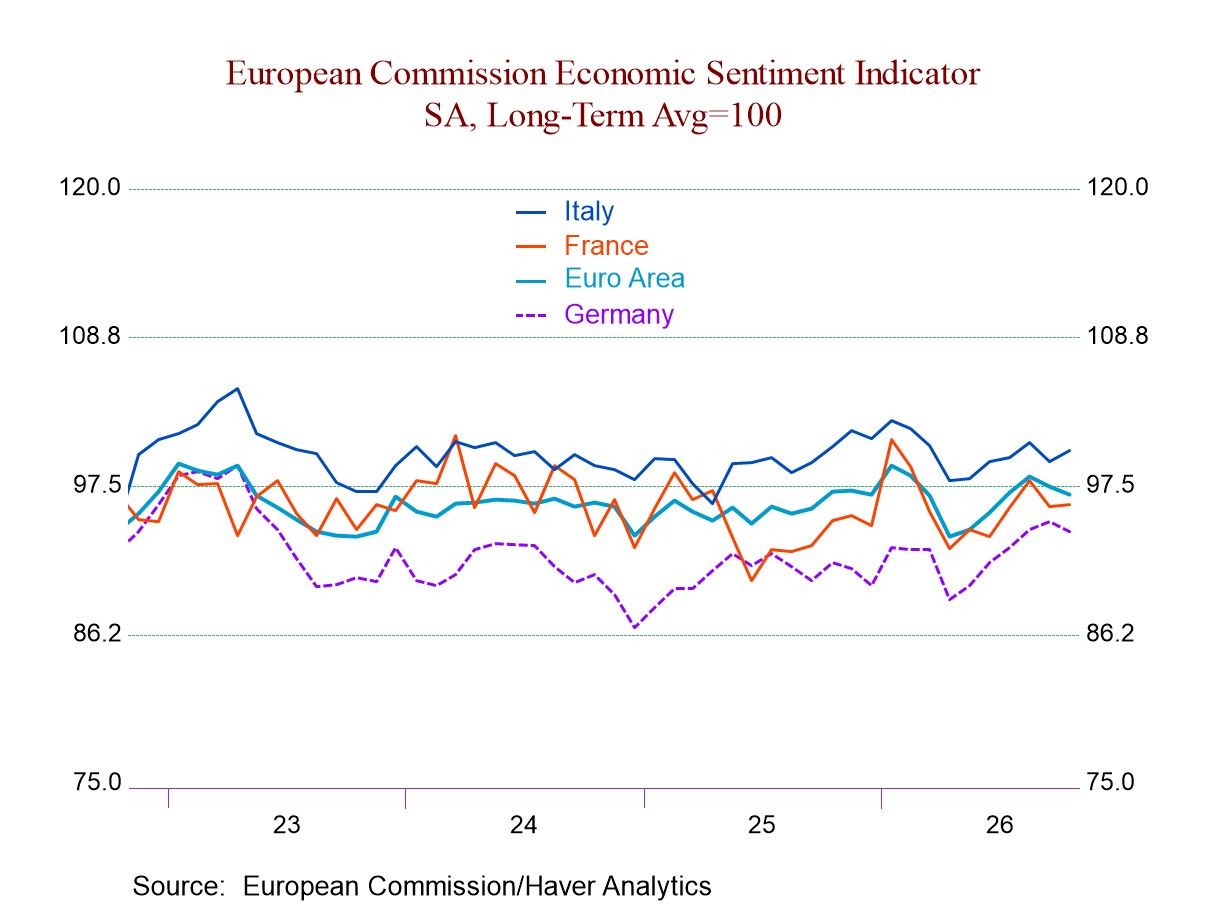
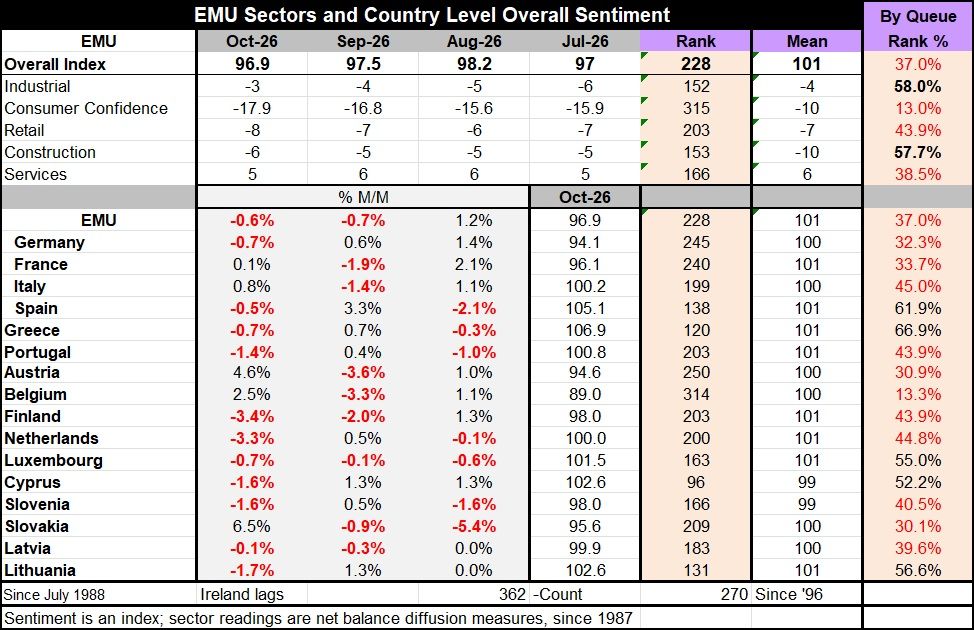
The EU index for the European Monetary Union (EMU) fell to 96.9 in October from 97.5 in September. The index was last lower in June of this year, so this is a multi-month low.
The main sector indexes showed a monthly improvement in only one, the industrial sector, with a rise of one point. Weakening on the month were the construction sector, retail sector, consumer confidence, and the services sector. Each of them slipped by about one point.
Across reporters, eleven of the 16 countries that are early reporting show month-to-month declines. There were monthly increases in France and Italy as well as among the smaller economies Austria, Belgium, and Slovakia. Nine countries had shown monthly declines in September and only seven had logged weakening in August; still, that’s seven out of sixteen.
EMU-wide sectors By sector, only two of the five sectors have rankings in their queue standings of historic data above their respective medians. Those two are the industrial sector (58.0%) and construction (57.7%). Below-median rankings were turned in by retailing (43.9%), services (38.5%), and consumer confidence (13.0%). Consumer confidence globally appears much weaker than the sector you might expect to see it affect, like retailing, wholesaling, or services. Consumers keep worrying but keep spending. Still, the overall ranking for the EMU index is at its 37th percentile. That overall ranking is lower than the unweighted simple average of the five-sector ranking (at 42.2%).
Across countries, the rankings show only five of 16 reporting countries with rankings above the 50% mark, a ranking that would place them above their respective historic medians.
The more conventional accounting data that lag (such as retail sales and industrial production as distinct from their diffusion survey counterparts) have continued to show a relatively firm picture, but one that only solidifies weak growth. Unemployment rates are historically low across the euro area. But the ECB is wary to hike rates anyway. No one is sure what lies ahead. There are rumblings of more hostilities in Iran after the U.S. midterm elections pass. If so, will the U.S. be more aggressive? More intrusive? Will it act to seize or stabilize the Strait of Hormuz as needed? Or will the attack only make things worse, and energy prices higher? No one knows, so the ECB is playing cautious and not betting on an uncertain future but is prepared to respond to its needs. The current reticence among central banks to hike rates is not now a positive reading on inflation or its prospects. It is, in fact, a negative vote indicating a rise in uncertainty and, unfortunately, a parallel rise in the hopes of central bankers that something will bail them out so they do not have to make tough decisions. I am very wary and somewhat concerned about the last part. We do not want central banks that are afraid to take the steps required to control inflation.

Robert Brusca
AuthorMore in Author Profile »Robert A. Brusca is Chief Economist of Fact and Opinion Economics, a consulting firm he founded in Manhattan. He has been an economist on Wall Street for over 25 years. He has visited central banking and large institutional clients in over 30 countries in his career as an economist. Mr. Brusca was a Divisional Research Chief at the Federal Reserve Bank of NY (Chief of the International Financial markets Division), a Fed Watcher at Irving Trust and Chief Economist at Nikko Securities International. He is widely quoted and appears in various media. Mr. Brusca holds an MA and Ph.D. in economics from Michigan State University and a BA in Economics from the University of Michigan. His research pursues his strong interests in non aligned policy economics as well as international economics. FAO Economics’ research targets investors to assist them in making better investment decisions in stocks, bonds and in a variety of international assets. The company does not manage money and has no conflicts in giving economic advice.
More Economy in Brief
 Global