EMU Unemployment Holds Its Ground But There Is Erosion
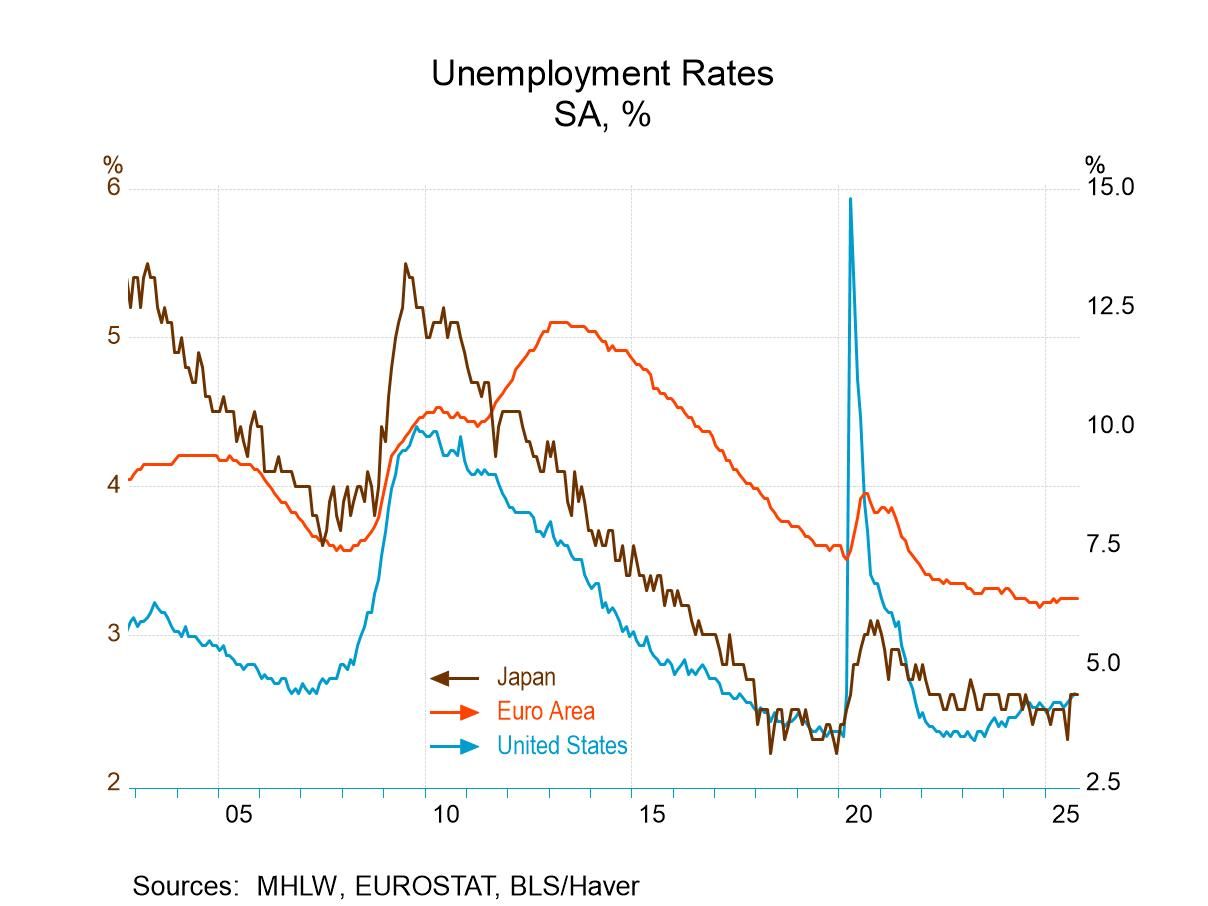
Unemployment rate holds in October Unemployment in the European Monetary Union held at 6.4% in October. That's just a couple of ticks off its all-time low. Unemployment at 6% is also just a couple of ticks off its all-time low in the European Union, and unemployment in the EU also was unchanged in October from September.
A good October Conditions in Europe for unemployment remain extremely favorable although there are signs of pressure and the rate itself is slightly off of its all-time low. October, however, was a pretty good month for unemployment as the table gives us unemployment statistics for 12 monetary union members. Among those 12, only three had unemployment rates rise: Finland (from 9.6% to 10.3%), Belgium (from 6.3% to 6.4%), and Austria (from 5.6% to 5.8%). Outmatching the rising unemployment rates, we're falling unemployment rates in Italy, Luxembourg, Ireland, Greece, and Portugal. The raw number of unemployed in October in the EMU fell (while the raw number of unemployed rose slightly in the EU).
Not such good September and August results In September, month-to-month unemployment rates rose more broadly in seven countries while falling and only two countries. In August, unemployment rates rose in five countries while falling in only two countries. October was an unusually good month for the unemployment rate that fell much more broadly than rose across these 12 monetary union members. Also in August and September, the raw number of unemployed rose month-to-month in each month in both the EU and the EMU.
A more tempered sequential look Sequential changes in unemployment rates over three months, six months and 12 months show some backtracking and potentially unemployment unrest. Over three months unemployment rates rose in six countries and fell in only two countries. Over six months, the unemployment rates rose in eight countries and fell in four countries. Over 12 months unemployment rates rose in seven countries while falling in four countries. The number of unemployed rose period-to-period in each of these time segments in both the EU and the EMU. Sequentially, there has been more backtracking than there has been progress. But the unemployment rates are so low even holding the line is an exceptionally good performance.
Ranking the unemployment rates The ranking of the unemployment rate for the European Monetary Union as a whole is in its 5.8 percentile; it has been lower 5.8% of the time. The unemployment rate in the European Union has been lower about 7.4% of the time. Unemployment rates are above their respective medians (which means above a ranking of 50%) only in Austria, Finland, and Luxembourg among EMU members.
Inflation: still stubborn Just released data show some inflation stubbornness in the monetary union. Core inflation (Country level) continues to be stubborn above ECB target of 2%. We have core inflation data for some selected countries in the union, and we do not yet have core inflation measures for the monetary union as a whole.
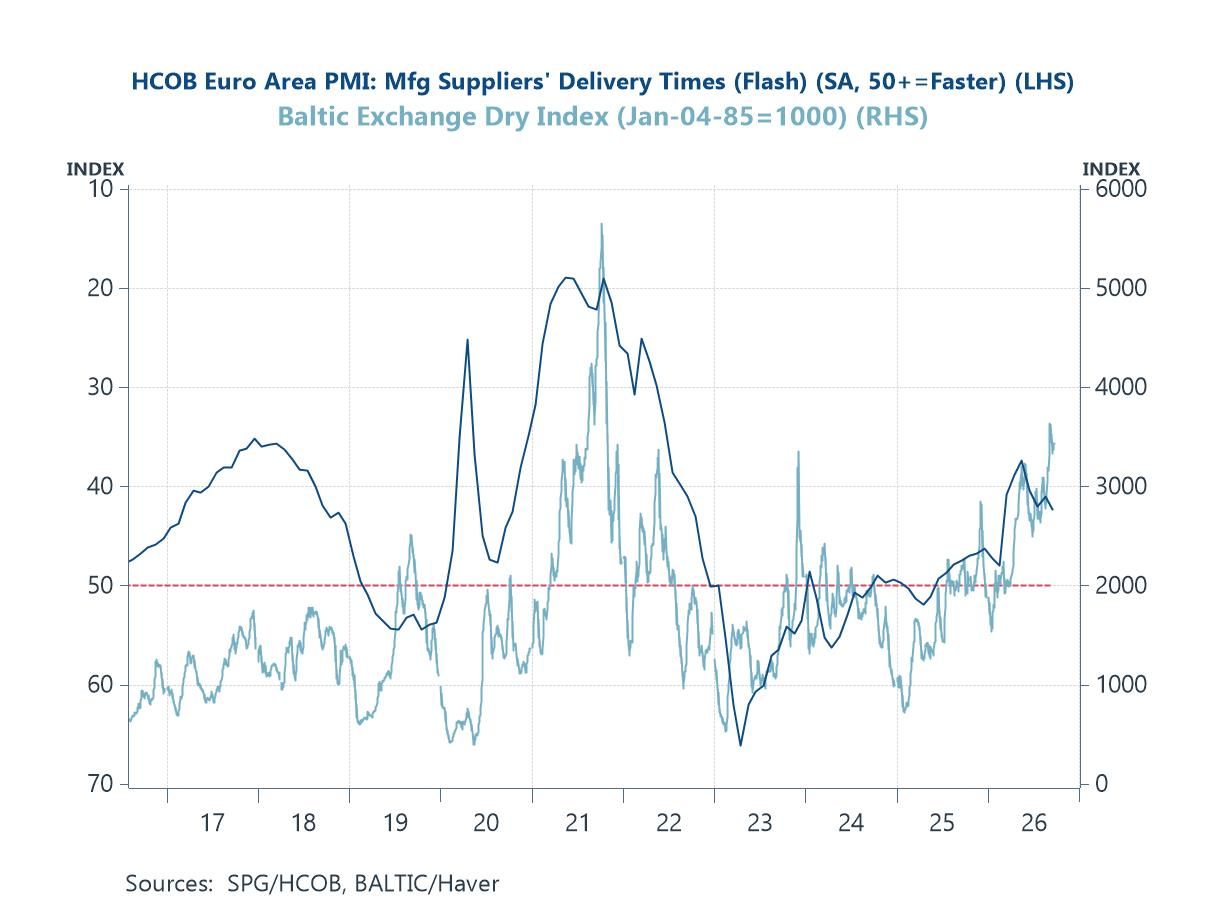
Baltic dry goods index is on a run higher Still, there some good news in the offing; oil prices continue to slip which is good for the longer term outlook for inflation and the Baltic dry goods index is making a significant ongoing push higher; it's currently sitting at high the highest point we've seen in over a year. That should be a good sign for the outlook for manufacturing and for the goods sectors of these economies. It’s also good news for the development of unemployment rates. The Baltic dry goods index is an index of global shipping volume; its revival is a welcome event in the wake of the Trump tariffs.
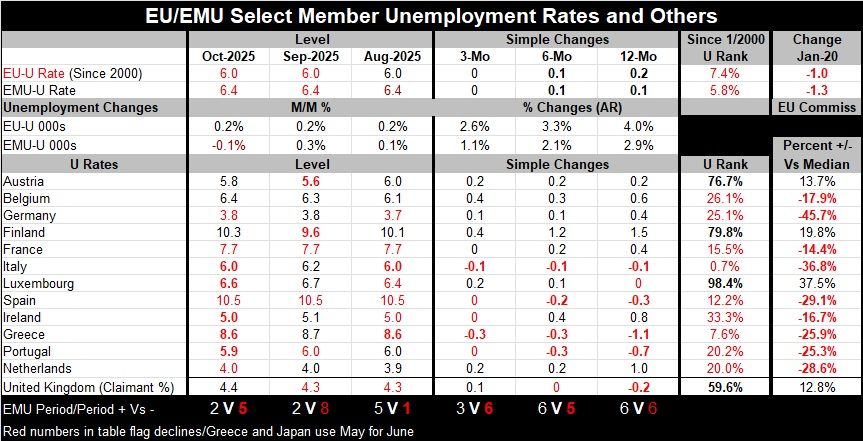
An assessment When the unemployment rate gets this low it's not reasonable to continue to look for the unemployment rate to fall even though we're constantly looking to make more progress on the economic front. Keeping the unemployment rate this low would be quite a good economic outcome. However, when labor markets get tight very often there's pressure on wages and that seeps into prices and the ECB, like the Federal Reserve in the U.S., has not exactly done a great job in hitting its price and target. The table on our employment also includes that of the United Kingdom which is still showing a low unemployment rate in terms of its claimant count. But that unemployment rate is not as low as it seems, as it stands in its 60th rank percentile; that's above its historic median. The U.K. has an ongoing inflation problem as well and the economy has been showing signs of weakness and slowing.
In conclusion We're still lacking some data for the U.S. in order to make comparisons with Europe. However, for the time being, the European progress is quite good. There are some hints of some backtracking on the inflation front, but more clearly inflation remains excessive. However, with oil prices in a downtrend trajectory, and the Baltic dry goods index on the rise, there is hope that manufacturing at long last is going to be recovering. All in all, October has not been a bad month for Europe.

Robert Brusca
AuthorMore in Author Profile »Robert A. Brusca is Chief Economist of Fact and Opinion Economics, a consulting firm he founded in Manhattan. He has been an economist on Wall Street for over 25 years. He has visited central banking and large institutional clients in over 30 countries in his career as an economist. Mr. Brusca was a Divisional Research Chief at the Federal Reserve Bank of NY (Chief of the International Financial markets Division), a Fed Watcher at Irving Trust and Chief Economist at Nikko Securities International. He is widely quoted and appears in various media. Mr. Brusca holds an MA and Ph.D. in economics from Michigan State University and a BA in Economics from the University of Michigan. His research pursues his strong interests in non aligned policy economics as well as international economics. FAO Economics’ research targets investors to assist them in making better investment decisions in stocks, bonds and in a variety of international assets. The company does not manage money and has no conflicts in giving economic advice.
More Economy in Brief
 Global