EMU Retail Sales Are Flat in October
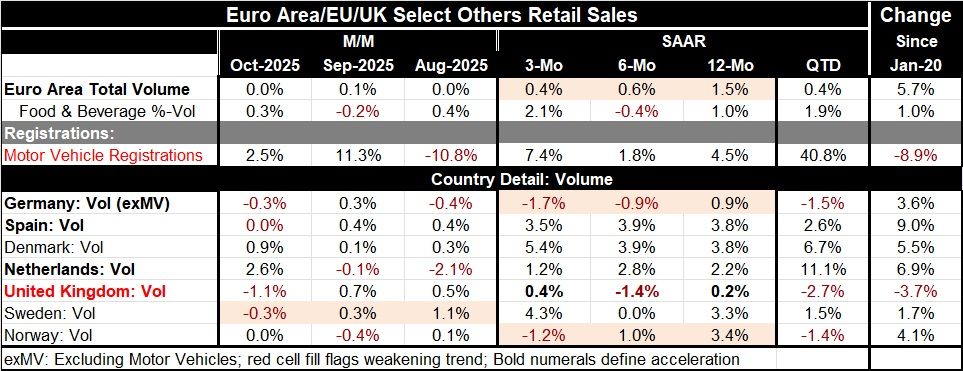
European Monetary Union (EMU) retail sales in October were flat. Food & beverage sales rose by 0.3%. The profile on sales continues to be weak although from 12-months to six-months to three-months sales are still growing. However, the growth rates are decelerating sequentially. Total sales volumes grow by 1.5% over 12 months, advance at a 0.6% annual rate over six months, and gain at an even slower 0.4% annual rate over three months. Food & beverage volume spending rises by 1% over 12 months and at a 2.1% annual rate over three months after declining 0.4% over six months.
Quarter-to-date total euro area sales volumes are rising at a 0.4% rate while food volume is rising at a 1.9% annual rate. None of this is impressive.
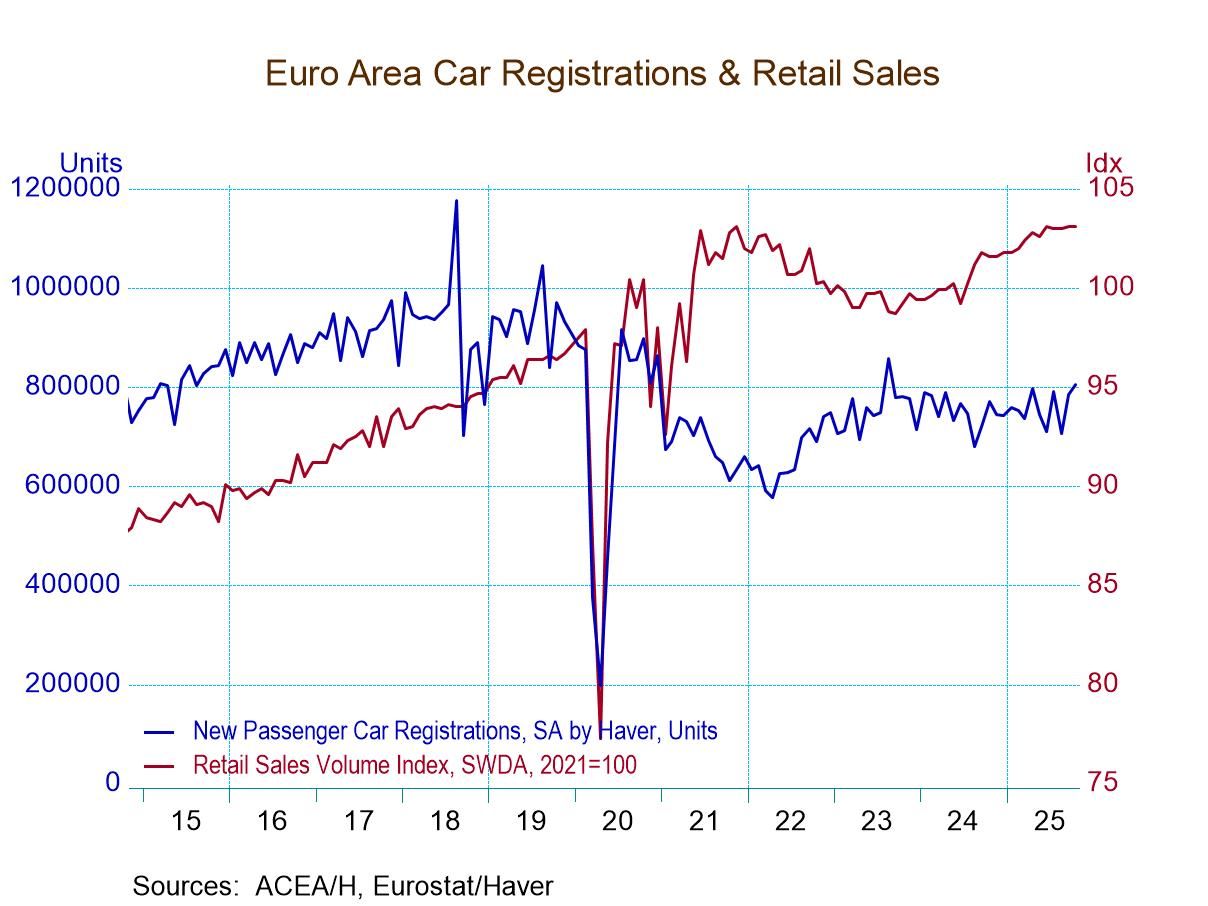
Motor vehicles show healthier trends Motor vehicle sales have shown some life the last two months after falling 10.8% in August; they snapped back, rising by 11.3% in September and now, in October, there's a further 2.5% increase month-to-month. Over 12 months vehicle sales rise by 4.5%, over six months sales slow to a 1.8% annual rate, but then, over three months, they pick back up to grow strongly at a 7.4% annual rate. As a result of these gyrations, motor vehicle sales volumes are up at a 40.8% annual rate in the quarter-to-date, that's one-month into the fourth quarter.
Country level retail performance On a country-by-country basis, we have a smattering of results from Monetary Union members and other European reporters. In October, among the seven individual countries reporting, there are sales declines in three of them; in Germany sales fell by 0.3%, in Sweden they fell by 0.3%, and in the United Kingdom volumes fell by 1.1%. In addition, sales were flat in Spain in October and flat in Norway as well. Only Denmark and the Netherlands logged sales increases. Dutch sales rose 2.6% month-to-month while Danish sales rose by 0.9% month-to-month.
Sequential country sales patterns Sequentially, looking at annualized growth rates over 12 months, six months and three months, there are steady decelerations in two countries in the table: Germany and Norway. For Germany sales grow 0.9% over 12 months but move on to contract at a 1.7% annual rate over three months. For Norway sales rise by 3.4% over 12 months, then contract at a 1.2% annual rate over three months. There's a slight acceleration in sales in Denmark as sales grow 3.8% over 12 months, rise at 3.9% annual rate over six months, and then advance at a 5.4% annual rate over three months. However, the rest of the countries in the table produce unclear trends.
On a quarter-to-date basis, motor vehicles are surging, rising at a 40.8% annual rate, and providing the clearest notion of all being well. Country level retail sales excluding autos are growing most strongly in the Netherlands, at an 11.1% annual rate, followed by Denmark with a 6.7% annual rate and Spain at a 2.6% annual rate. Swedish QTD sales grow at a 1.5% annual rate, as sales volumes in Germany, the United Kingdom, and Norway show declines. U.K. sales fall at a 2.7% annual rate, German volumes fall at 1.5% annual rate, and Norwegian volumes fall at a 1.4% annual rate.
Results since January 2020 The COVID and post COVID period results to date have been marked by significant weakness. Retail sales since January of 2020 show total Euro-Area sales volumes are up by 5.7%, that's barely 1% per year. Food and beverage volumes are up by only 1% on a net basis. By country, the UK shows sales falling on balance by 3.7% on this five- and three-quarter-year horizon. Sales rise 1.7% in Sweden, 3.6% in Germany, and 4.1% in Norway. There are slightly more substantial sales in Denmark with a gain of 5.5%. The Netherlands show a net sales gain of 6.9%, and Spain logs a net rise of 9%. So, the Spanish numbers are quite solid. The Dutch and Danish numbers are moderate, and apart from that the other sales numbers are quite weak. These sales results span a period of 5 ¾ years and over such a period we would expect more substantial gains than what these countries are reporting now. Compounded a 1% per-year gain would results in a 5.9% increase in sales on this period. However, over this span vehicle sales are lower by 8.9%. That’s a substantial setback over such a period. Only two countries surpass that marker, and one other one comes close. The overall euro area number comes close (5.7%).
Summing up Retail sales numbers do not signal recession; however, they continue to point to very weak retail sales. Vehicle sales have picked up recently and have showed increases in all three horizons and that's certainly a bright spot and welcome after a long span of underperforming. Across the European Monetary Union, consumer confidence continues to lag and that weakness is reflected in the ongoing sluggishness in retail sales.

Robert Brusca
AuthorMore in Author Profile »Robert A. Brusca is Chief Economist of Fact and Opinion Economics, a consulting firm he founded in Manhattan. He has been an economist on Wall Street for over 25 years. He has visited central banking and large institutional clients in over 30 countries in his career as an economist. Mr. Brusca was a Divisional Research Chief at the Federal Reserve Bank of NY (Chief of the International Financial markets Division), a Fed Watcher at Irving Trust and Chief Economist at Nikko Securities International. He is widely quoted and appears in various media. Mr. Brusca holds an MA and Ph.D. in economics from Michigan State University and a BA in Economics from the University of Michigan. His research pursues his strong interests in non aligned policy economics as well as international economics. FAO Economics’ research targets investors to assist them in making better investment decisions in stocks, bonds and in a variety of international assets. The company does not manage money and has no conflicts in giving economic advice.
More Economy in Brief
 Global