EMU IP Flat to Lower on the Month
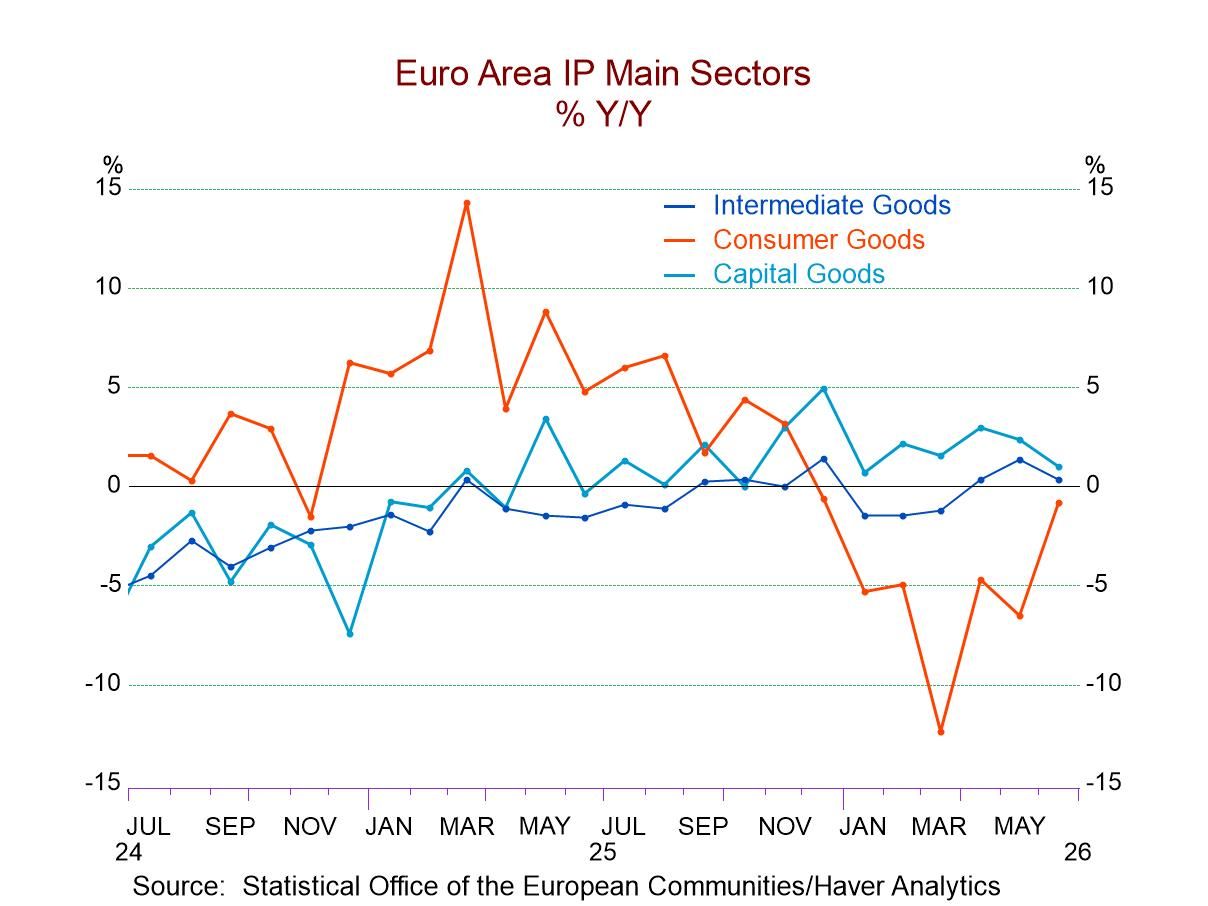
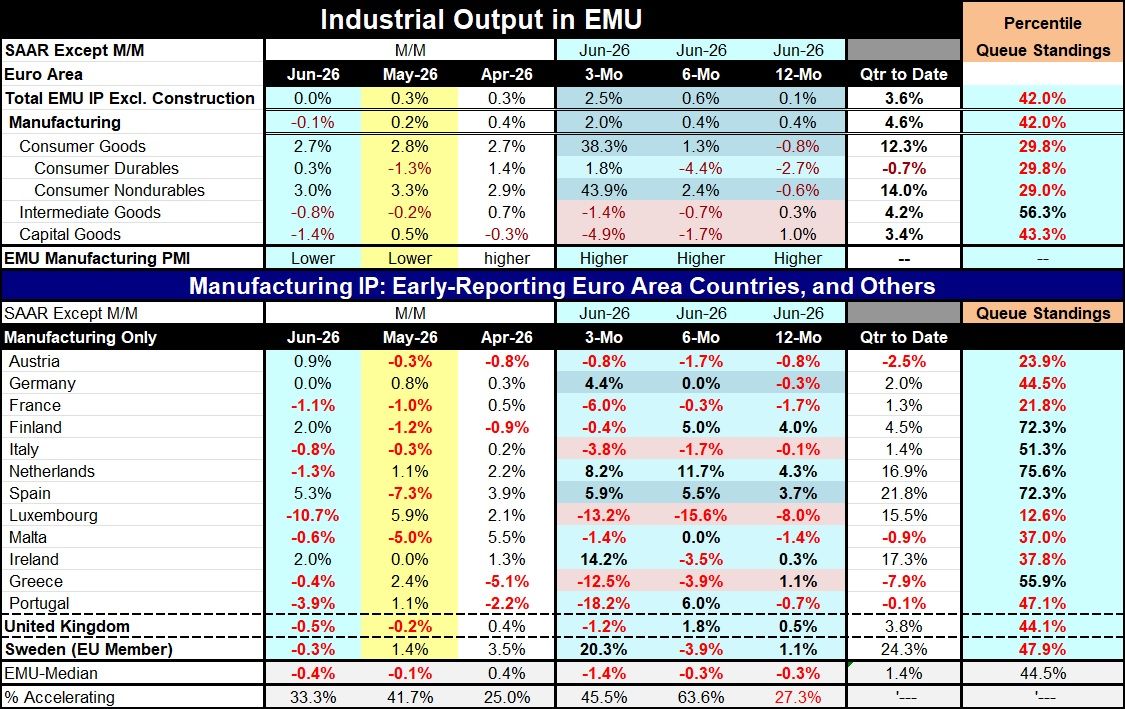
Industrial production in the euro area was flat in June, interrupting a four-month string of increases that had been in place. Despite the flatness and the decline in manufacturing output in the month, trends still show that output is on an expanding path. Consumer goods output was particularly strong in June, up 2.7% month-to-month, led by a 3% increase in nondurable goods output. However, intermediate goods output fell by 0.8%, and capital goods output fell by 1.4%. Growth is a matter for the weighting-game more than a statement about breadth.
The sequential calculations that give us a look at trend show that output is accelerating overall, barely growing at a 0.1% pace over 12 months, edging up to a 0.6% annual rate over six months, and culminating at a 2.5% annual rate over three months. Manufacturing output similarly has a slow start but builds a head of steam to grow at a 2% pace over three months. Consumer goods output ramps up very sharply. Although it declines by 0.8% over 12 months, over three months it is up at a 38.3% annual rate, led by strong expansion in consumer nondurables with output surging at a 43.9% annual rate over three months. However, consumer durable goods are still lagging, with output falling by 2.7% over 12 months, although it is rebounding at a 1.8% annual rate over three months.
The story across countries is varied with many European economies showing output declines in June. Of the 14 early-reporting European economies in June, nine showed declines in output in the month. For individual European economies, Germany and Spain are on accelerating paths, while Italy, Luxembourg, and Greece are posting decelerating output patterns.
In the quarter to date, output is rising for most industrial categories across the monetary union. The exception is consumer durables, the only category showing a decline on a quarterly basis with the second-quarter results now in. Manufacturing output is up at a 4.6% annual rate in the quarter. Consumer goods output is up to a 12.3% annual rate. Intermediate goods output is up at a 4.2% annual rate, and capital goods output is advancing at a 3.4% annual rate. Of the 14 European countries summarized in the table, Austria, Malta, Greece, and Portugal are the only countries showing quarter-to-date declines in the second quarter.
For the most part, these readings are upbeat, showing acceleration in most of the overall European manufacturing categories. However, when we evaluate annual growth rates compared to historic norms, all of the industrial categories for the monetary union are below their historic medians except for intermediate goods output. Across the European economies reporting in this table, only five have output speeds taking them above their historic medians. Those are Finland, Italy, the Netherlands, Spain, and Greece. All the rest of the reporters are below the 50% mark. The median ranking across the monetary union economies is at its 44.5 percentile.
Manufacturing in the monetary union hits a bit of a flat spot in June; however, it still continues to carry momentum from its earlier months, especially over three months. Obviously, conditions in the Middle East and the situation in the Strait of Hormuz are overhanging the industrial sector, and they will be important factors in how the sector performs from here through the rest of the year. As of June, conditions are carrying momentum, but that could change. The overview for Europe is an industrial sector that is expanding, mostly accelerating with more varied results across countries. Individual members show considerable variance in their performance. Compared to historic norms, year-over-year growth rates are mostly weaker than their median pace has been.

Robert Brusca
AuthorMore in Author Profile »Robert A. Brusca is Chief Economist of Fact and Opinion Economics, a consulting firm he founded in Manhattan. He has been an economist on Wall Street for over 25 years. He has visited central banking and large institutional clients in over 30 countries in his career as an economist. Mr. Brusca was a Divisional Research Chief at the Federal Reserve Bank of NY (Chief of the International Financial markets Division), a Fed Watcher at Irving Trust and Chief Economist at Nikko Securities International. He is widely quoted and appears in various media. Mr. Brusca holds an MA and Ph.D. in economics from Michigan State University and a BA in Economics from the University of Michigan. His research pursues his strong interests in non aligned policy economics as well as international economics. FAO Economics’ research targets investors to assist them in making better investment decisions in stocks, bonds and in a variety of international assets. The company does not manage money and has no conflicts in giving economic advice.
More Economy in Brief
 Global