EMU Indexes Back Off But Hold Uptrend
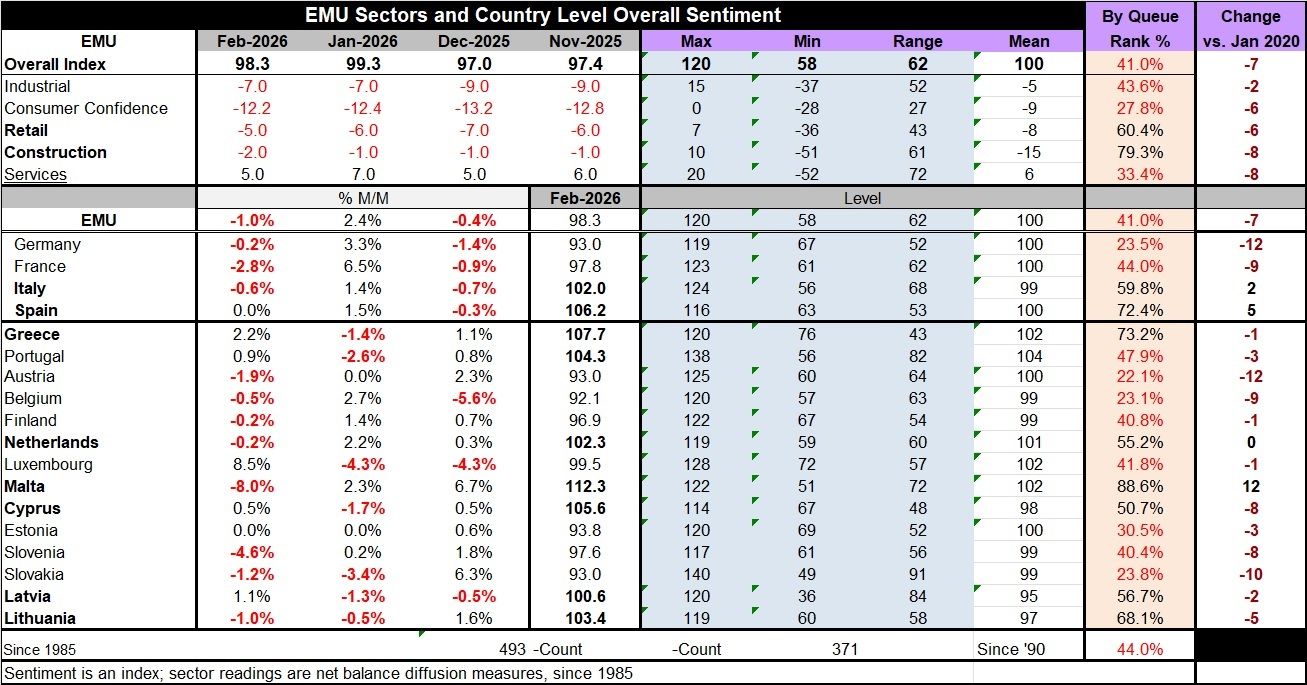
EU Commission indexes that assess economic performance for the countries in Europe and in the European Monetary Union slipped in February to 98.3 from 99.3 in January; however, the February reading is still relatively strong by recent standards and leaves the index largely in an uptrend.
The February readings saw the industrial sector unchanged, a small upward move in consumer confidence, and a one-point backtracking in construction, as retailing improved by a point. The services sector index stepped back by two points, putting it back at its December level.
Ranking standings for economic groups The key ranking of the sectors in February show only two of the sectors with readings above their medians (i.e., above a ranking of 50%). Those sectors are retailing with a queue standing in its 60.4 percentile and construction with its queue standing in its 79.3 percentile. Consumer confidence continues to be the weakest with a 27.8 percentile ranking, services check in with a 33.4 percentile ranking, and the industrial sector has moved up to a 43.6 percentile ranking. However, the overall monetary union ranking is only in its 41st percentile, substantially below its historic median which resides at a standing at the 50-percentile mark.
Country level performance Beyond the sectors, there are 18 of the 20 monetary union countries that provide early readings to this survey. Eleven countries showed weakened performance in February compared to January. In January, seven countries had weakened relative to December. In December, seven countries had weakened relative to November. However, in December, four of the countries that weakened were the four largest economies in the monetary union. In January, none of the largest four economies weakened month-to-month. Now, in February, we have three of the four largest economies weakening month-to-month, with the other one, Spain, posting an unchanged reading. The large countries in the monetary union have begun to have a little more difficulty over these last three months.
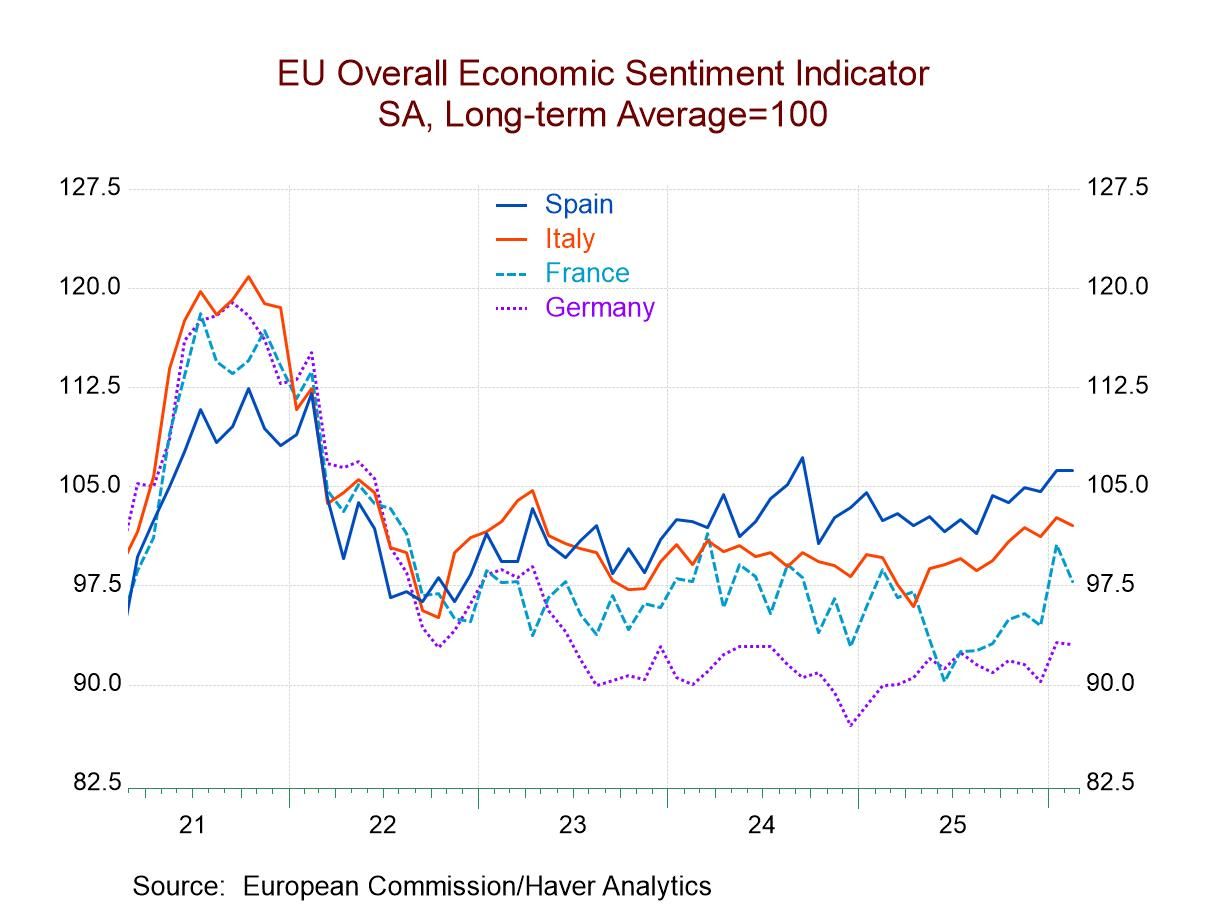
Standings by country Percentile-standing data showed that, of the 18 countries in the table, only 8 have readings that place them above their historic medians on data back to the mid-1980s. The large countries have split performance, with Italy reporting a 59.8 percentile standing and Spain reporting a 72.4 percentile spending, while the two largest monetary union economies, Germany and France, post readings in the 23rd percentile for Germany and the 44th percentile for France. The ranking for the monetary union as a whole is at its 41st percentile. That compares to an unweighted average ranking in the 44th percentile for all the countries when their individual rankings pooled and averaged. The two ratings are close together.
Apart from the Big Four Among the rest of the monetary union members, countries with readings above the 50th percentile are Malta, Greece, Lithuania, Latvia, the Netherlands, and Cyprus. Four countries vie for having the weakest reading in the table, with readings in their 20th percentile region. That list includes Big Four member Germany with the 23.5 percentile standing, Slovakia with a 23.8 percentile standing, Belgium with a 23.1 percentile standing, and Austria with a 22.1 percentile standing. There is considerable heterogeneity among the rankings of the monetary union member countries across all size classes. In addition, as we saw above, looking at the sectors, the sector rankings varied from a low of 27th percentile standing for consumer confidence to a high of 79th percentile standing for construction.
Summing up The chart shows the large economies nonetheless demonstrating some improvement with all of them displaying rising trends over the past year or so. However, the absolute rankings of the EU Commission assessment data remain low by historic comparison and the community still has a long way to go in order to get the majority of its members back on an even keel.

Robert Brusca
AuthorMore in Author Profile »Robert A. Brusca is Chief Economist of Fact and Opinion Economics, a consulting firm he founded in Manhattan. He has been an economist on Wall Street for over 25 years. He has visited central banking and large institutional clients in over 30 countries in his career as an economist. Mr. Brusca was a Divisional Research Chief at the Federal Reserve Bank of NY (Chief of the International Financial markets Division), a Fed Watcher at Irving Trust and Chief Economist at Nikko Securities International. He is widely quoted and appears in various media. Mr. Brusca holds an MA and Ph.D. in economics from Michigan State University and a BA in Economics from the University of Michigan. His research pursues his strong interests in non aligned policy economics as well as international economics. FAO Economics’ research targets investors to assist them in making better investment decisions in stocks, bonds and in a variety of international assets. The company does not manage money and has no conflicts in giving economic advice.
More Economy in Brief
 Global