EMU GDP in Member Countries: Some Minor Revisions
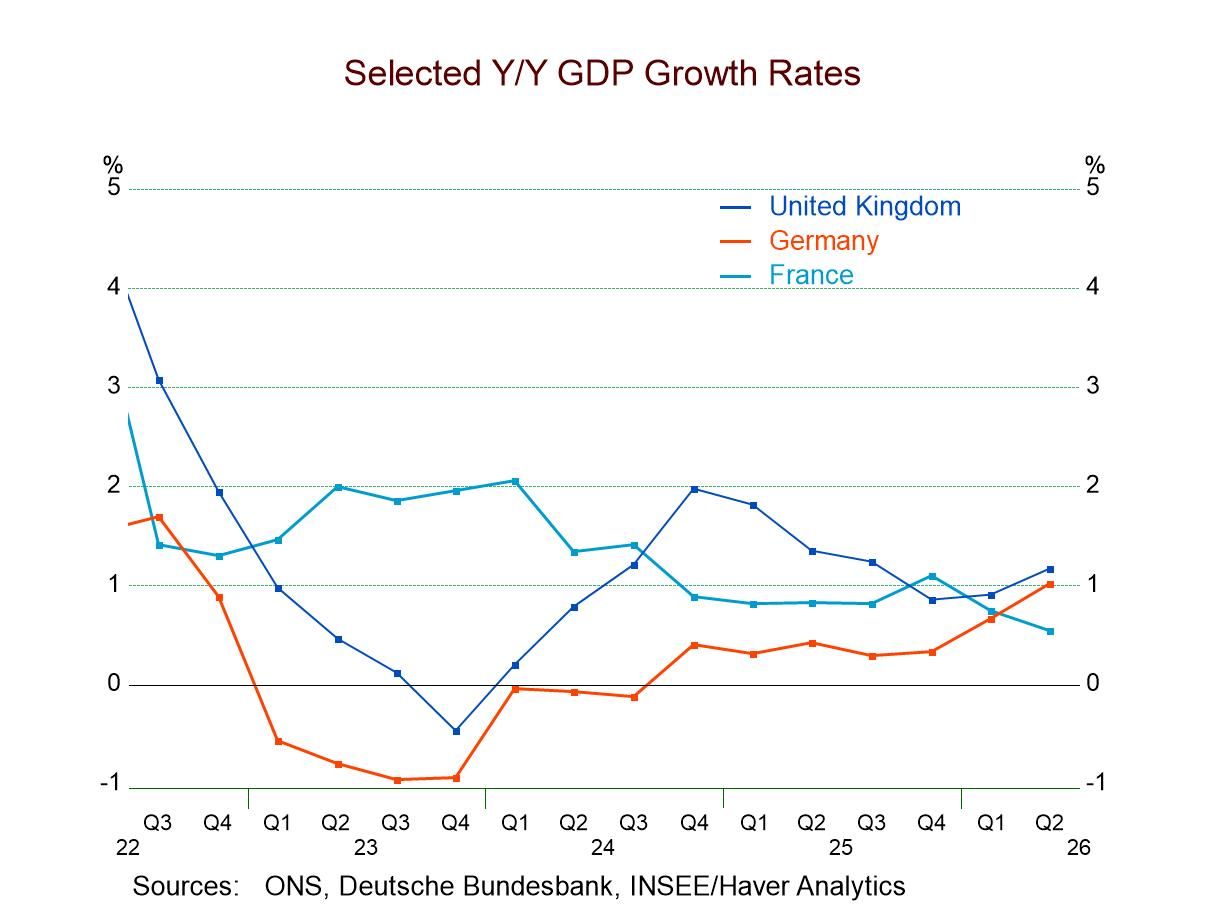
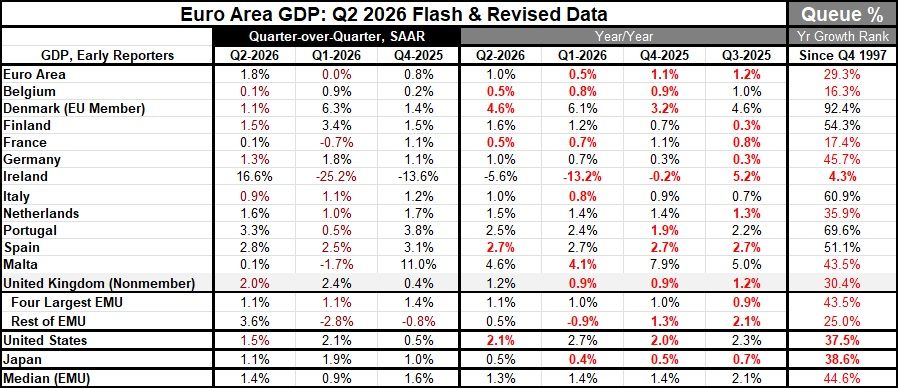
Growth among the eleven reporting EMU countries continues to be mixed. Growth in EMU is stable enough but modest at 0.5% to 1.2% over four quarters when assessed over the last four quarters. Quarterly results are more volatile, of course. Median annual growth is 1.3% to 2.1%.
Mixed Result on Growth In Q2, five of these eleven countries showed lower growth based on annualized quarter changes, while three showed weaker growth quarter-to-quarter based on four-quarter rates of growth. Belgium, Denmark, and France were weaker based on four-quarter growth rates. Growth in Spain was unchanged at 2.7%. Danish growth slowed to 4.6% from 6.1%.
Assessing Rates of Growth The change in growth rate assessment is useful but never quite definitive, as you can see from the still-strong, although slower, Danish pace of growth. 4.6% is less than 6.1%, but it is still quite strong, hardly a problem. Similarly, Ireland shows better growth, but that is an ‘improvement’ to -5.6% from -13.2%, an improvement and a sharp one, but still chillingly weak. Of course, Ireland, with a preponderance of multinational corporations headquartered there, shows some accounting fluctuations that are not that representative of a real macroeconomic impact on the Irish economy but can have a big impact on reported GDP. Ireland logs the only negative growth rate in the monetary union over four quarters, with Belgium the next weakest at 0.5%, and Germany and Italy at 1%.
The Big Four Economies The four largest EMU countries with GDP pooled have run an annual growth that has been quite steady around the 1% mark (0.9% to 1.1%). The rest of the EMU has had a more volatile growth rate. Pooling the remaining countries’ GDP performance yields growth rates over fourth quarters ranging from -0.9% to +2.1% over the last four quarters.
Within EMU The table chronicles growth rates for 11 EMU members plus the United Kingdom, the United States, and Japan. Among these 14 countries, year-over-year growth rates on data back to 1998 show only five countries with GDP growth rates ranking over four quarters above 50%; rankings above 50% put them above their median for that period. Those five countries are Spain, Finland, Italy, Portugal, and Denmark. While Spain and Italy have rankings above their medians for the period, German growth ranks at only 45.7%, and French growth is quite weak at a 17.4 percentile standing, marking a split in performance among the Big Four economies.
German GDP trends higher, U.K. waffles, and French trends continue to deflate.
Other Considerations Growth in the EMU is uneven across the community, and inflation has begun to rise with Germany recently showing an adverse uptick to 2.9% from 2.8%. Conditions in the Middle East regarding the Strait of Hormuz are impacting growth, inflation, and the outlook; conditions are still touch and go. While it is still August, colder weather is coming and LNG supplies are going to be very important for winter in Europe. Weather has been a factor with drought conditions again sapping many important European rivers of their lifeblood flow, causing ships and barges to either run with lighter loads or not at all. In a number of cases, European nuclear facilities were run at a slower pace; some were shut completely because river flows were so low and river temperatures were too high to permit cooling at full capacity.
Between nature and geopolitics, conditions remain uneven and that extends to the outlook. International relations are strained as well, and Russia has been creating mischief and trying to unnerve NATO members with threats of broadening the war in Ukraine. All in all, it is a difficult picture and one of considerable instability on offer. The shake-out in the Middle East will be important for inflation and the evolution of energy prices and more. The outlook is in flux.

Robert Brusca
AuthorMore in Author Profile »Robert A. Brusca is Chief Economist of Fact and Opinion Economics, a consulting firm he founded in Manhattan. He has been an economist on Wall Street for over 25 years. He has visited central banking and large institutional clients in over 30 countries in his career as an economist. Mr. Brusca was a Divisional Research Chief at the Federal Reserve Bank of NY (Chief of the International Financial markets Division), a Fed Watcher at Irving Trust and Chief Economist at Nikko Securities International. He is widely quoted and appears in various media. Mr. Brusca holds an MA and Ph.D. in economics from Michigan State University and a BA in Economics from the University of Michigan. His research pursues his strong interests in non aligned policy economics as well as international economics. FAO Economics’ research targets investors to assist them in making better investment decisions in stocks, bonds and in a variety of international assets. The company does not manage money and has no conflicts in giving economic advice.
More Economy in Brief
 Global