Economy Watchers Indexes Show Firmness; Impact of Takaichi Election to Come in Months Ahead
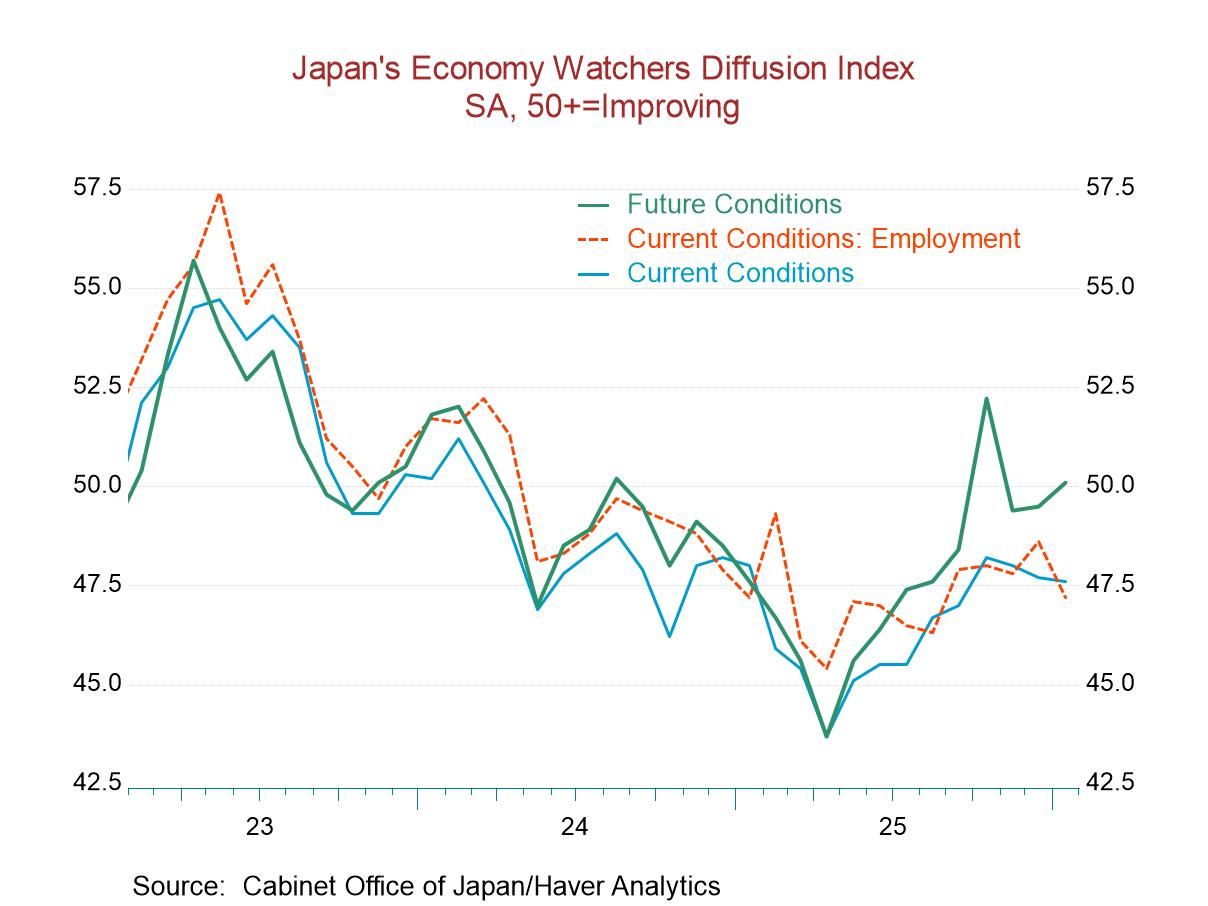
Japan's economy watchers index has flattened out and backed off slightly for the current and future outlooks depending on the time horizon that you seek. However, what's clear is that the index reached the low point around the middle of last year, has been rebounding and now the rebound has either run out of gas or slowed after the index has rebuilt itself considerably.
It is certainly too early to get pessimistic on Japan's economy, with Prime Minister Sanae Takaichi having just won a significant - essentially a landslide - snap election that she called after recently having been elected. The LDP would appear to be back in the driver's seat, and she has her sights set on more fiscal stimulus and expanded military spending. She is apparently much more on the same wavelength as Donald Trump in the United States. Mr. Trump was an Abe supporter, and Ms. Takaichi is a disciple of Mr. Abe.
At the moment, Japan would seem to have a groundswell of support behind the government and that government is set to try to rekindle some growth which could potentially put the Bank of Japan in a more decisively defensive track as far as setting rates and potentially raising rates.
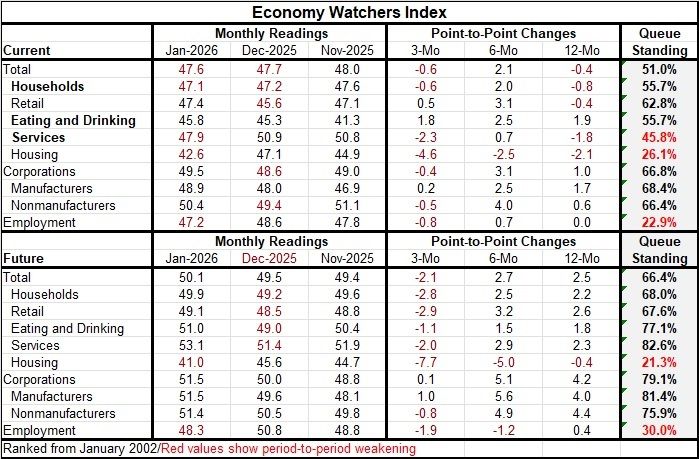
Economy watchers index is trending In January, the economy watchers index backed off for the second month in a row. However, it still has a percentile standing in its 51-percentile, slightly above its median standing since early-2005. The headline and all the components have standings above their respective 50th percentiles on this timeline, with the exception of housing, services, and employment; three readings that are extremely important to consumers. Housing has a 26.1 percentile standing, services (the employment sector) have a 45.8 percentile standing, while employment has a 22.9 percentile standing. Despite the otherwise solid and strong set of readings, there are these three significant flies in the ointment. Corporate Japan is doing extremely well with corporations having a 66.8 percentile standing; manufacturers and nonmanufacturers, separately, each come in with readings in their mid-to-upper 60th percentiles.
The future index The future readings from the economy watchers index show continued but slight increases over the last few months. Only two future readings weaken month-to-month: housing and employment—once again two key readings as far as consumers are concerned. However, in terms of current monthly diffusion readings, the assessment of households, retailing, housing, and employment all have current diffusion values below 50, indicating net declines rather than increases. The percentile standing is for the future index are, like those for the current index, generally upbeat - and generally stronger than for the current indexes - with the future headline posting a 66.4 percentile standing in January. However, like the current index, the standing for housing is at its 21.3 percentile and the standing for employment is at its 30th percentile, both well below the neutral level that would place the ranking at the 50th percentile. Corporations show high readings, higher for the future indexes than for the current index standings. There also are high readings and standings for eating and drinking places as well as services. It's good to see services come up with a strong rating since it creates hope for the future for employment because services are the core employment sector. It will be interesting to see how this value changes in the coming months as Takaichi’s new policies are implemented and take hold.
Summing up On balance, the economy watchers index has been firm to strong. There is some slight give-back in the current index in terms of trend. But beyond the index, there's more immediate reason to be more positive because Japan has just executed a very decisive and pro-growth snap election that is going to put the new Prime Minister Takaichi and strong control of the economy at a time where she seeks to cement economic strength. These elections were just completed over the weekend, and we will see the results reflected in data in the weeks and months to come.

Robert Brusca
AuthorMore in Author Profile »Robert A. Brusca is Chief Economist of Fact and Opinion Economics, a consulting firm he founded in Manhattan. He has been an economist on Wall Street for over 25 years. He has visited central banking and large institutional clients in over 30 countries in his career as an economist. Mr. Brusca was a Divisional Research Chief at the Federal Reserve Bank of NY (Chief of the International Financial markets Division), a Fed Watcher at Irving Trust and Chief Economist at Nikko Securities International. He is widely quoted and appears in various media. Mr. Brusca holds an MA and Ph.D. in economics from Michigan State University and a BA in Economics from the University of Michigan. His research pursues his strong interests in non aligned policy economics as well as international economics. FAO Economics’ research targets investors to assist them in making better investment decisions in stocks, bonds and in a variety of international assets. The company does not manage money and has no conflicts in giving economic advice.
More Economy in Brief
 Global