Consumer Confidence: Modest Change in April
Summary
- Expectations improved slightly in April, but are still subdued relative to norms.
- Moderately favorable view of current conditions.
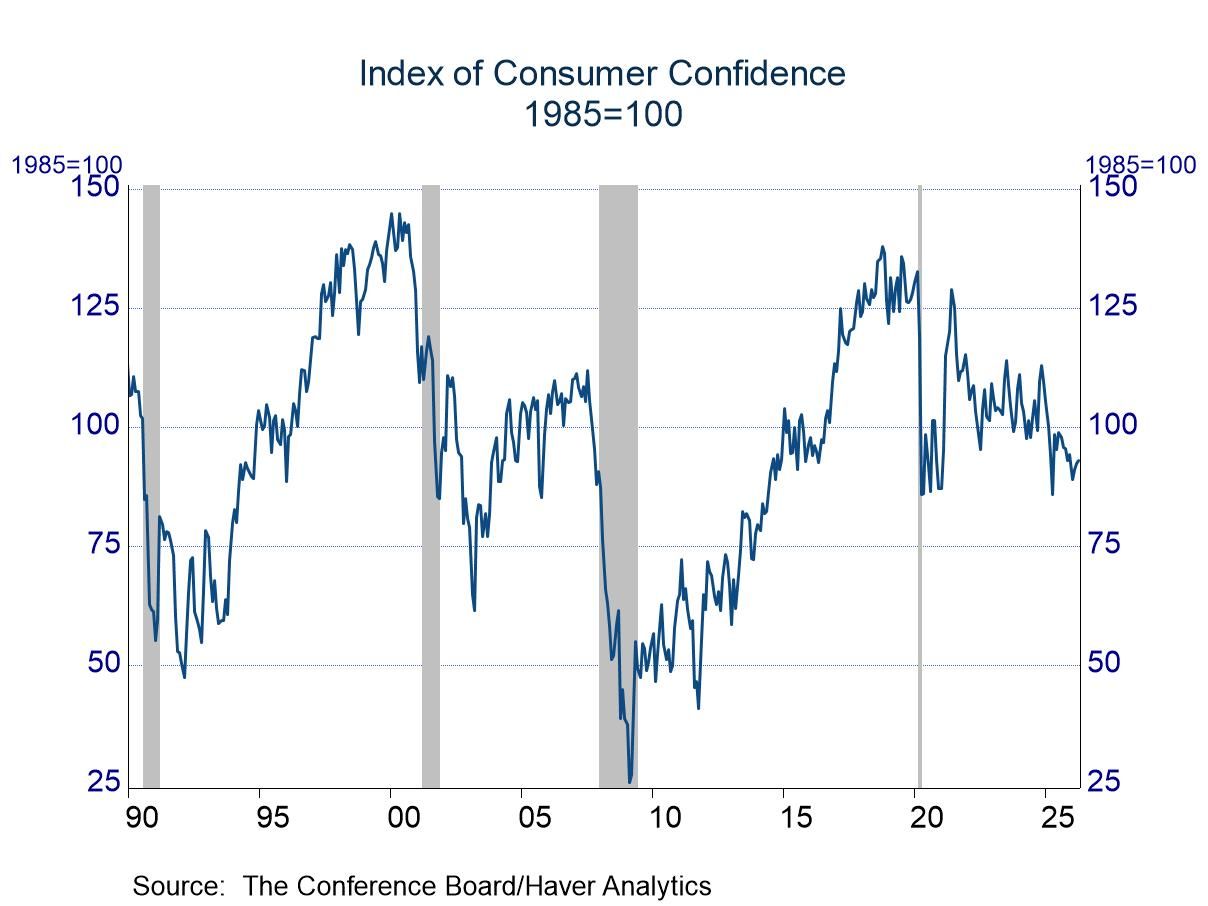
The Conference Board’s index of Consumer Confidence inched higher in April from an upwardly revised reading in March. The combined changes left the measure 1.1% higher than the preliminary tally in March. Despite the improvement, the index remained in the low end of the range for the current expansion. The index in April totaled 92.8, down from an average of 96.1 in 2025 and an annual cyclical high of 105.4 in 2023.
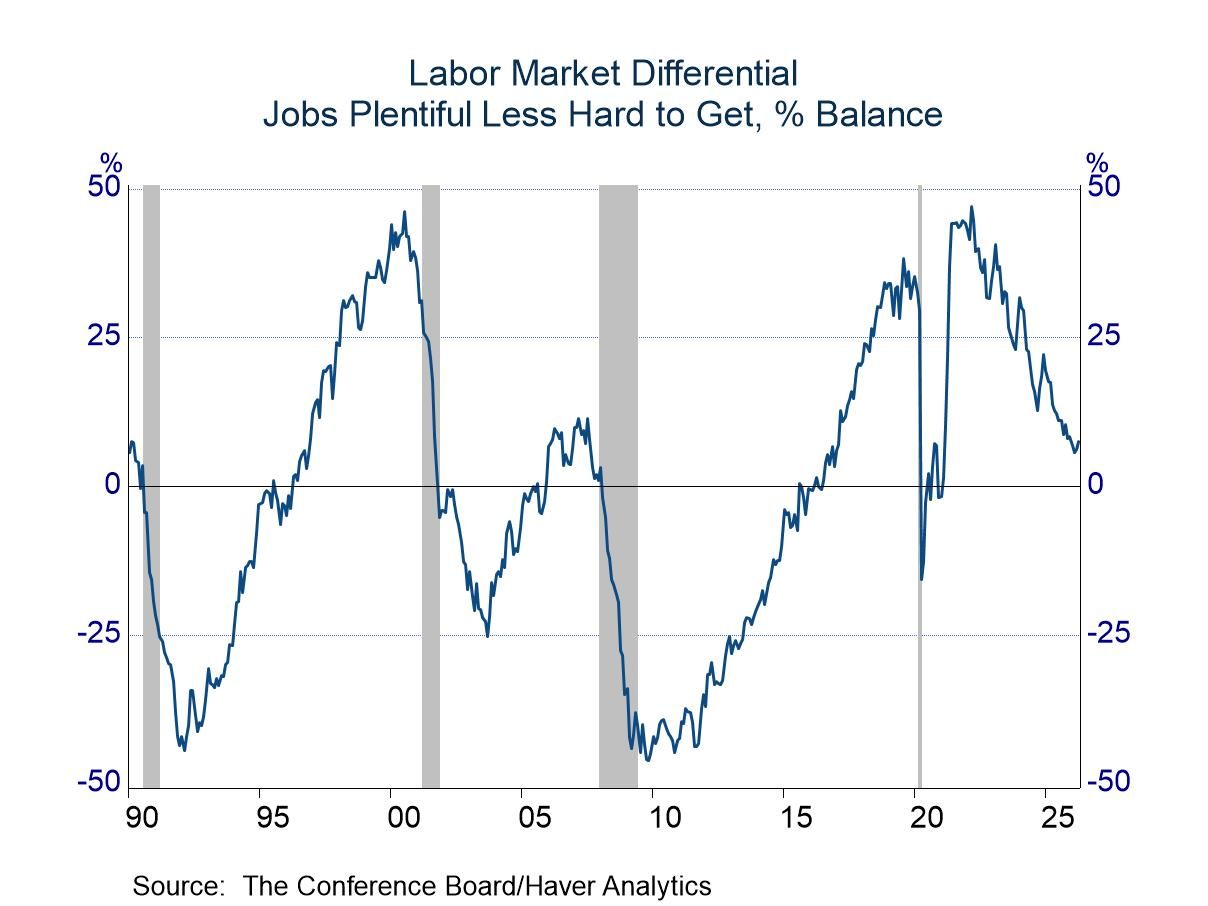
The Improvement in April reflected a pickup in the expectations component, which rose 1.7%. The current conditions component inched 0.2% lower. Overall views on current conditions slipped despite more favorable assessments of the labor market. The so-called measure of the jobs gap (share of respondents indicating that jobs are plentiful less the share saying that jobs are hard to get) rose 1.4 percentage points higher to 7.5%. The pickup reflected a drop in the share indicating that jobs are hard to get (down 1.5 percentage points to 19.8%). The share indicating that jobs are plentiful eased 0.1 percentage point to 27.3%.
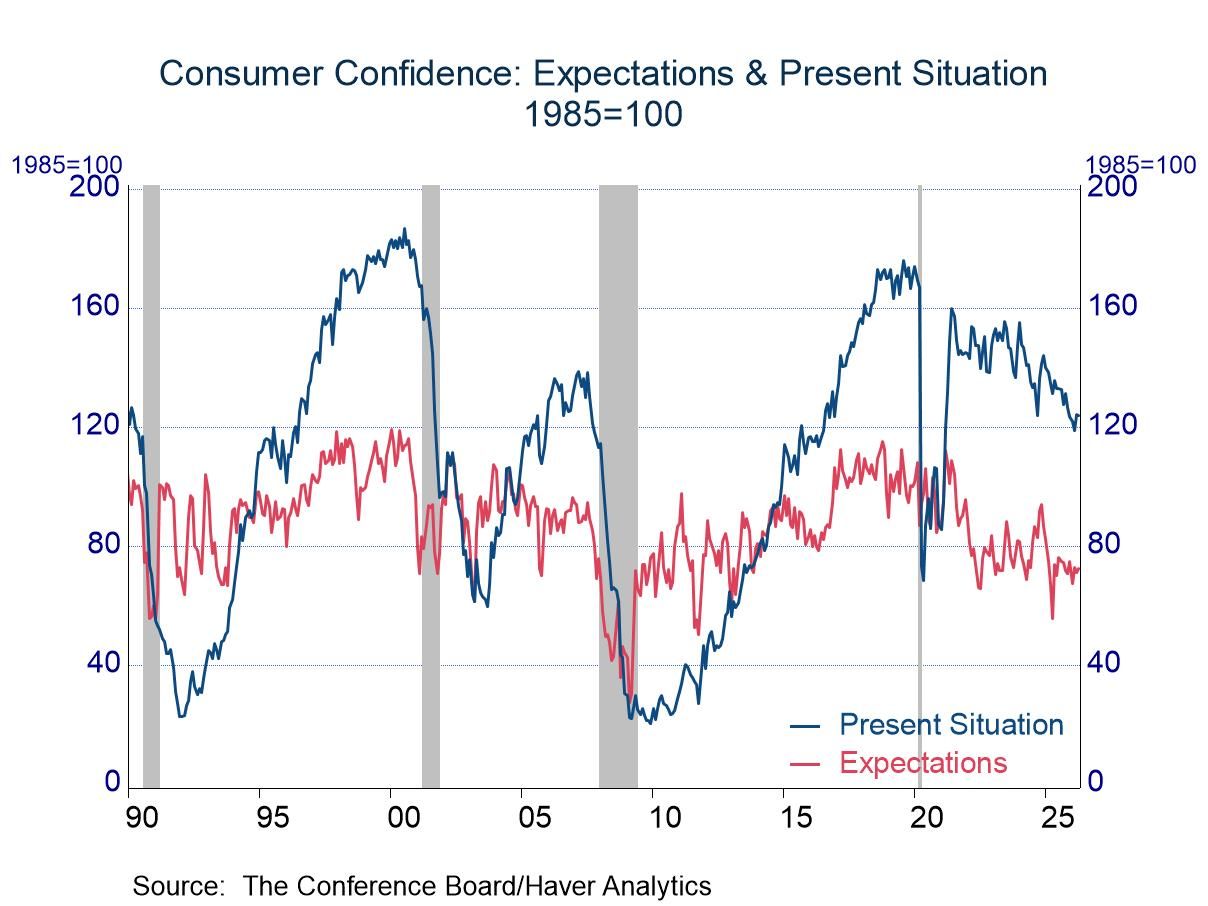
Although expectations improved in April, from a long-term perspective they could be viewed as the more important factor restraining the headline measure of confidence. As shown in the left chart below, the expectations component of confidence shows considerably less volatility than the current conditions component does. The contrasting patterns suggest that individuals realize that the economy will undergo possibly sharp cyclical swings, but they expect conditions at some point to return to an underlying norm.
The current conditions index in the current cycle has indeed dropped noticeably, but it is still above the long run average (123.8 in April versus the average of approximately 108 from 1990 to 2025). The expectations component, as usual, has eased less than the current conditions component, but its shift has pushed the measure to the low end of its long-run range (72.2 in April versus an average of approximately 88).
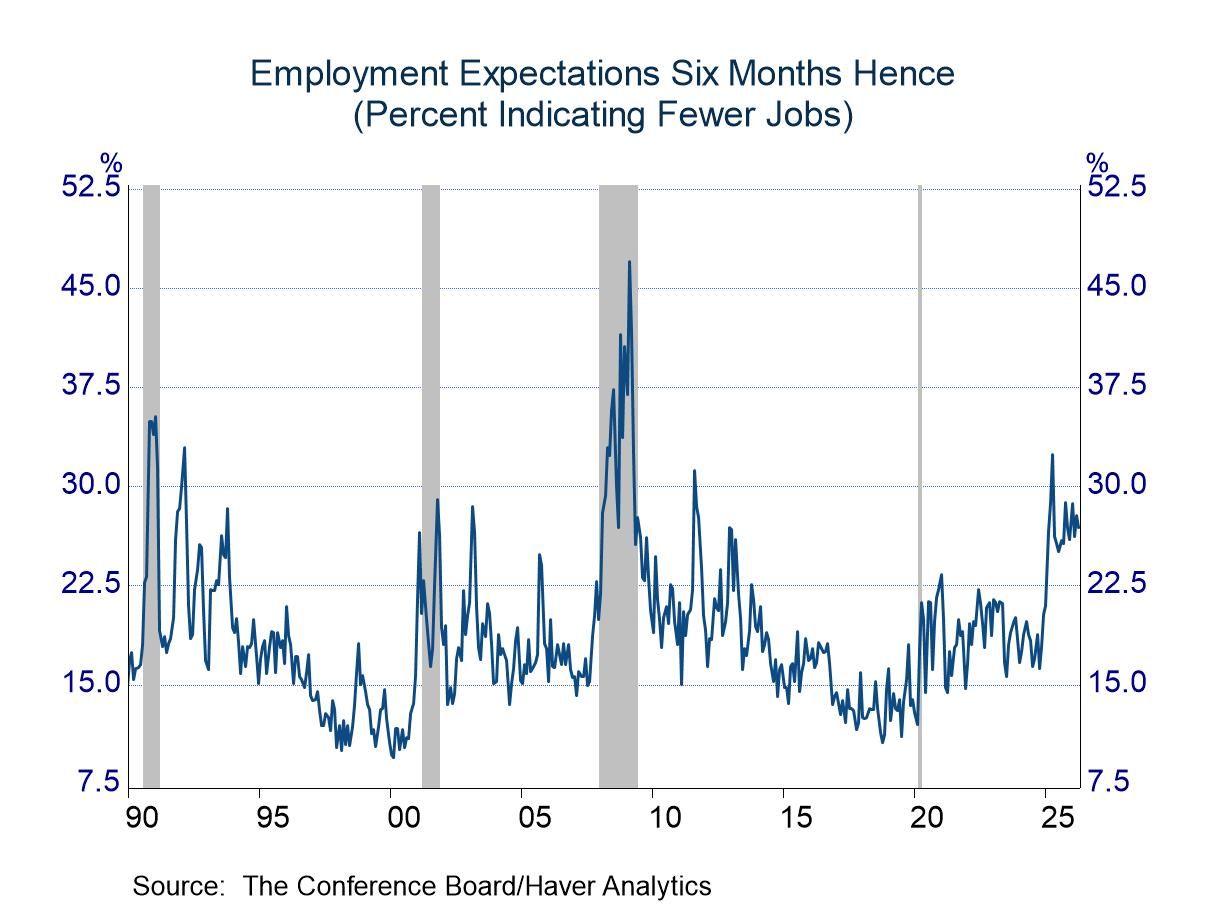
Interestingly, concern about the labor market seems to be a factor affecting expectations. While current views on the labor market are favorable (plentiful less hard to get jobs gap of 7.5%), Individual are concerned about the future. The survey asks respondents if they expect more jobs or fewer jobs six months hence. The share indicating fewer jobs has moved well into the upper end of the historical range. Such observations in the past were typically seen only during recession (chart, below right). An unfavorable view on interest rates also seems to be playing a role in depressing the expectations component. More than 60% of respondents to the current survey expect higher interest rates 12 months from now.
The results from the Conference Board survey of consumers differ markedly from those of the University of Michigan Survey Research Center. The Michigan results show consumer sentiment at a record low, while the Conference Board index is only slightly below its long-run average. The difference most likely reflects the nature of the questions in the surveys. The Conference Board focuses on business and employment conditions, while Michigan emphasizes personal finances. The focus on finances, along with questions on inflation, probably picks up concerns about affordability.
The Consumer Confidence data are available in Haver’s CBDB database. The total indexes, which are indexed to 1985=100, appear in USECON, and market expectations are in AS1REPNA.

Michael J. Moran
AuthorMore in Author Profile »Before joining Haver Analytics in 2025, Michael J. Moran was the chief economist of Daiwa Capital Markets America Inc. He was responsible for preparing the firm’s economic forecast and interest rate outlook. He traveled frequently to visit the clients of Daiwa Capital Markets and wrote weekly economic commentary. Mr. Moran also was involved in the flux of financial markets, as he spent a portion of each day on Daiwa’s trading floor interpreting economic statistics and Federal Reserve activity for traders and salespeople. Mr. Moran is quoted frequently in the financial press, and he appears regularly on cable news shows. He also has published articles in several journals and periodicals. Before joining Daiwa Capital Markets America, Mr. Moran worked as an economist at the Federal Reserve Board in Washington, D.C. where he analyzed a broad range of issues dealing with the financial sector of the economy and regularly briefed the Board of Governors. He was on the faculty of Pennsylvania State University from 1979 to 1980 and taught on a part-time basis at George Washington University from 1980 to 1987.
Mr. Moran received his Ph.D. in economics from Pennsylvania State University in 1980 and a B.S. in business administration from the University of Bridgeport in 1975. He was a CFA charter holder from 2002 until 2016.
More Economy in Brief
 Global