Canada’s Industrial Orders Falter
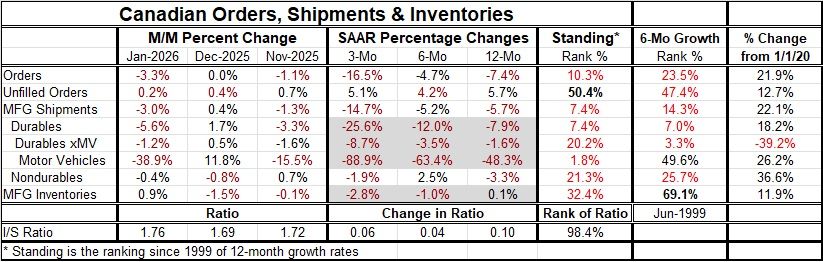
Canadian orders fell by 3.3% in January after running flat in December and falling by 1.1% in November.
The top-line sequential growth in orders shows contraction over 12 months, six months, and three months, with the pace of contraction having gotten more severe over the most recent three months.
In January, orders declined, while unfilled orders rose but decelerated from their December growth rate. Manufacturing shipments fell, durables shipments fell, durable shipments excluding motor vehicles fell, and motor vehicle shipments fell. In addition, nondurables orders declined in January although at a lesser pace than in December. Among this key batch of industrial statistics, only manufacturing inventories rose in January, increasing by 0.9%.
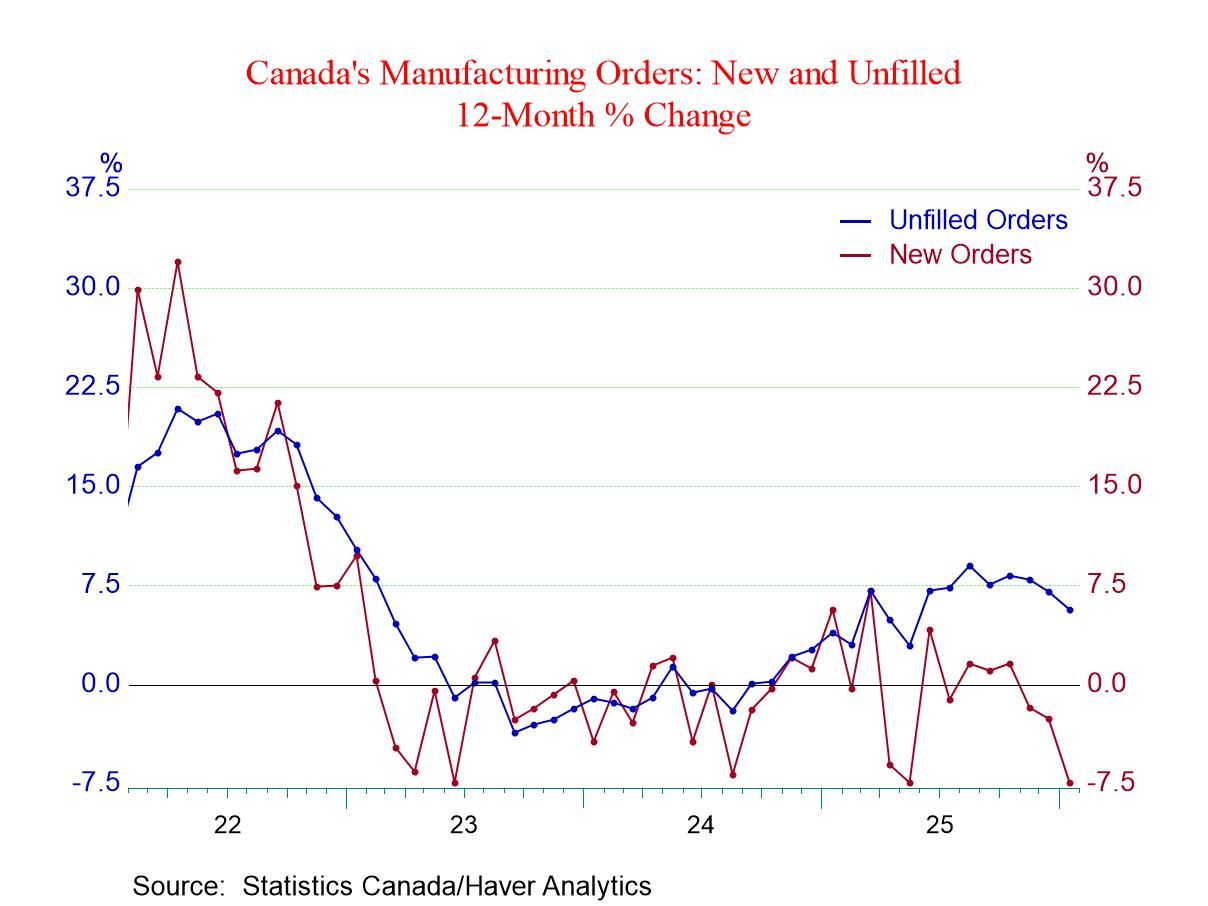
Progressive growth rates from 12 months to six months to three months show progressively weaker growth in shipments of durable goods, durables excluding motor vehicles, and motor vehicle shipments themselves. Inventories are also shrinking, and at a progressively faster pace over shorter periods. The headline series for orders shows a 16.5% annual rate contraction over three months, compared with a contraction pace of 7.4% over 12 months. There is no sign of stabilization in orders, and this shows up plainly in the data or on the chart.
The column heading marked “standing” shows that the standings of all the items listed in the stub are below 50%, placing each entry below its median based on data back to 1999. Judging from 12 month growth rates, the only exception is unfilled orders, which are right at the 50.4 percentile mark. For the most part, the shortfalls from their respective medians are quite severe, with the low standings for manufacturing shipments and durable goods shipments at 7.4%, out done only by a 1.8 percentile standing for motor vehicle shipments growth. The table also ranks the categories on six month growth rates, providing a slightly shorter term view to see how much conditions improve. On that basis, and viewed in that way, most of the rankings do improve. In fact, all rankings improve compared to the year over year growth rate rankings except for three: unfilled orders, durable goods shipments, and durable goods shipments excluding motor vehicles.
The six-year growth from January 2020 to date shows declines in real terms (inflation-adjusted net changes) for unfilled orders, durable goods shipments, durables shipments excluding motor vehicles, and inventories of manufactured goods. Increasing on balance over six years are orders and total manufacturing shipments, but by very thin margins. Motor vehicle shipments are up by 0.7% in real terms over six years, while nondurables shipments are up by 2.1% on balance over the same period. It has been a very difficult period for industry to cope with the strains from COVID, the war in the Ukraine, and more recently, the imposition of tariffs by the United States.

Robert Brusca
AuthorMore in Author Profile »Robert A. Brusca is Chief Economist of Fact and Opinion Economics, a consulting firm he founded in Manhattan. He has been an economist on Wall Street for over 25 years. He has visited central banking and large institutional clients in over 30 countries in his career as an economist. Mr. Brusca was a Divisional Research Chief at the Federal Reserve Bank of NY (Chief of the International Financial markets Division), a Fed Watcher at Irving Trust and Chief Economist at Nikko Securities International. He is widely quoted and appears in various media. Mr. Brusca holds an MA and Ph.D. in economics from Michigan State University and a BA in Economics from the University of Michigan. His research pursues his strong interests in non aligned policy economics as well as international economics. FAO Economics’ research targets investors to assist them in making better investment decisions in stocks, bonds and in a variety of international assets. The company does not manage money and has no conflicts in giving economic advice.
More Economy in Brief
 Global