Belgian Consumer Confidence Up and Strong; Fear of Unemployment at 35-Year Low! Is That Possible?
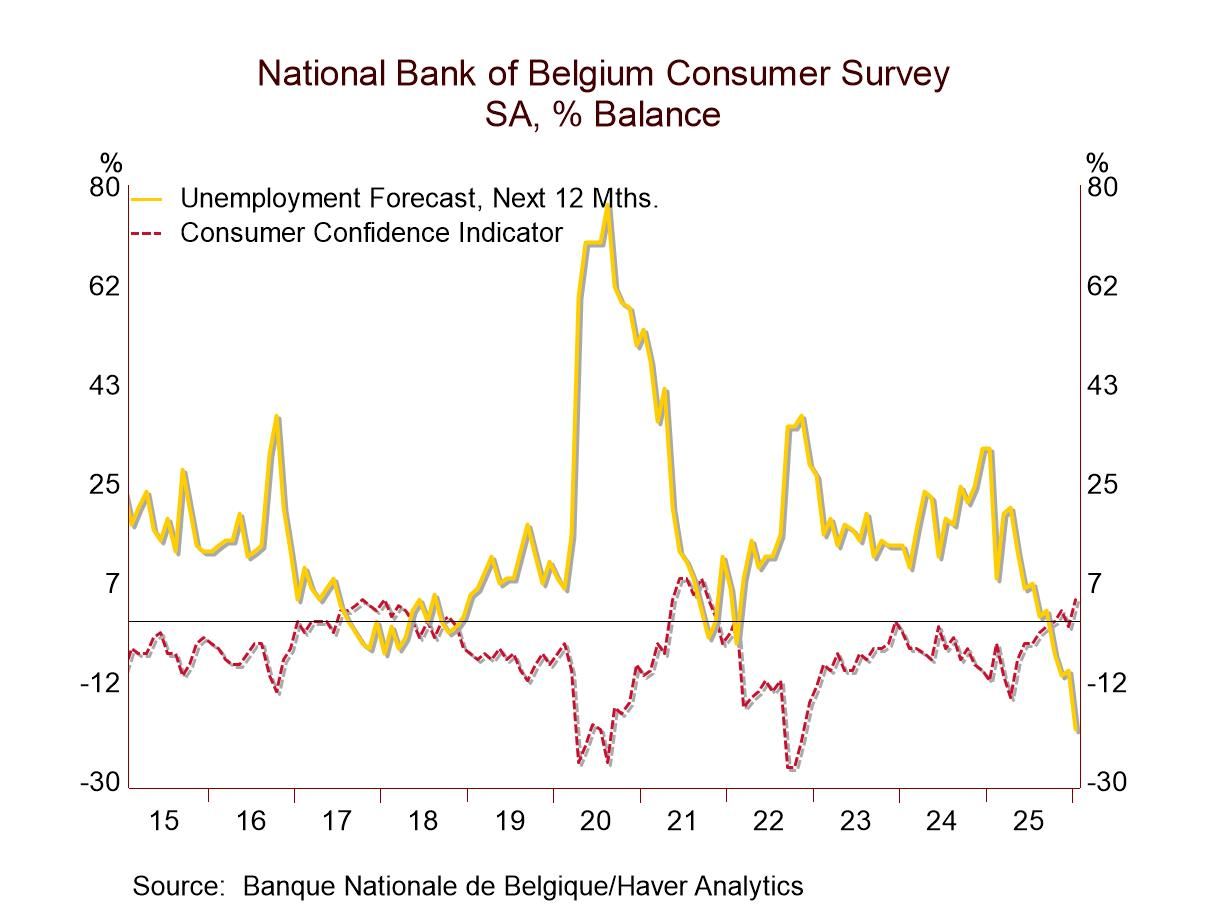
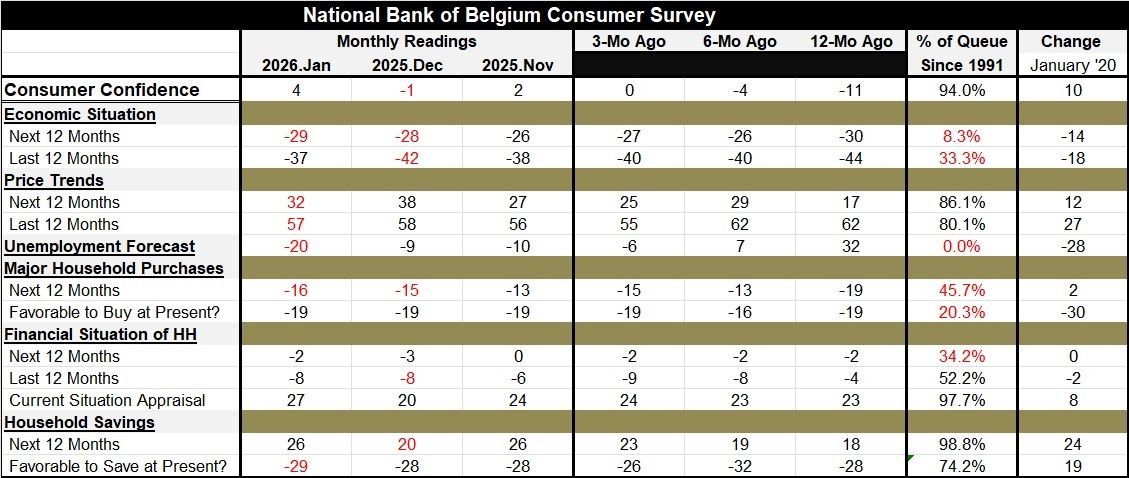
The National Bank of Belgium index for January 2026 rose to +4 from -1 in December, stronger than its November 2025 reading of +2. The survey value is exceptionally strong, lying in the top 6% of all observations back to 1991, even as the survey contains significant variations that range from strong to quite weak across its various components. What is most notable is that the index itself is extremely high-ranking; the current situation appraisal is also quite high-ranking; and, that the forecast for unemployment embedded in this survey is at a 35-year low. Considering current circumstances, against the events of the last 35 years, that's a rather remarkable finding especially considering the world situation.
The times, they are a changin’ was Dylan 50 years early? These have been remarkable times in a number of different ways with a clear transition from the circumstances of the post-war period under way. The solidarity of the NATO alliance is clearly in a situation in flux, revealed since Russia invaded Ukraine. Prior to that, the Europeans had resisted putting more money into the NATO pot as the United States had been frantically asking them while it funded most of the security umbrella. Now, in the wake of these new events, and with the changes to the global stage wrought by climate shifting, the U.S. finds Greenland to be a more important piece on the geopolitical chess board and wants to have more say there in order to protect its own flank as Arctic ice packs recede. This is after a period when NATO basically failed to engage in the front-line protections of its own doorstep that the U.S. had thought were necessary. Not surprisingly, the U.S. found that whole episode unsatisfactory and is now reluctant to give up control to NATO of what it regards as the protection of its own back door for the area around Greenland. But at last, Europe and the U.S. appear to have a deal or the makings of one, so, stay tuned. Maybe all civility is not lost.
Geopolitical shifts meld with economic issues to change the landscape Geopolitical shifts are part of the problem because geopolitics and economics help shape one another. And there has been a great deal of economic turmoil as well. The U.S., after reassessing the Post War order, is bringing back to life tariffs, in order to try to get economic leverage after running 33 consecutive years of current account deficits under what people want to call a free trade system. The U.S. finds itself with a still very overvalued dollar and in a situation where its current account deficits are poised to continue to run high and perhaps get higher. Economists say tariffs are not the solution, but maybe they ARE the wake-up call that will lead to a solution? Europeans have also shifted to embracing a larger and larger government sector and ever larger fiscal deficits and more fiscal debt while absorbing migrants. This is constraining its ability to have any kind of a flexible macroeconomic policy and is a severe problem already for the U.K. and France. And these changes are wreaking havoc with what has been a very solid post-war Atlantic alliance.
Views change But the changes that the U.S. has pushed on to the system from its geopolitical adventurism to its use of tariffs and other strong rhetorical comments have led economists to focus on the elevation of uncertainty in the economic system. Elevating uncertainty has an adverse impact on the economy and on growth. I mentioned this with the obvious caveat that this warning by economists seems to have been completely wrong. U.S. growth has turned out to be quite resilient and even strong. It is not the only adamant position that has proved to be wrong and malleable. Despite the reality of climate change, the view that once took carbon as the main and unequivocal climate change agent, itself is shifting. Opposition to carbon has dwindled, more as the U.S. is embracing nuclear power. Artificial intelligence is becoming a strong bet for stronger growth in the future, and this explains why there have been so many shifting views on energy since artificial intelligence requires massive amounts of energy and would make it impossible to make progress on carbon and to push ahead with the AI agenda at the same time. So, instead of delaying AI, the view on carbon had to go. So much for ‘science.’
Why are Belgians so satisfied? The finding that in Belgium consumer confidence has risen sharply in this environment and fears of unemployment are the lowest they've been in 35 years is another shocking development in this pantheon of incredible and shocking changes. As the above discussion points out, a lot is changing and NATO is at odds with the U.S., its lynchpin. Yet, there is no clear increase in uncertainty in Belgium, while they maybe more in Brussels.
The Belgian Survey: strong despite waffles Belgians do not read the economic situation over the next 12 months as that strong at a reading of -29 on the survey; it has weakened over the last few months, and the economic situation assessment is only at its 8.3 percentile, an extremely weak standing. Price trends are the opposite; they have eased somewhat in the recent months, but over the next 12 months the assessment still has a top 14-percentile evaluation. It is in this context that the unemployment forecast, which is the lowest in 35 years, emerges as surprising. The environment to make major household purchases over the next 12 months is only a mid-range at a 45.7 percentile standing. And people rate their financial situation over the next 12 months slightly better than at the end of last year but at only a 34.2 percentile standing. However, the appraisal of the current situation moved up sharply in January and has a 97.7 percentile standing, which is extremely strong.
Low unemployment fear spurs confidence The reason for consumer confidence to be strong is clear when you see how low concerns are about unemployment. But it's hard to understand why concerns about unemployment are so low with the rest of the economic metrics so varied in the survey. This is especially true with Belgium nestled in the heart of Europe and all of these concerns between the U.S. and NATO swirling around as well as a still very hot war occurring on Europe's border between Ukraine and Russia. Meanwhile, the U.S. position about this war continues to seem to back Ukraine a lot less than it should.
Belgium is a good bellwether The Belgian survey is not the most important bit of economic activity. Belgium is not an extremely important country in Europe, although it's in the heart of the European Union, a member of the European Monetary Union, linked closely to Germany, and to other key European economies through trade, so that its performance likely is a good reflection of what's going on in Europe. It is not a European border country. It is in the heartland of Europe. That may explain a little bit why Belgians are not perhaps as nervous as Poles, are or Finns or the small Baltic countries, and others, with potentially more border proximity and vulnerability to the Russia-Ukraine conflict.
Belgian optimism flies in out of the blue This is an observation. I think it's the kind of observation in this world economy that we find striking and unusual and will bear some further watching and some watching of other similar readings in Europe to see if there's evidence that there's some kind of new resilience that we might have missed. Economists seem hung-up broken-record style on uncertainty. Certainly, there's something here that economists have missed who have only seen these new actions by the U.S. as creating more uncertainty since we do not know what the new Greenland deal is. And uncertainty should create more adversity for growth except that it hasn't worked out that way. And it's a reminder that separating economics from geopolitics may take more than a crowbar. And also that uncertainty comes in many shapes and sizes while some may argue that there still is not a Greenland deal, what we see is a lowering of the temperature, a calming of the rhetoric and a sense that the parties have a horse trade they think they can do to resolve their differences. And while there is still uncertainty, there is also clear progress and a clear reduction in risk. Still, the times are changing.

Robert Brusca
AuthorMore in Author Profile »Robert A. Brusca is Chief Economist of Fact and Opinion Economics, a consulting firm he founded in Manhattan. He has been an economist on Wall Street for over 25 years. He has visited central banking and large institutional clients in over 30 countries in his career as an economist. Mr. Brusca was a Divisional Research Chief at the Federal Reserve Bank of NY (Chief of the International Financial markets Division), a Fed Watcher at Irving Trust and Chief Economist at Nikko Securities International. He is widely quoted and appears in various media. Mr. Brusca holds an MA and Ph.D. in economics from Michigan State University and a BA in Economics from the University of Michigan. His research pursues his strong interests in non aligned policy economics as well as international economics. FAO Economics’ research targets investors to assist them in making better investment decisions in stocks, bonds and in a variety of international assets. The company does not manage money and has no conflicts in giving economic advice.
More Economy in Brief
 Global