

Again, with the elimination of the government's program to stimulate housing, the sector's activity fell. June housing starts dropped another 5.0% m/m to 549,000 (AR) after a 14.9% May drop that was deeper than reported initially. The [...]
Introducing
Tom Moeller
in:Our Authors
Prior to joining Haver Analytics in 2000, Mr. Moeller worked as the Economist at Chancellor Capital Management from 1985 to 1999. There, he developed comprehensive economic forecasts and interpreted economic data for equity and fixed income portfolio managers. Also at Chancellor, Mr. Moeller worked as an equity analyst and was responsible for researching and rating companies in the economically sensitive automobile and housing industries for investment in Chancellor’s equity portfolio. Prior to joining Chancellor, Mr. Moeller was an Economist at Citibank from 1979 to 1984. He also analyzed pricing behavior in the metals industry for the Council on Wage and Price Stability in Washington, D.C. In 1999, Mr. Moeller received the award for most accurate forecast from the Forecasters' Club of New York. From 1990 to 1992 he was President of the New York Association for Business Economists. Mr. Moeller earned an M.B.A. in Finance from Fordham University, where he graduated in 1987. He holds a Bachelor of Arts in Economics from George Washington University.

Publications by Tom Moeller
 Global| Jul 20 2010
U.S. Housing Starts Fall Again After Tax Incentive Expires
by:Tom Moeller
|in:Economy in Brief
It had been a weak housing market recovery anyway, but the National Association of Home Builders reported that their index of housing market activity fell back this month to 14, the lowest level since March 2009. Perhaps this is the [...]
by:Tom Moeller
|in:Economy in Brief
- Global| Jul 19 2010
New NABE Survey Indicates Pace of Business Recovery Eases But Job Creation Improves
In their latest report, the Nat'l Association for Business Economics indicated that net industry demand increased during 2Q for the fourth consecutive quarter. There was a sign, however, of moderation in the rate of demand's expansion [...]
by:Tom Moeller
|in:Economy in Brief
- Global| Jul 16 2010
U.S. CPI: Broad-Based Declines For Third Straight Month
Broad-based weakness in pricing power continues to accompany moderate U.S. economic growth. The June Consumer Price Index fell 0.1% (+1.1% y/y) for the third consecutive monthly decline. During the first six months of this year prices [...]
by:Tom Moeller
|in:Economy in Brief
- Global| Jul 16 2010
U.S. Consumer Sentiment Falls Sharply
Consumer Sentiment
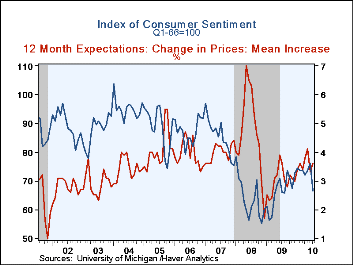 Consumers aren't upbeat about much these days. As of mid-July,
the University
of Michigan reported that its consumer sentiment measure dropped
sharply from
June to 66.5 which was the lowest reading since last August.
Nevertheless the
index level remained up 20.3% since the low in November 2008. During
the last
ten years there has been an 89% correlation between the level of
sentiment and
the y/y change in real consumer spending.
Consumers aren't upbeat about much these days. As of mid-July,
the University
of Michigan reported that its consumer sentiment measure dropped
sharply from
June to 66.5 which was the lowest reading since last August.
Nevertheless the
index level remained up 20.3% since the low in November 2008. During
the last
ten years there has been an 89% correlation between the level of
sentiment and
the y/y change in real consumer spending.The expectations index dropped sharply m/m but remained up a modest 12.4% from the 2008 low. The readings for expected business conditions during the next year (-5.8% y/y) and expectations for business conditions during the next five years (0.0% y/y) both fell sharply from June. Expectations for personal finances also fell hard from June (-6.4% y/y).
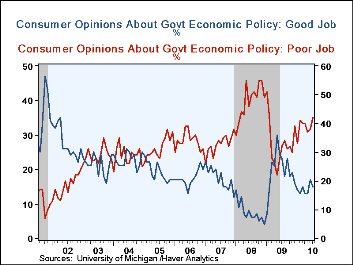
Expected price inflation during the next year ticked higher to 3.6% and remained up from the December 2008 low of 1.7%. Respondents' view of government policy, which may eventually influence economic expectations, retraced the gains of the prior two months and remained down sharply from its high last May. Fifteen percent of respondents thought that a good job was being done by government versus 42% who thought a poor job was being done.
Sentiment about current economic conditions also fell sharply from June to the lowest level since November. The assessment of current personal finances reversed its improvement (7.1% y/y) since February while perceived buying conditions for large household goods, including furniture, refrigerators, stoves & televisions fell hard to the lowest level since November (8.1% y/y).
The Reuters/University of Michigan survey data are not seasonally adjusted. The reading is based on telephone interviews with about 500 households at month-end. The summary indexes are in Haver's USECON database with details in the proprietary UMSCA database.
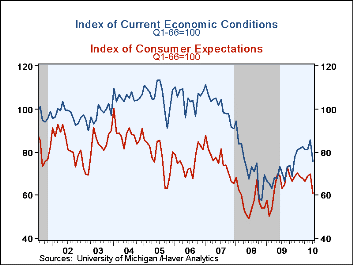
University of Michigan Mid- July June May June Y/Y 2009 2008 2007 Consumer Sentiment 66.5 76.0 73.6 0.8% 66.3 63.8 85.6 Current Economic Conditions 75.5 85.6 81.0 7.1 69.6 73.7 101.2 Expectations 60.6 69.8 68.8 -4.1 64.1 57.3 75.6 by:Tom Moeller
|in:Economy in Brief
- Global| Jul 16 2010
U.S. CPI: Broad-Based Declines For Third Straight Month
Broad-based weakness in pricing power continues to accompany moderate U.S. economic growth. The June Consumer Price Index fell 0.1% (+1.1% y/y) for the third consecutive monthly decline. During the first six months of this year prices [...]
by:Tom Moeller
|in:Economy in Brief
- Global| Jul 16 2010
U.S. CPI: Broad-Based Declines For Third Straight Month
Broad-based weakness in pricing power continues to accompany moderate U.S. economic growth. The June Consumer Price Index fell 0.1% (+1.1% y/y) for the third consecutive monthly decline. During the first six months of this year prices [...]
by:Tom Moeller
|in:Economy in Brief
- Global| Jul 16 2010
U.S. CPI: Broad-Based Declines For Third Straight Month
Broad-based weakness in pricing power continues to accompany moderate U.S. economic growth. The June Consumer Price Index fell 0.1% (+1.1% y/y) for the third consecutive monthly decline. During the first six months of this year prices [...]
by:Tom Moeller
|in:Economy in Brief
- Global| Jul 15 2010
U.S. Producer Prices Decline For Third Month, Again With Lower Food & Energy Costs
Pricing pressures at the wholesale level again diminished last month. A 0.5% decline in the June PPI was the third in a row that owed to consecutive declines in food & energy prices. The drop exceeded Consensus expectations for a 0.1% [...]
by:Tom Moeller
|in:Economy in Brief
- Global| Jul 15 2010
U.S. Weekly Initial Unemployment Insurance Claims Drop Sharply To Lowest Since 2008
Perhaps the job market is improving. Initial claims for jobless insurance fell last week to 429,000 following a decline during the prior week to 458,000. It was revised up from 454,000 claims. The latest figure was the lowest since [...]
by:Tom Moeller
|in:Economy in Brief
- Global| Jul 15 2010
Philadelphia Fed Index Suggests Further Economic Slowdown
The Philadelphia Federal Reserve Bank indicated that as the third quarter began, the U.S. economy's forward momentum waned. The Bank's July index of regional factory sector activity fell for the second straight month to 5.1, the [...]
by:Tom Moeller
|in:Economy in Brief
- Global| Jul 15 2010
U.S. Industrial Production Recovery Stutters
The recovery in industrial output ground to a halt last month. Overall production ticked up just 0.1 after a little-revised 1.3 May increase. But all of the latest increase was due to hot temperatures and higher utility output. In the [...]
by:Tom Moeller
|in:Economy in Brief


- of1081Go to 660 page