Global| Oct 20 2026
ZEW Survey Shows a Sharp Reduction in Inflation Concerns
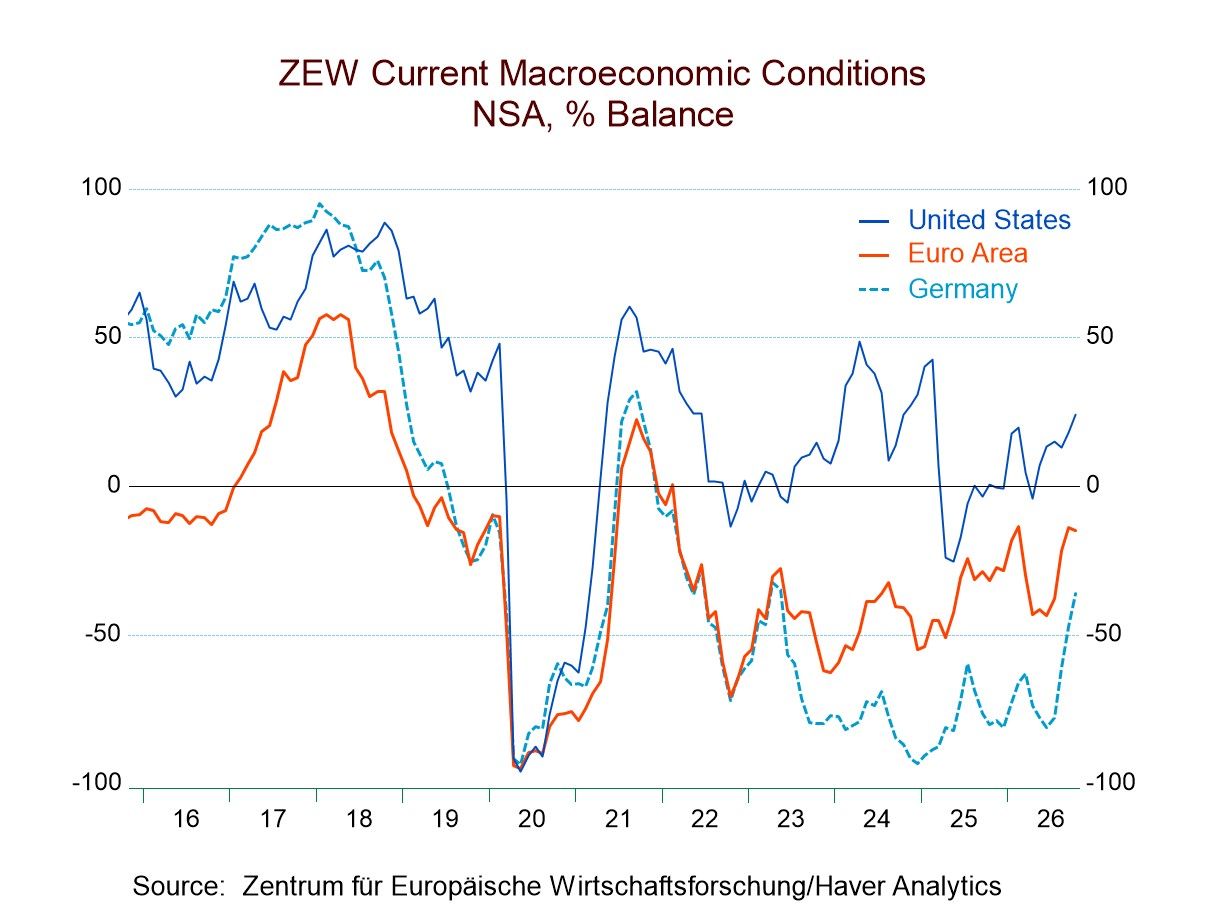
The current situation assessment is mixed To the ZEW experts, economic assessments of the current situation in October are split, with slight deterioration reported for the euro area as a whole and a two-point step-back for China. However, for Germany and the United States, there were significant improvements with the month-to-month diffusion indexes improving by 6 points in the U.S. and by 11 points in Germany. Ironically, both of the weakening areas, the euro area and China, have percentile standings above their historic medians, with China at a 76.1 percentile standing and the euro area at a 58.7 percentile standing. Germany and the U.S. show some strengthening month-to-month, but their standings are still below their historic medians. The German standing is at a 42.5 percentile and the U.S. standing is at a 46.2 percentile.
Economic expectations ease broadly Economic expectations, however, are unequivocally weaker across the reporting countries. There were declines in expectations in Germany of 6.6 points, in the U.S. of 5.3 points, and in China of 4.2 points; each of these three reporters shows a measurable slippage in October. Among the three countries showing slippage, only Germany continues to report economic expectations ranking above its historic median, at a standing of its 53rd percentile (a ranking above 50 means above median).
Inflation makes a sharp step back The real story of the ZEW survey this month, however, is on inflation where the inflation expectations dropped sharply across the board. For the euro area, expectations dropped 26 diffusion points; in Germany, they dropped 24 diffusion points; in the U.S., they dropped 22 diffusion points; and in China, they dropped by 15 diffusion points. Inflation expectations are above their median now only in China, with a 62nd percentile standing. In the U.S., inflation expectations have dropped to a 28th percentile standing.
Rising short-term rates continue as inflation is expected to abate With the decline in inflation expectations, however, short-term interest rate expectations rose by 2 points in the euro area and by 5.2 points in the United States, while in China there was a step-back of 4.1 diffusion points. All three areas, however, have short-term rate expectations well above the historic median levels.
Low inflation expectations boost bond values The reduction in inflation expectations has had the biggest impact on long-term interest rate expectations. Those have fallen in Germany by 13.2 diffusion points; they've fallen in the U.S. by 18.3 diffusion points; and they've fallen in China by 5.0 diffusion points. The ZEW experts apparently think that central banks are going to continue to raise interest rates and the impact is going to be to flatten yield curves globally.
ZEW experts’ outlook for stocks The final market expectation of the ZEW experts is that stock markets generally are seen improving in this environment. For the euro area, there's a 4.1-point improvement; for Germany, a 5.8-point improvement; and for China, the diffusion index is 4.9 points higher. Only the U.S. has a slightly weaker outlook as the outlook falls by 2.3 diffusion points. All the stock market expectations are above their historic medians, generally ranging between readings above 50, at the 54th percentile to the 57th percentile, except for China, where the stock market expectation is in its 83rd percentile, extremely strong.
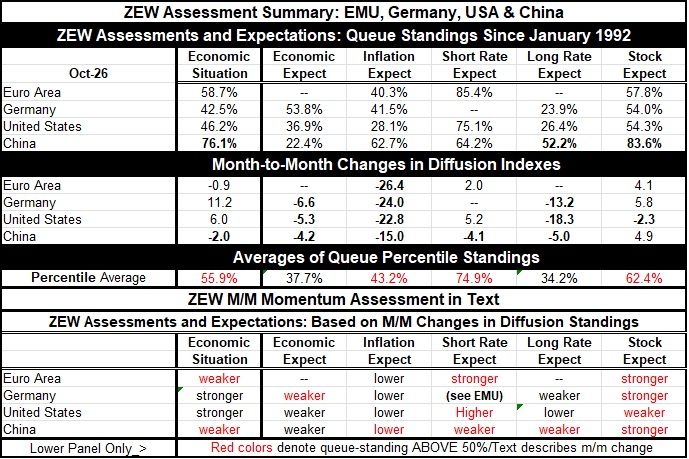
What the consolidated outlook implies To sum up, the outlook of the ZEW officials this month sees current conditions as mixed, economic expectations as lower, inflation expectations as much lower, and short-term interest rates generally creeping a little bit higher, with the impact being to reduce long-term interest rates significantly and allow stock markets to improve in most places except in the U.S. The most significant thing about these expectations is a sharp step-back in inflation expectations. For the overall inflation expectation across the euro area, Germany, and the United States, those readings average below the 40th percentile standing at a time when the economic expectations are slightly stronger than that in percentile levels. The outlook for short-term interest rates is much stronger in percentile terms, but the outlook for long-term interest rates is weaker in percentile terms. That is the focus of stimulus.
ZEW forecasters seem to be not very concerned about the short term, but apparently they are hedging their bets about the long term, as economic expectations are weaker and long-term rates are easing and logging weak levels on a historic ranking basis. The one element about this outlook that may seem a bit incongruent is that stock markets continue to post above-median results as economic expectations and long-term interest rates fall significantly. I suppose the message from the ZEW experts is that they expect the drop in the interest rates to help stock markets more than the weakness in the future economic conditions will hurt them.

Robert Brusca
AuthorMore in Author Profile »Robert A. Brusca is Chief Economist of Fact and Opinion Economics, a consulting firm he founded in Manhattan. He has been an economist on Wall Street for over 25 years. He has visited central banking and large institutional clients in over 30 countries in his career as an economist. Mr. Brusca was a Divisional Research Chief at the Federal Reserve Bank of NY (Chief of the International Financial markets Division), a Fed Watcher at Irving Trust and Chief Economist at Nikko Securities International. He is widely quoted and appears in various media. Mr. Brusca holds an MA and Ph.D. in economics from Michigan State University and a BA in Economics from the University of Michigan. His research pursues his strong interests in non aligned policy economics as well as international economics. FAO Economics’ research targets investors to assist them in making better investment decisions in stocks, bonds and in a variety of international assets. The company does not manage money and has no conflicts in giving economic advice.
More Economy in Brief