Global| Sep 15 2026
ZEW Current Situation Improves; Inflation Expectations Jump!
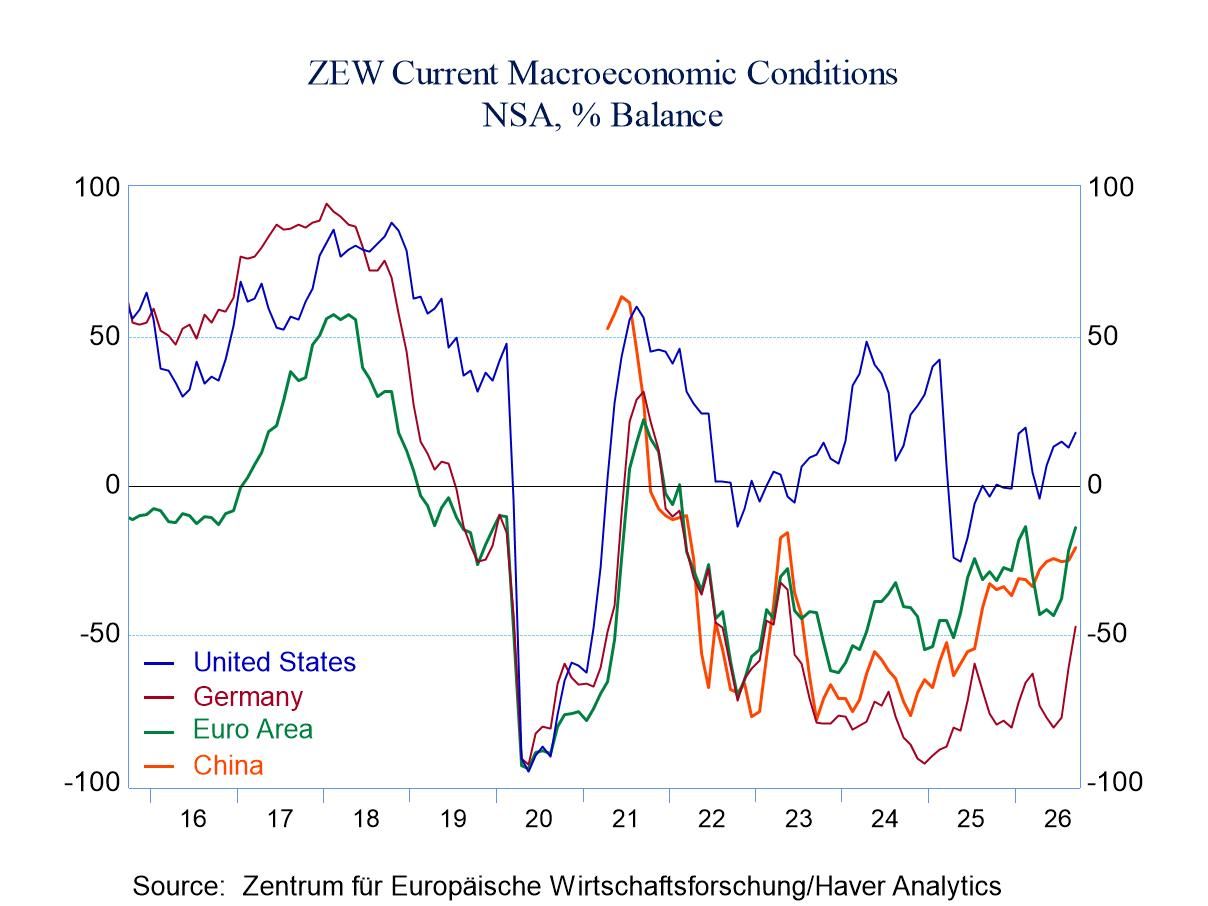
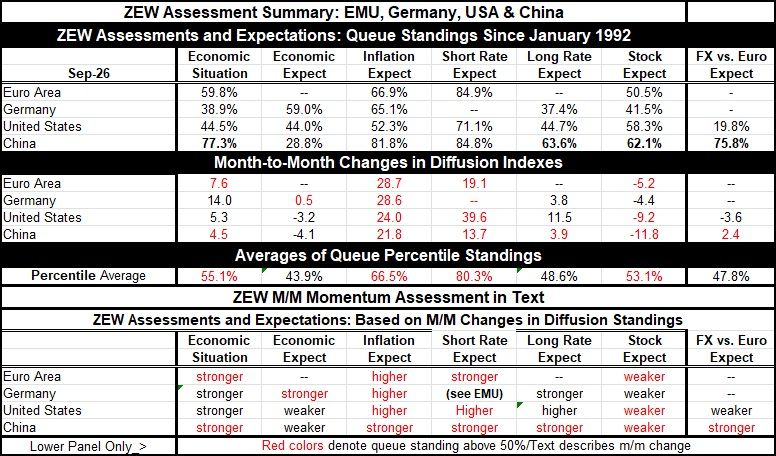
The ZEW financial experts in September see broadly improving macroeconomic conditions in the euro area, Germany, the United States, and China. There are step-ups in each of these areas, mostly by modest increases of four to seven points month-to-month. However, Germany shows a month-to-month increase of 14 points, the largest gain of the group. The percentile standings of the readings show an above-median (which means an above 50th percentile reading) for the euro area at a 59.8 percentile and for China at a 77.3 percentile. Both Germany and the U.S. lag their medians, with Germany at a 38.9 percentile standing and the U.S. at a 44.5 percentile standing.
Economic expectations are little changed and mixed among the three countries: Germany, the U.S., and China. The U.S. sees a slight setback as its monthly reading falls by 3.2 points; German expectations edge up by 0.5; China’s reading falls by 4.1 points. Only the reading for Germany stands above its 50th percentile, at the 59th percentile standing.
Inflation expectations are probably the big story this month, with big changes in all the reporting units of over 20 points on the month and all of them jumping up well over their median estimates, with rankings ranging from a 52.3 percentile standing in the U.S. to an 81.8 percentile standing in China. The outlook for inflation has suddenly worsened largely on events in the Middle East, rising oil prices, and increased pessimism about prospects for peace in the Middle East anytime soon.
Because of this short-term interest rate expectations are also higher, rising by 39 points in the U.S., 19 points in the euro area, and over 13 points in China month-to-month. All the readings for short-term rate expectations are above their medians, well above their respective 50th percentiles, with standings ranging from a low of the 71st percentile for the U.S. to the mid-80th percentile for both the euro area and China.
There are smaller increases, although increases in each of the areas, for long-term interest rate expectations, with the largest increases for the U.S. at 11.5 points on the month, whereas Germany and China log increases of about 3.8 to 3.9 points. Percentile standings show that long-term rate expectations are only above the 50th percentile standing for China, whereas for Germany they are at the 37th percentile. For the U.S., they are at the 44th percentile. Though the sharp increase in inflation expectations seems to have caught short-term interest rates off guard, longer-term interest rates have followed suit with only relatively small adjustments, not jumping to draconian levels, at least not yet. This would suggest that, with the rise in short-term expectations, financial experts think that central banks are still in control of inflation developments. That’s good news.
Not surprisingly, against this background stock market expectations deteriorated in each region. The smallest decline was in Germany, a decline of 4.4 points, while the largest was in China, a decline of 11.8 points. Germany is the only area where the stock assessments are below their 50th percentile. The euro area just makes the 50th percentile mark at 50.5. The U.S. comes in at a 58.3 percentile, while China has a 62.1 percentile standing assessment for the month. Generally speaking, the acceleration of inflation expectations has created some setback on stocks but hasn't had a draconian impact there either.
The outlook is that the economic situation has improved slightly in the month and economic expectations have a mixed performance and are generally slightly subpar. Inflation expectations jump sharply and have had a big impact on short-term rates, a more moderate impact on long-term rates, and a modest impact on stock values. Because of the sharp one-month rise in inflation expectations, we're going to want to watch these developments very closely.

Robert Brusca
AuthorMore in Author Profile »Robert A. Brusca is Chief Economist of Fact and Opinion Economics, a consulting firm he founded in Manhattan. He has been an economist on Wall Street for over 25 years. He has visited central banking and large institutional clients in over 30 countries in his career as an economist. Mr. Brusca was a Divisional Research Chief at the Federal Reserve Bank of NY (Chief of the International Financial markets Division), a Fed Watcher at Irving Trust and Chief Economist at Nikko Securities International. He is widely quoted and appears in various media. Mr. Brusca holds an MA and Ph.D. in economics from Michigan State University and a BA in Economics from the University of Michigan. His research pursues his strong interests in non aligned policy economics as well as international economics. FAO Economics’ research targets investors to assist them in making better investment decisions in stocks, bonds and in a variety of international assets. The company does not manage money and has no conflicts in giving economic advice.
More Economy in Brief