Japan’s IP Shows Developing, Solid Uptrend
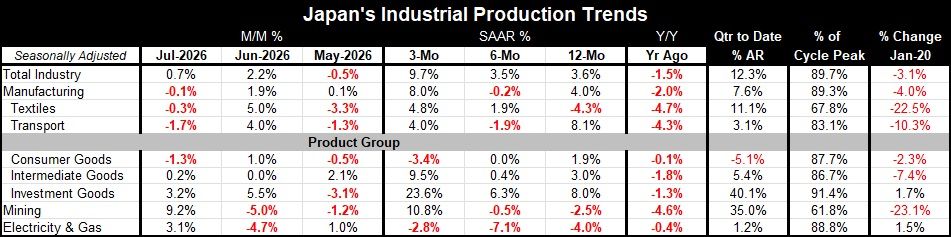
Japan’s industrial production rose in July largely on a jump in gas & electric utilities output. But manufacturing IP made a small move backward, with output falling by 0.1% month-to-month. Consumer goods output did turn sharply lower in July, dropping by 1.3% month-to-month, but intermediate goods output advanced by 0.2% as capital goods output continued to gear up, rising 3.2% month-to-month after rising 5.5% month-to-month in June. These gains in capital goods output followed a 3.1% drop in May.
Overall industrial output sequential gains show an accelerating output trend. The 12-month gain is 3.6%, the six-month annualized gain is nearly identical at 3.5%, and the three-month annualized gain is at a hefty 9.7%.
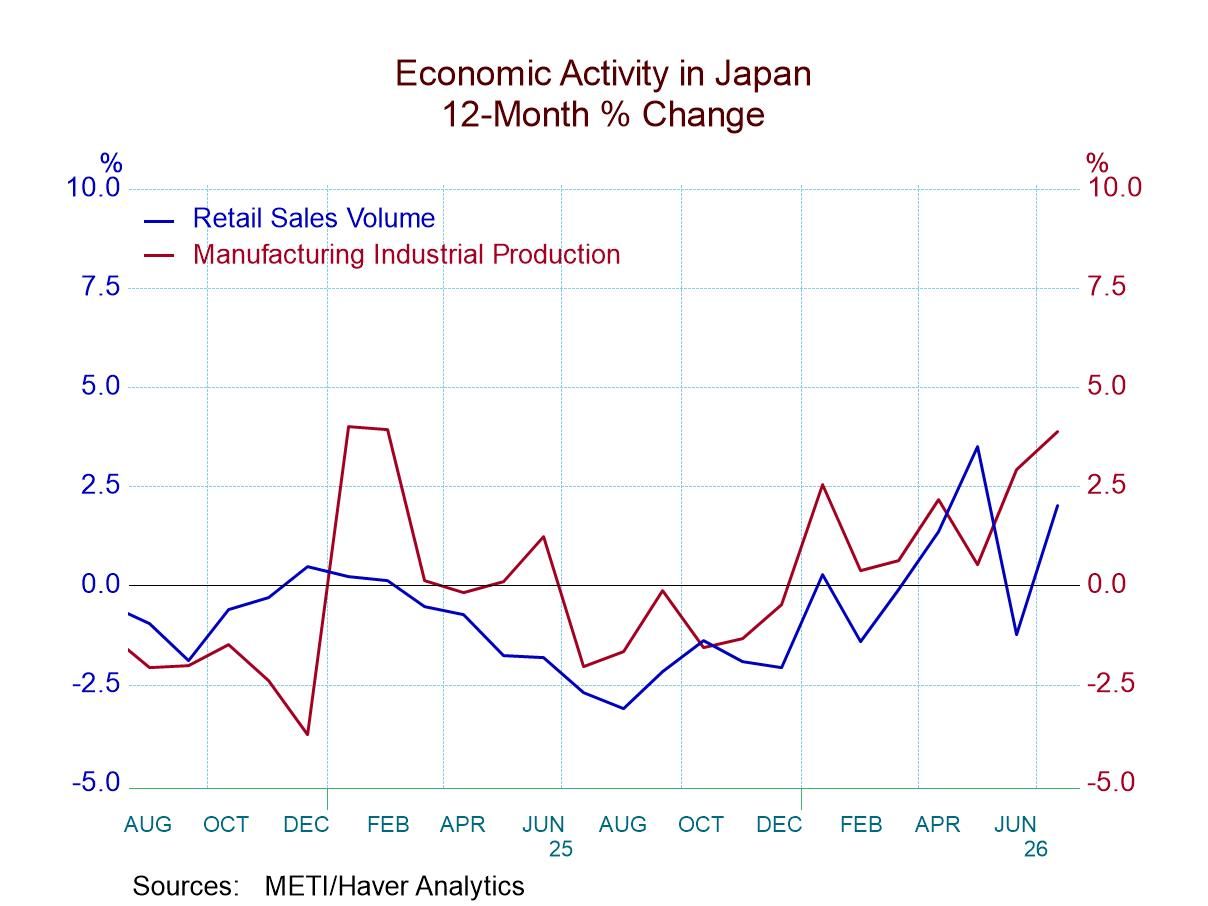
Sequential trends in manufacturing show more fluctuations and less of an arrow-straight trend. For manufacturing, 12-month growth is 4%, while three-month annualized growth is 8%. There is a lull in between, with six-month growth showing a 0.2% annual rate decline. Manufacturing sectors generally show a similar pattern, with solid 12-month growth, weaker growth over six months, and a pick-up over three months, with the three-month pace rebounding and turning sharply stronger than its 12-month pace. We see that for intermediate goods and capital goods, with only consumer goods showing steady output deterioration from 12 months to six months to three months. Yet, as the graphic shows, retail sales are holding up and tracking with industrial output gains overall.
On a quarter-to-date basis, very early in Q3, output is rising at a 12.3% annualized rate over its Q2 level. Manufacturing output is up at a 7.6% pace. Consumer goods output is a drag, with output falling at a 5.1% annual rate, offset by a 5.4% gain in intermediate goods and capital goods output exploding at a 40.1% annual gain. Utilities & mining output also are rising clearly and strongly in the quarter.
However, Japan’s economy is still in recovery mode. As the table clearly shows, all IP measures are lower than they were one year ago. The economy is still digging out after retrenchment. Moreover, output is still broadly weaker than it was in January 2020 before COVID struck. That’s a long time for output to not have risen, 6½ years. On that comparison, only investment goods output and electric & gas utilities output are higher in July of this year than in January 2020, and in both cases it is by less than 2%.
Japan is having an output revival. It looks real. The weakening of the yen may have given it a tailwind. Now the yen is stabilizing and gaining back some of that loss, but I do not look for yen appreciation to run far or fast.
For now, Japan manufacturing is reviving, and this is clear in the IP report as well as in the PMI surveys. The economy watchers don’t quite seem to see it yet. But motor vehicle production is back in gear, and the leading economic index is showing solid upward momentum. Japan, much like the U.S., is showing better industrial revival statistics than consumer confidence readings, which continue to lag. Income growth in Japan shows solid performance, and asset valuations are high, but consumers are not eager to spend, or so they tell surveys. Consumers also give their overall livelihood assessment a poor score. Still, consumers manage to spend enough to keep retail sales advancing after some significant retrenchment in 2025. Japan’s economy, like the U.S., seems to still be expanding and not under any real threat despite its irregularities.

Robert Brusca
AuthorMore in Author Profile »Robert A. Brusca is Chief Economist of Fact and Opinion Economics, a consulting firm he founded in Manhattan. He has been an economist on Wall Street for over 25 years. He has visited central banking and large institutional clients in over 30 countries in his career as an economist. Mr. Brusca was a Divisional Research Chief at the Federal Reserve Bank of NY (Chief of the International Financial markets Division), a Fed Watcher at Irving Trust and Chief Economist at Nikko Securities International. He is widely quoted and appears in various media. Mr. Brusca holds an MA and Ph.D. in economics from Michigan State University and a BA in Economics from the University of Michigan. His research pursues his strong interests in non aligned policy economics as well as international economics. FAO Economics’ research targets investors to assist them in making better investment decisions in stocks, bonds and in a variety of international assets. The company does not manage money and has no conflicts in giving economic advice.
More Economy in Brief
 Asia
Asia