Asia| Sep 14 2026
Economic Letter from Asia: Same Shocks, Different Paths
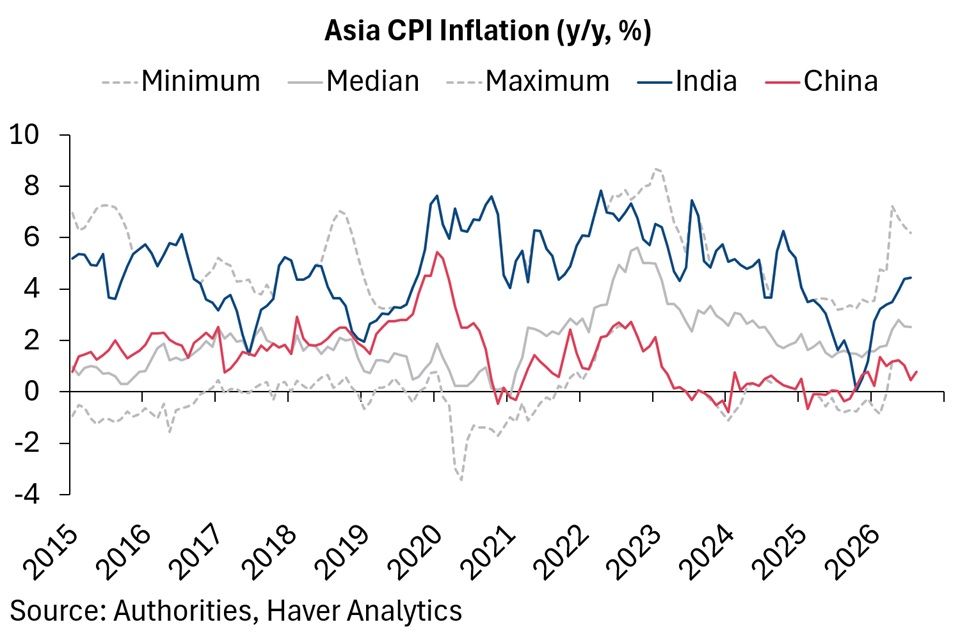
In this week's Letter, we examine the divergences running through Asia's inflation, monetary policy and currency performance. Headline CPI inflation has risen across much of the region, driven in large part by the closure of the Strait of Hormuz. Underlying dynamics nonetheless remain disparate, with China recording the region's lowest inflation rates and India facing renewed food and oil pressures (chart 1). China warrants closer attention still, since its producer price inflation now runs far ahead of consumer inflation (chart 2). Weak passthrough to domestic prices, soft demand and Beijing's campaign against destructive price competition all help explain that gap. Disparate inflation outcomes, in turn, are feeding divergent monetary policy stances, though that divergence has narrowed somewhat (chart 3). India has paused its rate cuts, while the Bank of Japan continues its gradual normalisation. Japan also sits at the centre of a protracted rise in yields, shared with its major-economy peers. A decomposition suggests real yields, rather than breakevens, have been the greater driver, amid concerns about fiscal policy and capex (chart 4). Divergence runs through currency performance too, with relative standings shifting repeatedly on a trade-weighted basis (chart 5). The Indian rupee has been the worst performer year-to-date, only recently ceding that position to the Philippine peso. At the other end of the table, the Chinese yuan has been dethroned by a resurgent South Korean won. Strong AI-driven export inflows had long been offset there by persistent portfolio outflows.
Inflation divergence Headline CPI inflation has risen across much of Asia this year, on many measures. Surging energy prices, driven by the continued closure of the Strait of Hormuz, account for a large part of that rise. Underlying inflation dynamics within the region, however, remain quite disparate from one economy to the next. External forces such as oil prices and supply shocks are only part of the story. Domestic conditions matter too, notably the strength of domestic demand and each economy's dependence on imported goods, which is another way of describing its degree of self-sufficiency. China illustrates the point, with inflation still short of breaking conclusively above the low to no inflation region. That owes arguably in part to domestic demand conditions, which remain comparatively weak. It has once again logged the region's lowest inflation rates in recent months, reclaiming that spot from Thailand (chart 1). India sits at the other end, having ceded the top spot for headline CPI inflation to the likes of Vietnam and the Philippines since early 2025. Its recent resurgence in consumer inflation nonetheless points to a dependence on imported oil. Fresh risks have also emerged more recently from food and agricultural shocks, tied to ongoing and possibly worsening El Niño effects.
Chart 1: CPI inflation in Asia
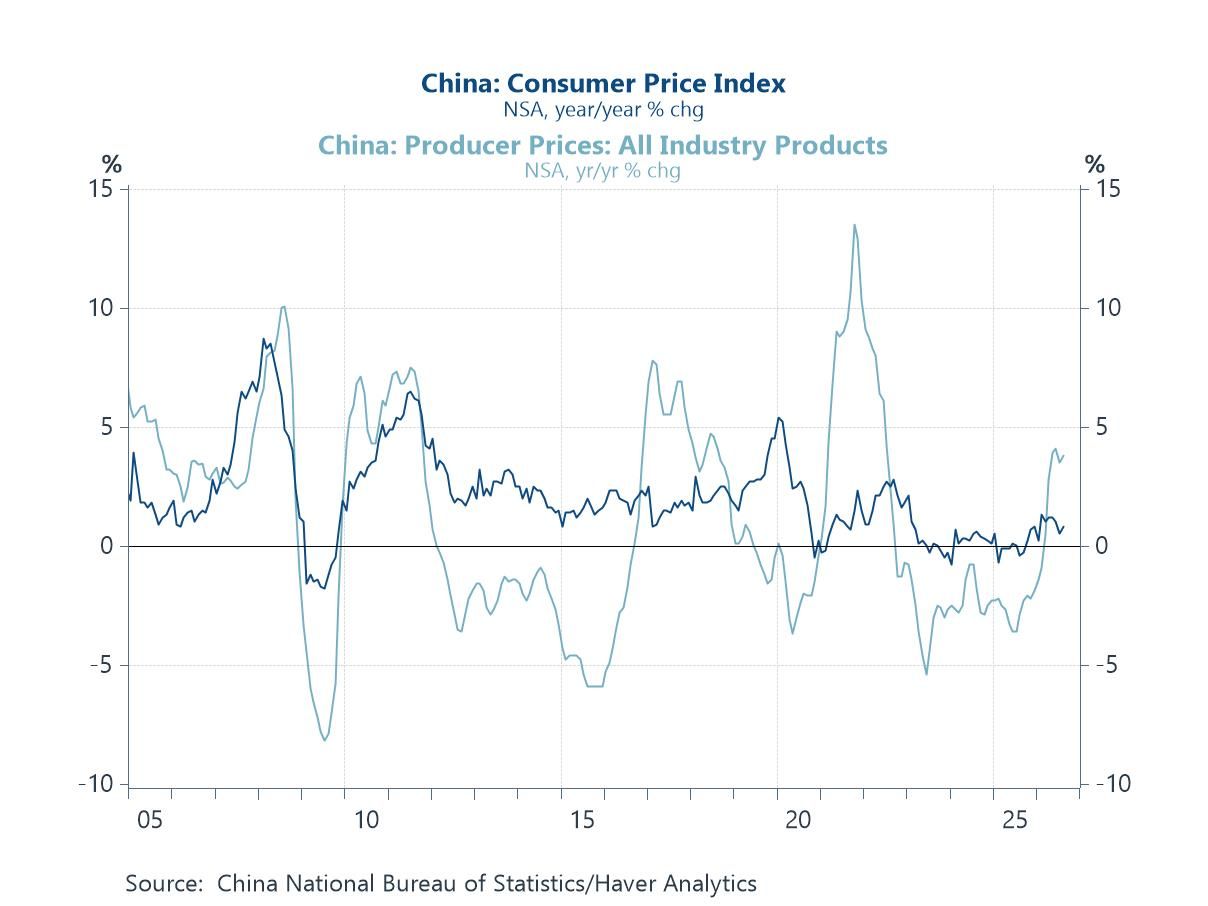
China merits a closer look, with producer price inflation now running far above consumer price inflation (chart 2). Producer price inflation has staged a resurgence after a protracted stretch of deflation. Consumer inflation, however, improved only briefly before recent readings slipped back towards the low to no inflation region. Several factors lie behind the producer price pickup, starting with low base effects from prior periods. Rising energy costs have added to it, as has surging demand in certain sectors, such as tech and AI-related goods. Some passthrough to export prices is evident, but passthrough to domestic prices has been weak. That weakness owes in part to soft domestic demand and may be eating into margins, leaving producer price inflation running well ahead of consumer inflation. This ties into the two-speed dynamic in China's economy, where externally facing sectors continue to outgrow more domestically oriented ones. Looking further out, the authorities' clampdown on excessive producer price wars, termed "involution", may push producer prices higher still.
Chart 2: China consumer and producer inflation
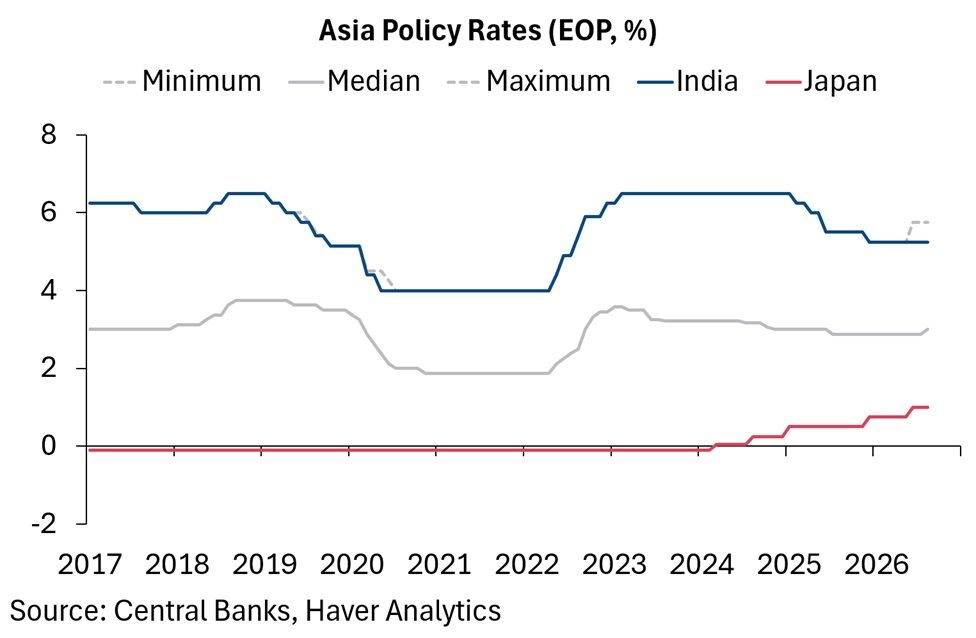
Monetary policy divergence Monetary policy stances remain divergent across Asian economies, although that divergence has narrowed somewhat. A shared impetus to hold or tighten on inflation risks accounts for much of that narrowing. Take India, which until recently had the highest main policy rate among major Asian economies (chart 3). It had nonetheless been easing for a time, until protracted currency weakness and resurgent inflation arguably led the central bank to pause its rate cuts. The Bank of Japan, by contrast, has long been pursuing gradual policy normalisation, given its delayed exit from the prior era of easy monetary policy. Prior yen weakness and still-wide interest rate differentials with major peers have also lent credence to its tightening bias.
Chart 3: Monetary policy rates in Asia
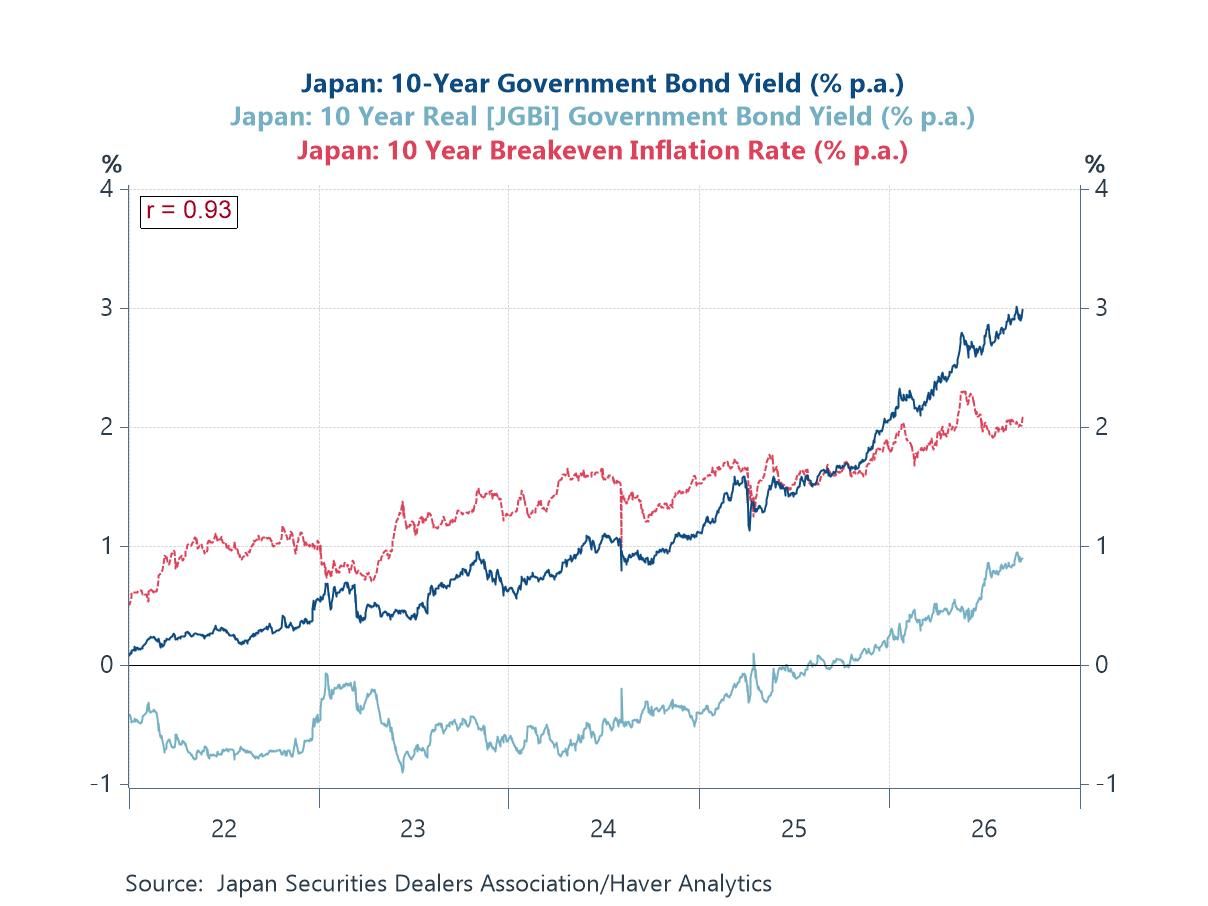
Japan has drawn attention in recent weeks for its protracted surge in yields, alongside its major economy peers. Chart 4 decomposes that increase into real and breakeven inflation components, arguably pointing to the former as the greater driver. Inflationary risks, granted, remain live and potentially the more potent of the two. Japanese real yields have nonetheless surged considerably in their own right. That would not be the case were the recent move in nominal yields driven by non-real aspects alone. Instead, investor concerns or expectations of higher real yields are possibly at work. An expected large upcoming fiscal bill and intense capex spending sit among the likely drivers. Eyes now turn to the Bank of Japan's meeting this week for further cues, with a 25 bps rate hike expected.
Chart 4: Japan real and nominal 10-year JGB yields
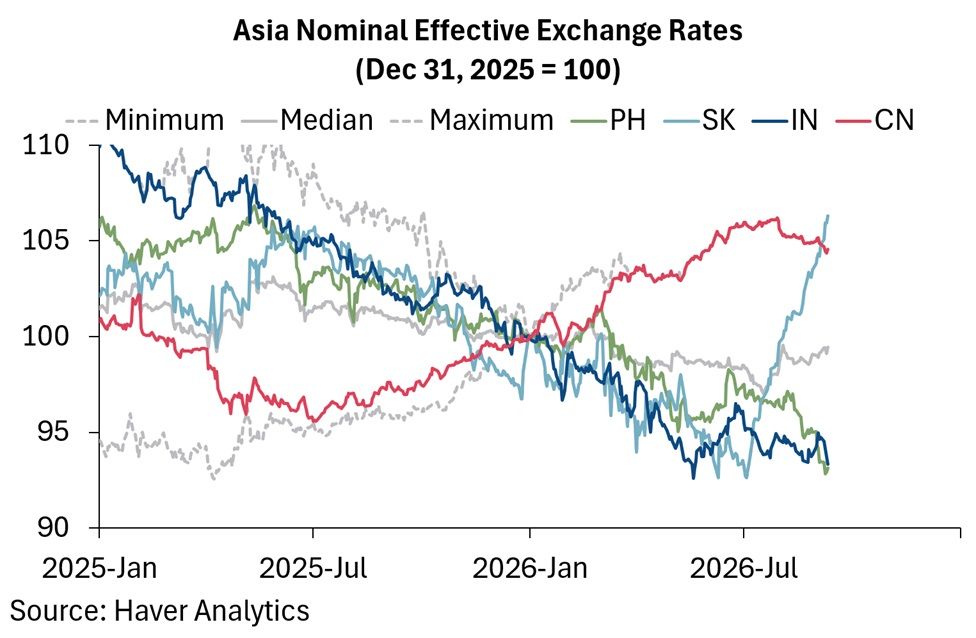
Currency divergence We turn now to divergences in Asia's currency performance and the recent drivers behind them. On a trade-weighted basis, relative standings have shifted repeatedly through the course of this year (chart 5). At the bottom of the table sits the Indian rupee, the worst-performing Asian currency year-to-date. Capital outflows have weighed on it, as has a hefty oil bill reflecting India's heavy import dependence. Only recently has the Philippine peso taken over from it as the prime laggard. The top of the table has proved similarly unsettled. The Chinese yuan held the leading spot for much of the year so far, before being dethroned by the South Korean won. That marks a spectacular turnaround for the won, from briefly being this year's worst performer to its best. It is a reversal worth dwelling on, and we take it up in the next segment.
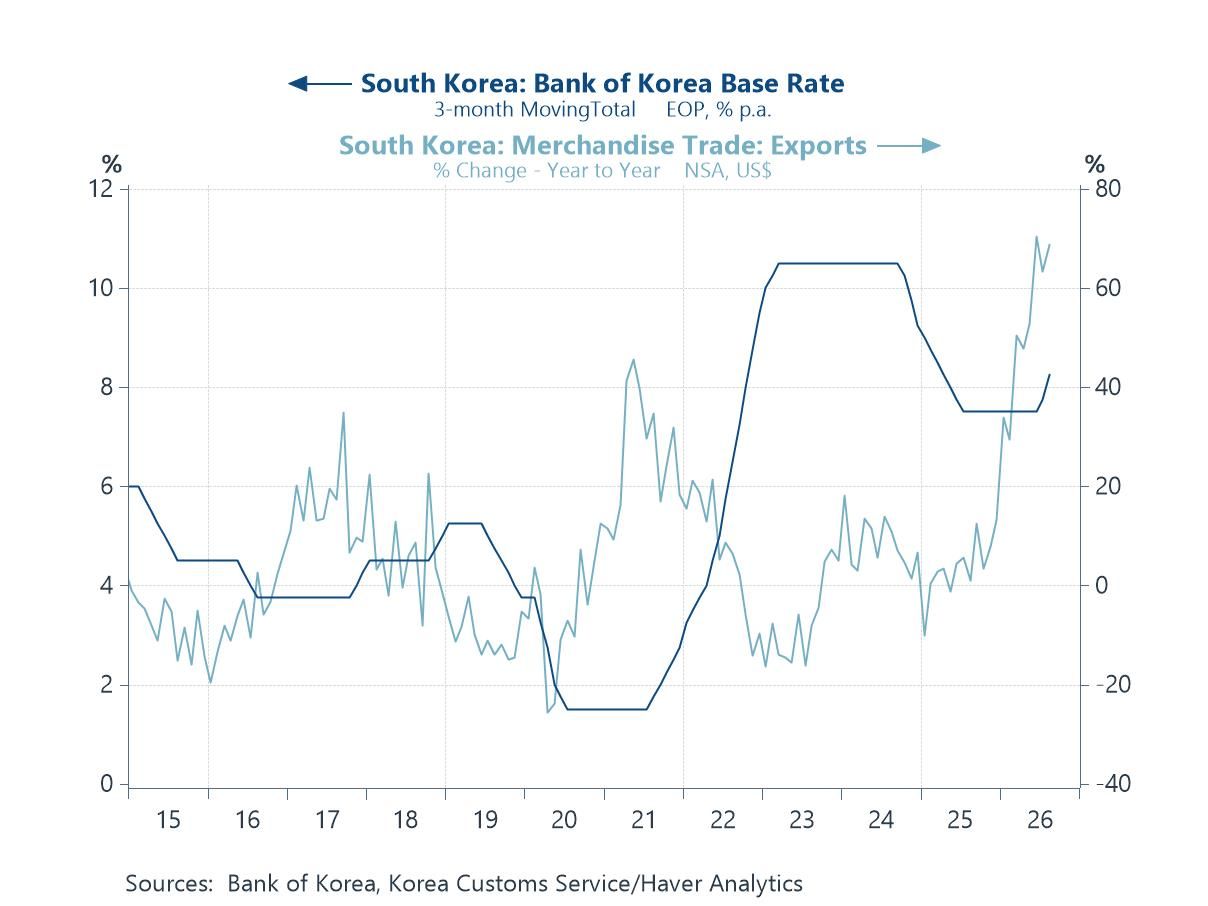
That reversal is worth unpacking, since the won had been on the back foot for some time beforehand. Exports growth through the year has been high and accelerating, driven mainly by AI-related goods. Those persistent and strong current account inflows nonetheless did little to prop up the currency. Working against them were portfolio outflows from South Korea, which ran persistently in the opposite direction. It was only recently, against that backdrop, that the won staged its turnaround. Behind it sits South Korea's building domestic growth story, alongside back-to-back rate hikes by the Bank of Korea. Whether this currency recovery still has legs is another question.
Chart 6: South Korea policy rate and exports

Tian Yong Woon
AuthorMore in Author Profile »Tian Yong joined Haver Analytics as an Economist in 2023. Previously, Tian Yong worked as an Economist with Deutsche Bank, covering Emerging Asian economies while also writing on thematic issues within the broader Asia region. Prior to his work with Deutsche Bank, he worked as an Economic Analyst with the International Monetary Fund, where he contributed to Article IV consultations with Singapore and Malaysia, and to the regular surveillance of financial stability issues in the Asia Pacific region.
Tian Yong holds a Master of Science in Quantitative Finance from the Singapore Management University, a Master of Science in Analytics from the Georgia Institute of Technology, a Bachelor of Science in Mathematics from the Singapore University of Social Sciences, and a Bachelor of Science in Banking and Finance from the University of London.
More Economy in Brief