Unemployment Remains Quite Low in Europe
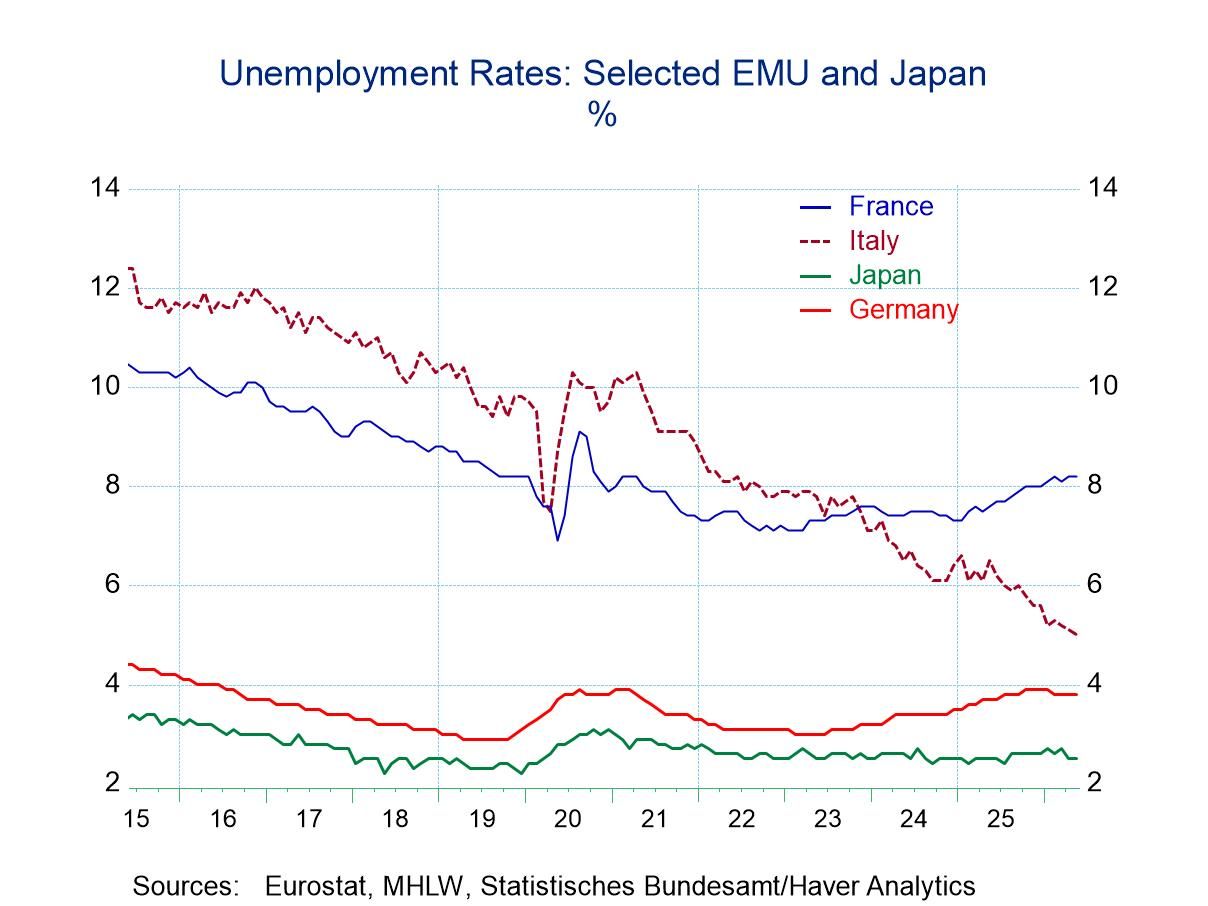
Unemployment rates in the European Monetary Union (EMU) were steady in May at 6.2%, the same level as in April, after April had fallen to 6.2% from 6.3%. The 6.2% reading is the lowest for the community since it was formed. Meanwhile, for the larger community, the EU, the unemployment rate has stabilized at 5.9%, the same as in April, again, a tick lower than it was in March. This 5.9% reading is a tick above the historic low for the European Union (EU). In both cases, the performance of these two economic conglomerations is quite excellent.
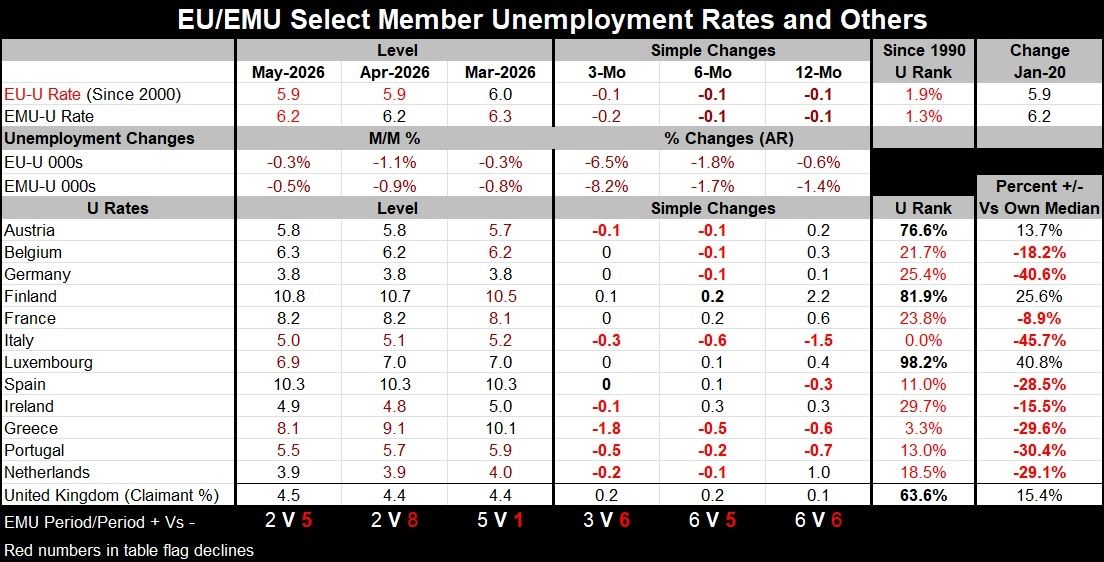
Monthly The table looks at 12 of the most senior members of the monetary union, including an observation for the United Kingdom based on its claimant-count unemployment rate, presented at the bottom of the table. In May, the monetary union saw 4 of 12 members in the table with lower unemployment rates than they had in April. In April, five members had lower unemployment rates than in March. In March, seven members had lower unemployment rates than they posted in February. The progression to lower unemployment rates has slowed based on monthly data.
Sequentially Looking at changes in the unemployment rates over broader sequential periods—three months, six months, and 12 months—6 out of 12 reporters have lower unemployment rates over three months; 7 have lower unemployment rates over six months; only 4 report unemployment rates that are lower over 12 months. The broader periods for comparison show changes in the unemployment rates that report more declines over the shorter and more recent periods compared to the longer/older periods. This is not the same trend leaning that we get from the last three months of data. It'll be good to watch these developments in the coming months to see if the tendency to lower unemployment rates is slowing or whether dropping unemployment is continuing in force.
Rankings The ranking of unemployment rates since 1990 finds only three of these 12 monetary union members with unemployment rates above their medians. Those are Luxembourg, with a 98.2 percentile standing, Finland with an 81.9 percentile standing, and Austria with a 76.6 percentile standing. Italy, on the other hand, is reporting the lowest unemployment rate that it has seen during this period. The Greek unemployment rate has been this low or lower only about 3% of the time, while in Spain the unemployment rate has been this low or lower 11% of the time. For Portugal, the unemployment ranking figure has been weaker 13% of the time. The monetary union continues to report excellent labor market results even though economic growth has been relatively disappointing.
Summing up and central bankers In the wake of the monetary conference in the Sintra this past week, central banks featuring contributions from the European Central Bank, the Bank of England, the Federal Reserve, and the Bank of Canada, saw central bank heads talking about getting back to basics and stopping the use of some of the newer tools that had been pressed into service after the great financial crisis and during COVID. Bankers are getting back to basics to focus on short-term interest rates and say they will stop fiddling with the size of the balance sheet and to largely set aside the use of forward guidance. It will take time to determine what these changes are going to mean in terms of how policy performs and how markets will react. While there was a lot of discussion, and in some places concerns about the loss of forward guidance, what is clear is that, with forward guidance gone, there will be more volatility; however, the markets will be freer to price economic events themselves and will not be so stuck to the outlook of the central bank. That could turn out to be a gigantic win for both markets and central bankers.

Robert Brusca
AuthorMore in Author Profile »Robert A. Brusca is Chief Economist of Fact and Opinion Economics, a consulting firm he founded in Manhattan. He has been an economist on Wall Street for over 25 years. He has visited central banking and large institutional clients in over 30 countries in his career as an economist. Mr. Brusca was a Divisional Research Chief at the Federal Reserve Bank of NY (Chief of the International Financial markets Division), a Fed Watcher at Irving Trust and Chief Economist at Nikko Securities International. He is widely quoted and appears in various media. Mr. Brusca holds an MA and Ph.D. in economics from Michigan State University and a BA in Economics from the University of Michigan. His research pursues his strong interests in non aligned policy economics as well as international economics. FAO Economics’ research targets investors to assist them in making better investment decisions in stocks, bonds and in a variety of international assets. The company does not manage money and has no conflicts in giving economic advice.
More Economy in Brief
 Global