U.S. JOLTS: Openings and Hiring Fell in February
by:Sandy Batten
|in:Economy in Brief
Summary
- Openings fell 4.9% m/m to 6.882 million from an upwardly revised 7.240 million in January.
- Hiring plummeted 9.3% m/m to 4.849 million, the lowest reading since April 2020.
- Separations fell 3.4%% m/m to 4.971 million with a decline in Quits and an increase in Layoffs.
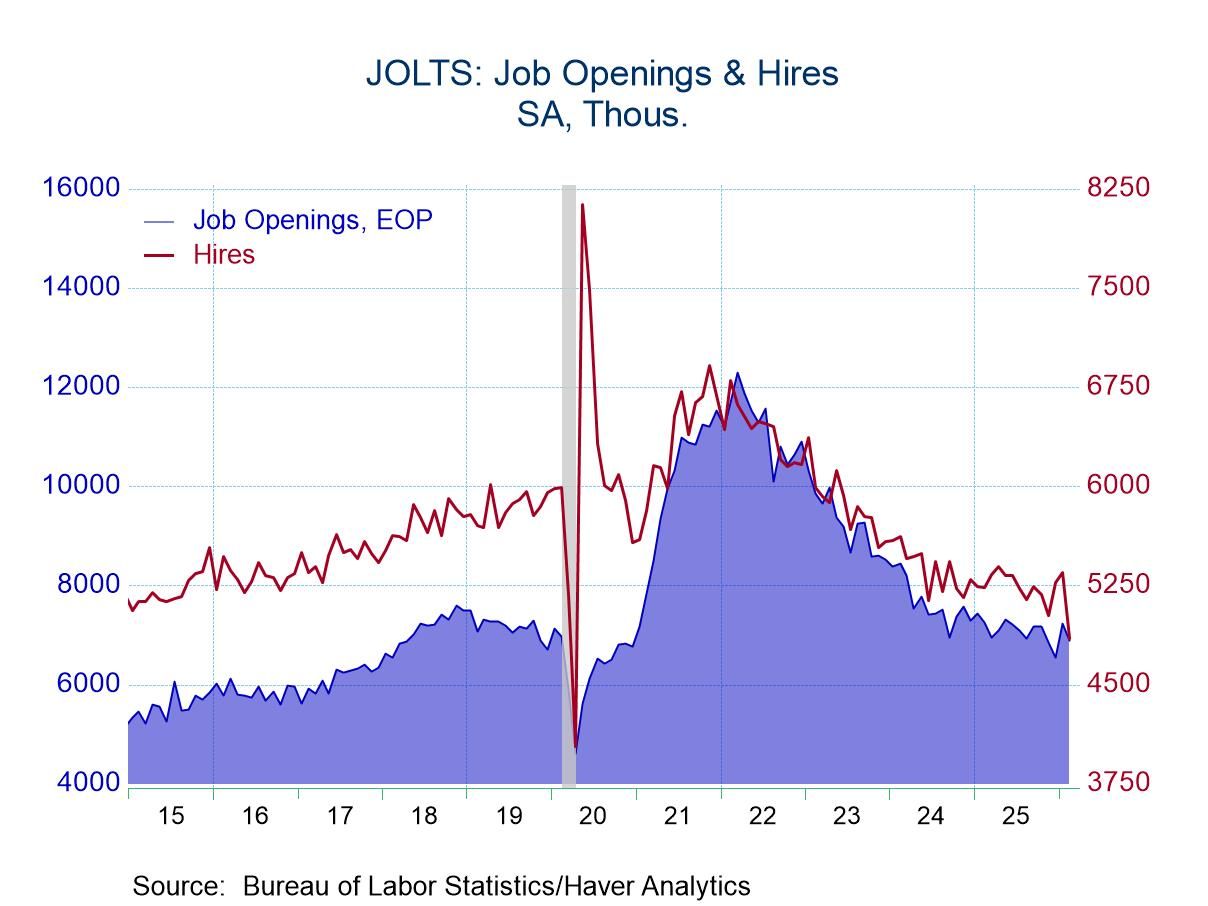
Total job openings declined 4.9% m/m (-5.0% y/y) to 6.882 million in February from an upwardly revised 7.240 million in January (previously 6.946 million), according to the Job Openings and Labor Turnover Survey. The job openings rate (the ratio of openings to nonfarm employment plus openings) fell to 4.2% in February from an upwardly revised 4.4% in January (previously 4.2%). In February, the number of unemployed increased while openings declined, meaning that the excess of unemployment over openings rose. The number of unemployed has exceeded the number of openings for seven consecutive months, highlighting the softening of labor market conditions over that period.
Private sector openings fell 3.7% m/m (-307k) in February to 6.181 million in January. Accordingly, the private sector openings rate declined to 4.4% from an upwardly revised 4.6% in January (previously 4.4%). Declines were widespread across major industries, led by 213k decline in leisure and hospitality openings. Manufacturing openings fell 71k, the first decline in three months. Construction openings dropped 28k, their third consecutive monthly decline. Private education and healthcare openings declined 78k, their second decline in the past three months. By contrast, professional and business services openings rose 64k in February, their fifth monthly gain in the past six months. Government openings declined 51k, their first monthly decline in three months, led by a 48k drop in state and local government openings.
Total hiring plunged 9.3% m/m (-498k) to 4.849 million in February, the lowest level since April 2020, from 5.347 million in January (previously 5.294 million). The hiring rate slumped to 3.1%, also the lowest since April 2020, from 3.4% in January. Private sector hiring plummeted 503k to 4.523 million with the private sector hiring rate falling to 3.3% from 3.7%. Declines were widespread across major sectors, led by a 185k drop in hiring in leisure and hospitality, a 154k decline in professional and business services hiring, a 103k drop in private education and healthcare hiring and a 88k decline in construction hiring. By contrast, financial activities hiring rose 40k. Government hiring edged up 5k, accounted completely by an 8k increase in state and local government hiring.
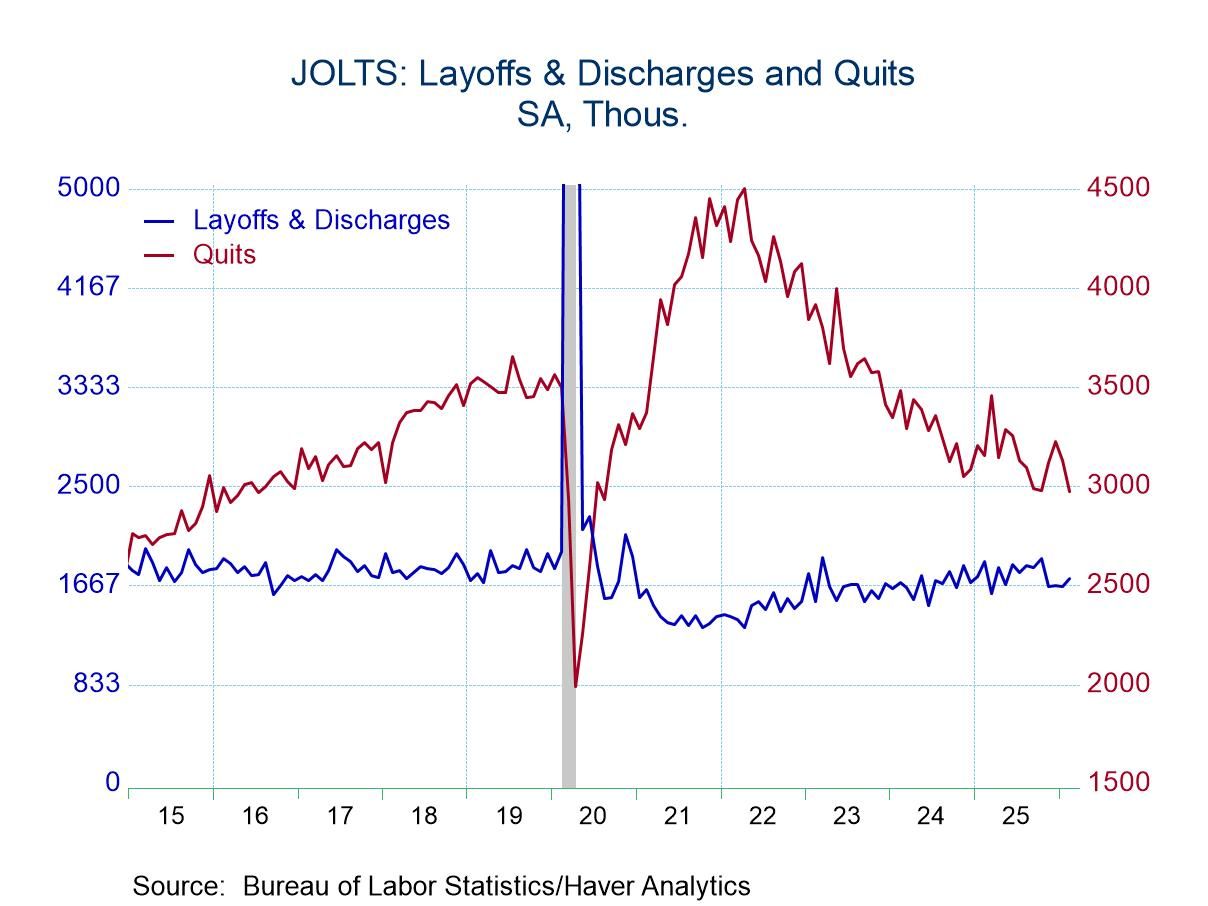
Total separations fell 3.4% m/m (-173k) to 4.971 million in February from 5.144 million in January (previously 5.203 million). The separation rate slipped to 3.1% from 3.2%. The February reading was the lowest separation rate since March 2013. Private separations declined 3.4% m/m (-163k) in February to 4.657 million with the private separation rate falling to 3.4% from 3.6%. Separations varied across major sectors. Separations in professional and business services fell 112k while leisure separations declined 111k. By contrast, separations in trade and transportation rose 66k while private education and healthcare separations increased 15k.
Within private sector separations, quits declined 157k, layoffs rose 62k and other separations fell 67k. Quits are generally voluntary separations initiated by the employee. Therefore, the quits rate can serve as a measure of workers’ willingness or ability to leave jobs. Amid the volatility, quits stabilized somewhat last year after having trended down since early 2022. However, they have fallen markedly for two consecutive months, pointing to some recent further softening in labor market conditions. In contrast, layoffs and discharges are involuntary separations initiated by the employer. Even though layoffs have risen in each of the past two months, they have moved little since last fall. Low levels of quits indicate that there is more difficulty finding a new job, while flattish layoffs indicate that firms are less willing to lay off existing workers, a general theme of the current economic environment.
The Job Openings and Labor Turnover Survey (JOLTS) data are available in Haver’s USECON database.

Sandy Batten
AuthorMore in Author Profile »Sandy Batten has more than 30 years of experience analyzing industrial economies and financial markets and a wide range of experience across the financial services sector, government, and academia. Before joining Haver Analytics, Sandy was a Vice President and Senior Economist at Citibank; Senior Credit Market Analyst at CDC Investment Management, Managing Director at Bear Stearns, and Executive Director at JPMorgan. In 2008, Sandy was named the most accurate US forecaster by the National Association for Business Economics. He is a member of the New York Forecasters Club, NABE, and the American Economic Association. Prior to his time in the financial services sector, Sandy was a Research Officer at the Federal Reserve Bank of St. Louis, Senior Staff Economist on the President’s Council of Economic Advisors, Deputy Assistant Secretary for Economic Policy at the US Treasury, and Economist at the International Monetary Fund. Sandy has taught economics at St. Louis University, Denison University, and Muskingun College. He has published numerous peer-reviewed articles in a wide range of academic publications. He has a B.A. in economics from the University of Richmond and a M.A. and Ph.D. in economics from The Ohio State University.
More Economy in Brief

 Global