Confidence in Turkey Advances
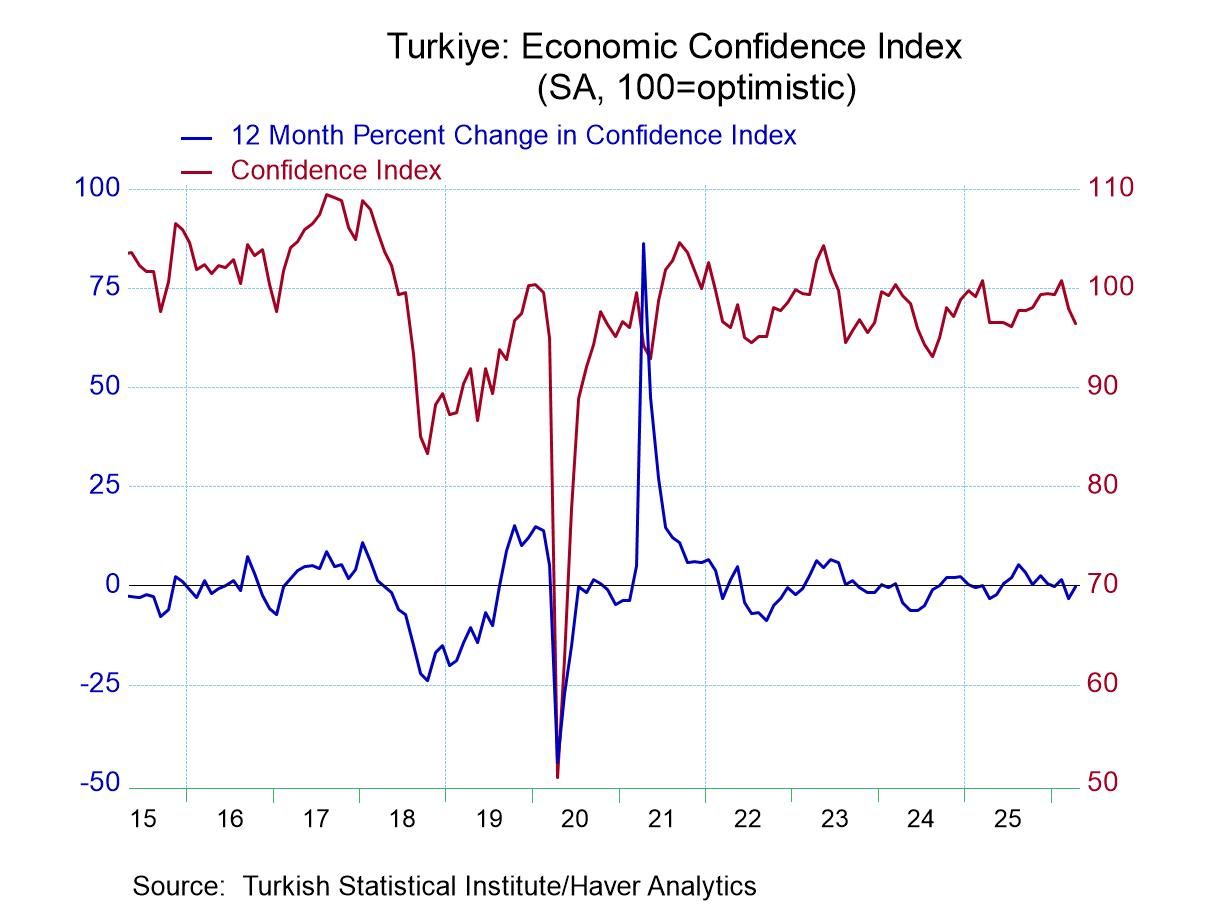
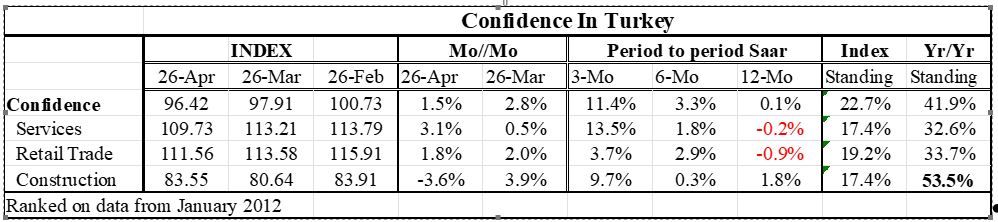
Confidence for Turkey in April improved rising by 1.5% month-to-month to an index value of 96.42. Services and retail confidence both rose on the month as confidence in Construction fell by a sharp 3.6%, partly reversing an even sharper gain form a month ago.
The sequential performance of confidence in Turkey finds overall, services and retail sector confidence accelerating. Construction confidence is stronger over 3-months than over 12-months but its six-month gain shows slowing. Performance is still getting settled and the service and retail sector readings are still lower on balance over 12-months, even as they show acceleration and growth in train. Turky is a work in progress.
The individual sector standings of the confidence metrics by sector are surprisingly similar and cluster around the 20-percentile mark. Overall confidence at 22.7% has the strongest reading while the weakest sector reading is 17.4-percent and it finds construction and services in a tie for the lowest index rank standing.
The table also ranks confidence by growth rates, comparing growth over the past year across the sector readings. The growth sectors have relatively strong reading that the sector index standings. That is an admission that conditions currently have, when compared back to 2012, ranked weaker than the level of economic conditions (as proxied by confidence, of course) evaluated over the same period. It is evidence that some improvement in conditions (perceived improvement) is underway. The growth rate rankings stretch from the 32nd percentile to the 53rd percentile- all the growth standings exceed the index standings.
The growth in construction at a 53.5-perntiel standing is above its median growth rate since January 2012. Overall confidence still has a growth rate below its median at a 41.9 percentile standing; the shortfall is significant but not severe. Services and retail are more significant laggard with growth rate standings in their respective 32nd- and 33rd-percentiles – historically, reading that are higher about two-thirds of the time on the timeline back to early 2012.
Turkey continues to experience high inflation at 33% over the last year, a small deceleration from the month before. With global energy price pressures rising, Turkey’s central bank has recently lifted its outlook for inflation hear as well. The economy grew about 3.6% this year; it is on track for about 3% growth. Confidence readings suggest some ambivalence to these conditions. By this time, the population has gotten used to the high inflation. But growth has not stepped up significantly. That could be the key driver for improved expectations and confidence. But it is not yet a reality. Turkey is still, affected, of course, by the war-time conditions in Iran that is right on its border.

Robert Brusca
AuthorMore in Author Profile »Robert A. Brusca is Chief Economist of Fact and Opinion Economics, a consulting firm he founded in Manhattan. He has been an economist on Wall Street for over 25 years. He has visited central banking and large institutional clients in over 30 countries in his career as an economist. Mr. Brusca was a Divisional Research Chief at the Federal Reserve Bank of NY (Chief of the International Financial markets Division), a Fed Watcher at Irving Trust and Chief Economist at Nikko Securities International. He is widely quoted and appears in various media. Mr. Brusca holds an MA and Ph.D. in economics from Michigan State University and a BA in Economics from the University of Michigan. His research pursues his strong interests in non aligned policy economics as well as international economics. FAO Economics’ research targets investors to assist them in making better investment decisions in stocks, bonds and in a variety of international assets. The company does not manage money and has no conflicts in giving economic advice.
More Economy in Brief
 Global