U.S. ADP Private Employment Growth Accelerates in February, Exceeding Expectations
Summary
- Private payrolls +63K, eighth straight m/m gain and largest in three months.
- Hiring increase is driven by small businesses (+60K, strongest in four months).
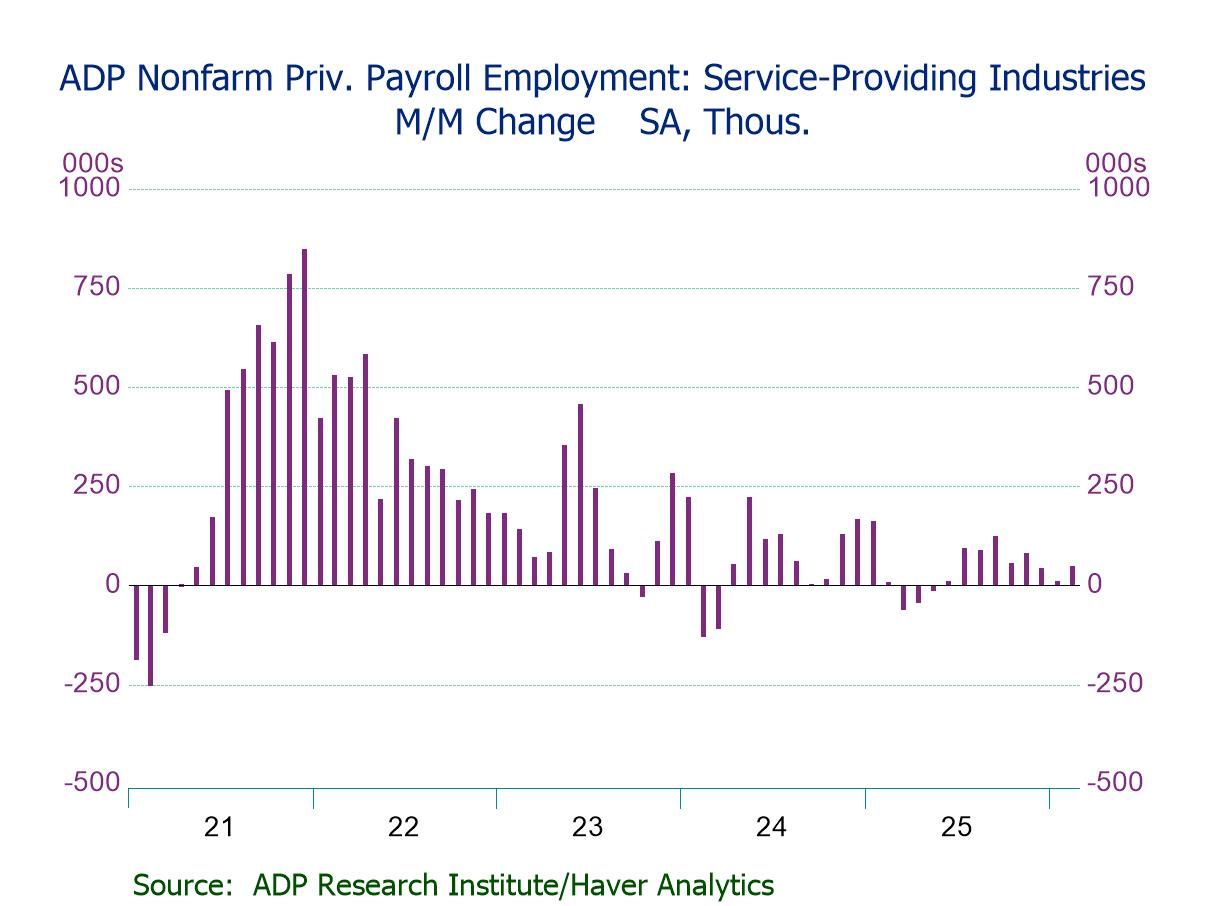
- Service-sector jobs up (+47K), led by education & health svs. (+58K) and information (+11K).
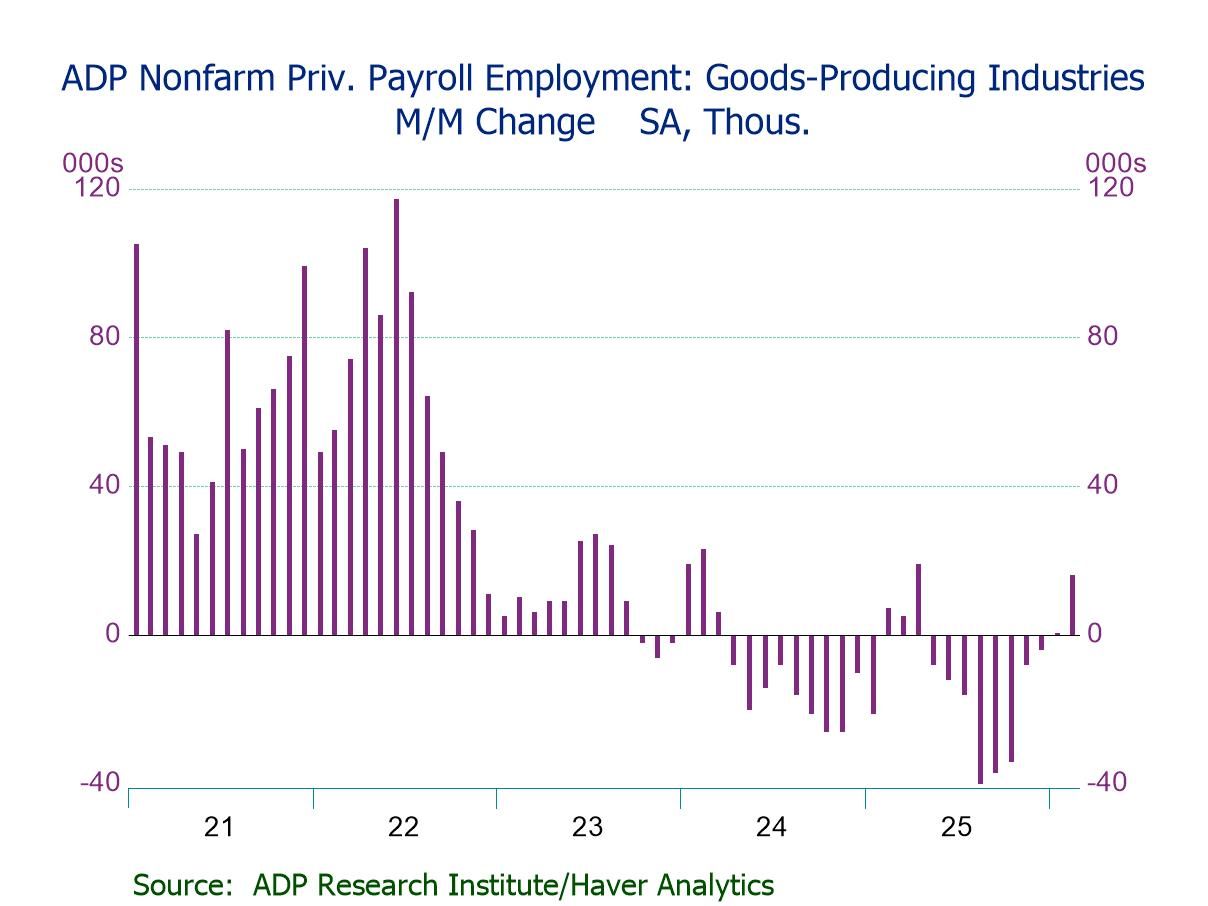
- Goods-producing jobs up (+16K), driven by construction (+19K).
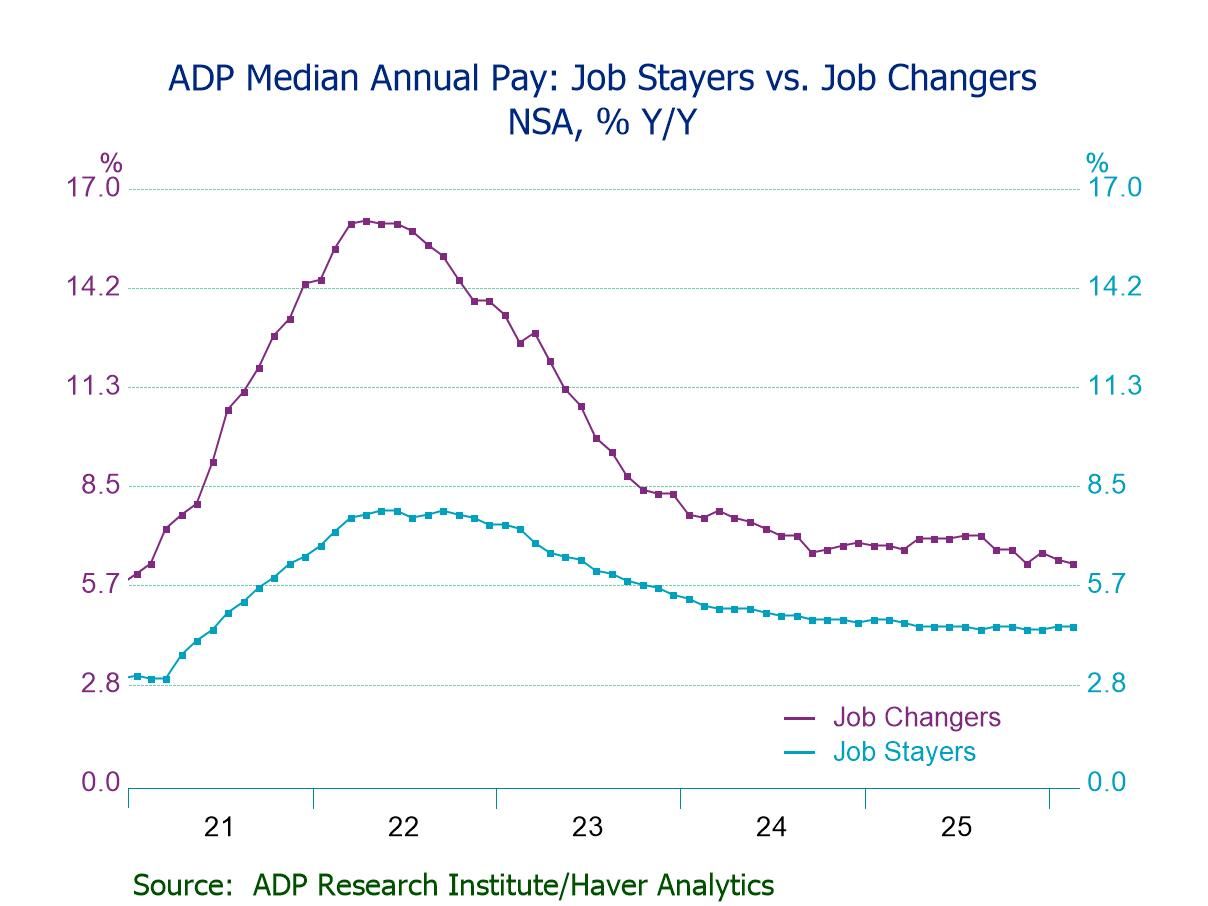
- Wage growth eases y/y for job changers (6.3%) but steady for job stayers (4.5%).
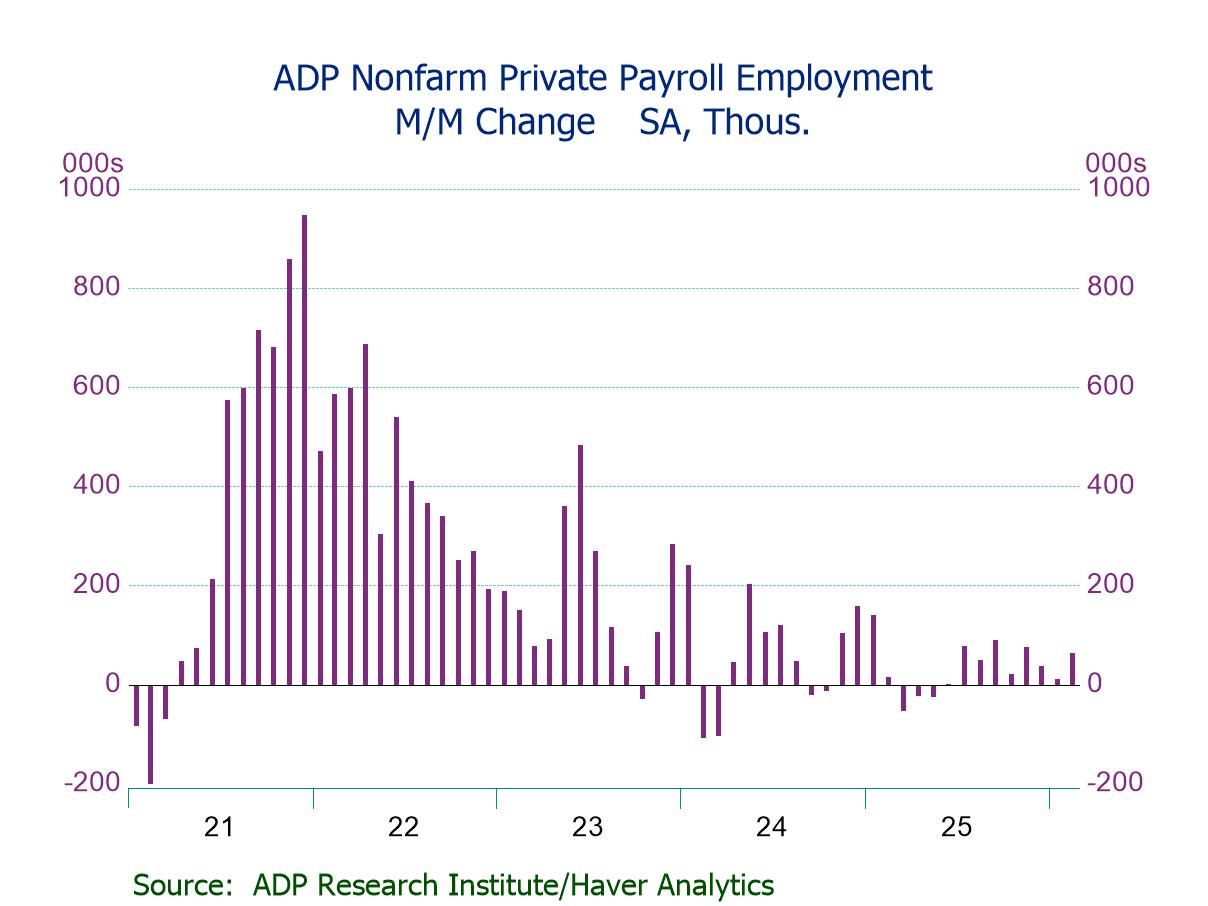
U.S. nonfarm private sector payrolls rose a larger-than-expected 63,000 (0.2% y/y) in February after increases of 11,000 in January (+22,000 initially) and 37,000 in December (unrevised), according to the ADP National Employment Report. February’s m/m gain was the biggest since November. The three-month average change was +37,000 in February, smaller than +41,000 in January and +44,000 in December. The Action Economics Forecast Survey expected a 43,000 increase in February.
Small business hiring (less than 50 employees) climbed a solid 60,000 (0.5% y/y) in February—the largest m/m rise in four months—following a modest 1,000 increase in January (no change initially), with employment in very small firms (1-19 employees) up 58,000, the strongest m/m gain since October, and employment in small firms (20-49 employees) up 2,000. Employment at medium-sized firms (50-499 employees) fell 7,000 (-0.5% y/y) in February, the first m/m fall in three months, after a 29,000 rise in January (+41,000 initially). Large business hiring (500+ employees) rebounded 10,000 (1.0% y/y), the eighth m/m increase in nine months, following a 19,000 January drop (-18,000 initially).
Service-producing jobs advanced 47,000 (0.4% y/y) in February after an 11,000 gain in January (+21,000 initially), marking the ninth straight m/m increase and the largest in three months. February’s rise was led by education & health services (+58,000), followed by information (+11,000), other services (+6,000), financial activities (+2,000), and leisure & hospitality (+1,000). To the downside, m/m employment fell in professional & business services (-30,000) and trade, transportation & utilities (-1,000).
Goods-producing employment rose 16,000 (-0.5% y/y) in February, the first m/m rise in 10 months, after no change in January (+1,000 initially). February’s gain was driven by construction (+19,000) and natural resources & mining (+2,000), while manufacturing (-5,000) continued to decline.
By region, nonfarm private payroll employment increased m/m in the South (+37,000; +0.3% y/y), West (+19,000; +0.3% y/y), and Northeast (+11,000; +0.5% y/y). In contrast, employment fell m/m in the Midwest (-4,000; -0.1% y/y).
Wage growth for job changers eased to a three-month-low 6.3% y/y in February from 6.4% y/y in January, remaining far below a high of 16.1% in April 2022. Wage growth for job stayers held steady at 4.5% y/y in February, holding in a narrow 4.4%-4.5% range since April 2025. Pay growth also remained steady in major industries, including financial activities (5.2% y/y), construction (4.7% y/y), professional & business services (4.3% y/y), and other services (4.1% y/y).
The ADP National Employment Report and Pay Insights data can be found in Haver's USECON database. Historical figures date back to January 2010 for private employment. Pay data date back to October 2020. The expectation figure is available in Haver's AS1REPNA database.

Winnie Tapasanun
AuthorMore in Author Profile »Winnie Tapasanun has been working for Haver Analytics since 2013. She has 20+ years of working in the financial services industry. As Vice President and Economic Analyst at Globicus International, Inc., a New York-based company specializing in macroeconomics and financial markets, Winnie oversaw the company’s business operations, managed financial and economic data, and wrote daily reports on macroeconomics and financial markets. Prior to working at Globicus, she was Investment Promotion Officer at the New York Office of the Thailand Board of Investment (BOI) where she wrote monthly reports on the U.S. economic outlook, wrote reports on the outlook of key U.S. industries, and assisted investors on doing business and investment in Thailand. Prior to joining the BOI, she was Adjunct Professor teaching International Political Economy/International Relations at the City College of New York. Prior to her teaching experience at the CCNY, Winnie successfully completed internships at the United Nations. Winnie holds an MA Degree from Long Island University, New York. She also did graduate studies at Columbia University in the City of New York and doctoral requirements at the Graduate Center of the City University of New York. Her areas of specialization are international political economy, macroeconomics, financial markets, political economy, international relations, and business development/business strategy. Her regional specialization includes, but not limited to, Southeast Asia and East Asia. Winnie is bilingual in English and Thai with competency in French. She loves to travel (~30 countries) to better understand each country’s unique economy, fascinating culture and people as well as the global economy as a whole.
More Economy in Brief
 Asia
Asia