Global| Sep 03 2026
Total PMIs Show Slow Improvement in August
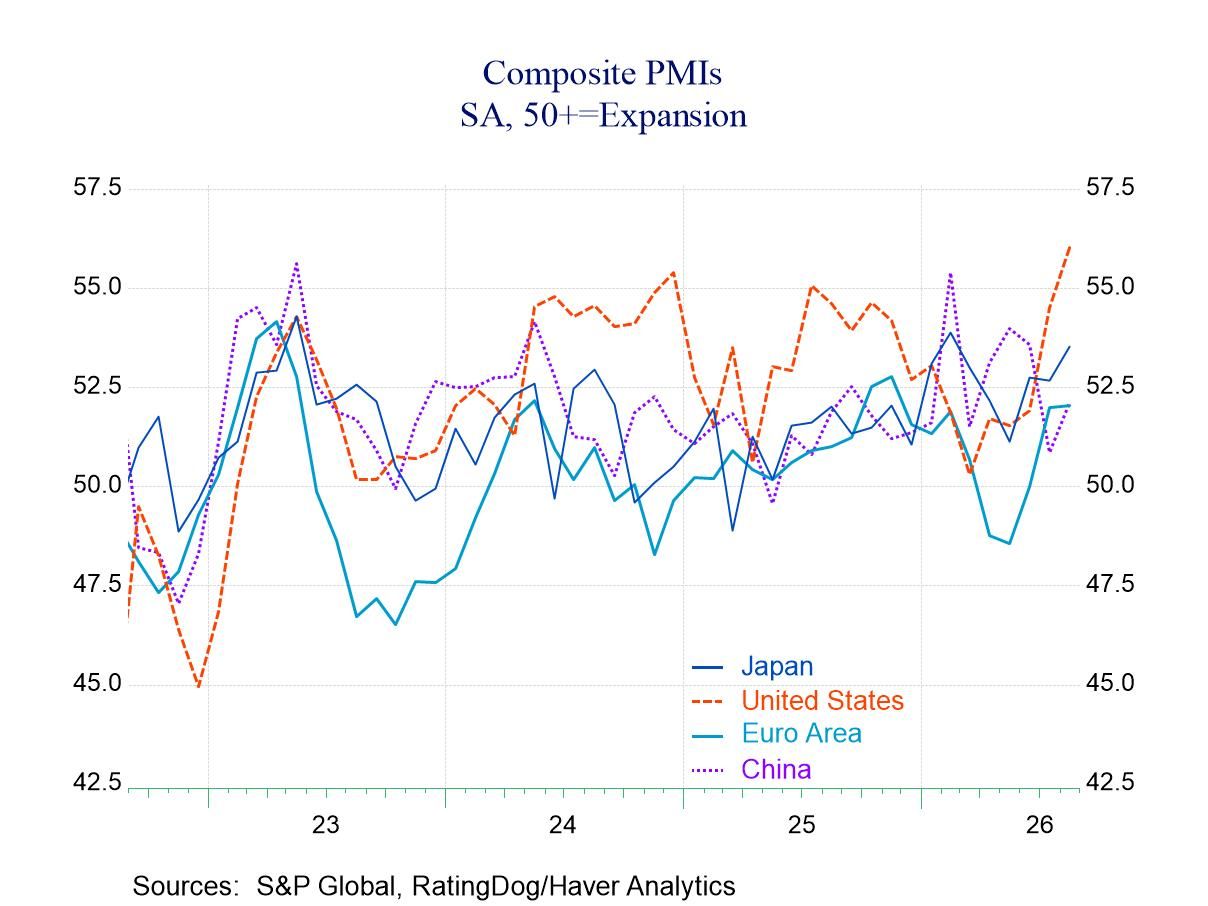
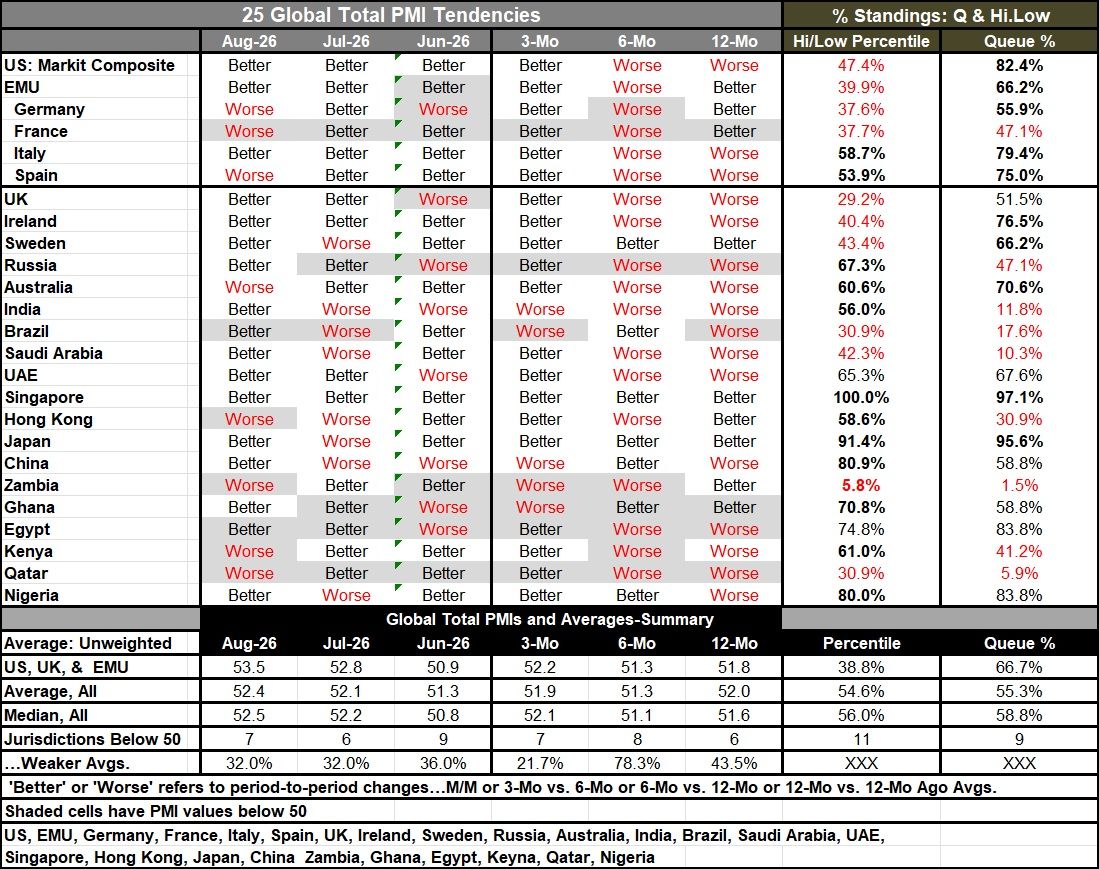
The total PMIs from S&P improved in August, with only eight of the reporting jurisdictions showing month-to-month backtracking. Only seven of the reporters in the table show readings below 50, indicating a contraction of output in the reporting country or unit.
The average and median readings for the full table show improvements, by and large, month to month in the total PMI readings. The sequential progression is more complicated, with a weakening in pace over six months and an improvement over three months compared to six months.
France, Ghana, Egypt, and Qatar show persistent levels of activity below a diffusion value of 50, indicating ongoing contraction over three months, six months, and 12 months, in addition to recent monthly readings that remain below 50 (except for Ghana in the latter case).
Nine of these 25 regions have percentile standings, depicted in the far right-hand column, below the 50% mark. These represent rankings of the August values among all observations back to January 2021. Readings below 50% indicate values below their respective medians on this timeline. So, 9 of 25 countries or reporting units as of August are showing readings that are below what they produced as a median over the previous approximately 4½ years. Among some of the larger countries, this includes France, the BRIC member Brazil, and Hong Kong, which has traditionally been a strong-performing unit when it was the British Crown Colony of Hong Kong.
Over three months, only five of the reporting areas have weakened compared to their averages over six months, and only seven of the reporting units show contraction over three months.
Conditions across the surveyed countries continue to remain somewhat touch-and-go and certainly reflect a number of different economic circumstances. Globally, there is still a war in progress, with Russia and Ukraine enmeshed in as deep a conflict as they have experienced and with some concerns that it could spread. Russia is alleged to have been creating mischief in Europe in an attempt to unsettle NATO. The U.S. has warned Russia to stop meddling and, under no circumstances, attack a NATO country. Meanwhile, in the Middle East, the U.S. and Iran continue to trade shots back and forth as the ceasefire has collapsed, and the U.S. has put one of the most intense embargoes in place on Iran to try to force economic pain while the U.S. naval presence tries to keep the Strait of Hormuz open for trade and oil traffic. These situations continue to dog the global economy and have continued to pressure oil prices, which in turn has put central banks on the defensive. Interest rates are either going up or threatening to go up again on a global scale, although perhaps only a mild gradient of increase is on offer. But this is something we will have to continue to watch in the period ahead.

Robert Brusca
AuthorMore in Author Profile »Robert A. Brusca is Chief Economist of Fact and Opinion Economics, a consulting firm he founded in Manhattan. He has been an economist on Wall Street for over 25 years. He has visited central banking and large institutional clients in over 30 countries in his career as an economist. Mr. Brusca was a Divisional Research Chief at the Federal Reserve Bank of NY (Chief of the International Financial markets Division), a Fed Watcher at Irving Trust and Chief Economist at Nikko Securities International. He is widely quoted and appears in various media. Mr. Brusca holds an MA and Ph.D. in economics from Michigan State University and a BA in Economics from the University of Michigan. His research pursues his strong interests in non aligned policy economics as well as international economics. FAO Economics’ research targets investors to assist them in making better investment decisions in stocks, bonds and in a variety of international assets. The company does not manage money and has no conflicts in giving economic advice.
More Economy in Brief