Global| Aug 05 2026
Total PMIs Show Confused Trends
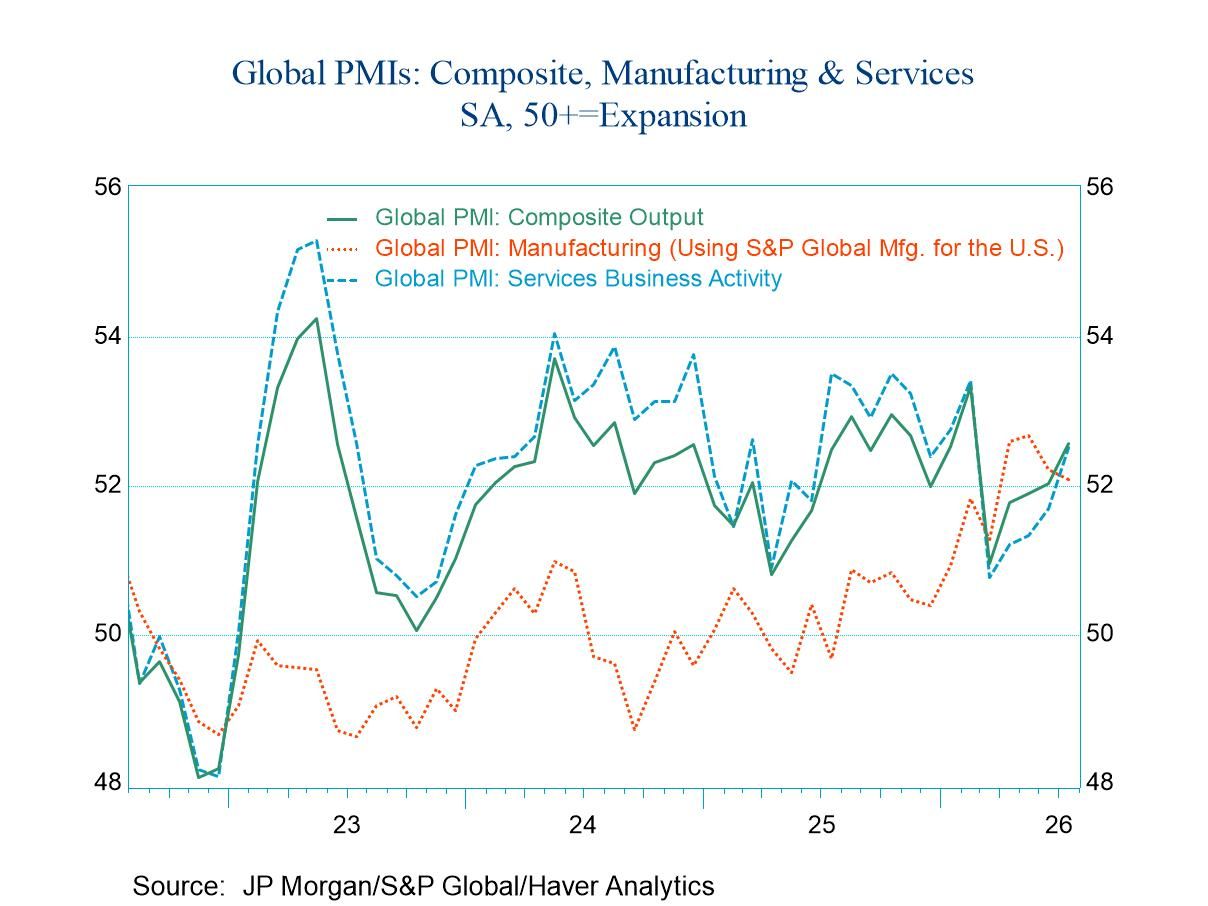
The total or composite PMIs in July released by S&P showed mixed performance although the average and median readings for the 25 reporters improved slightly month-to-month. The average reading rose to 52 in July from 51.3 in June, and the median reading rose to 52.2 from 50.8.
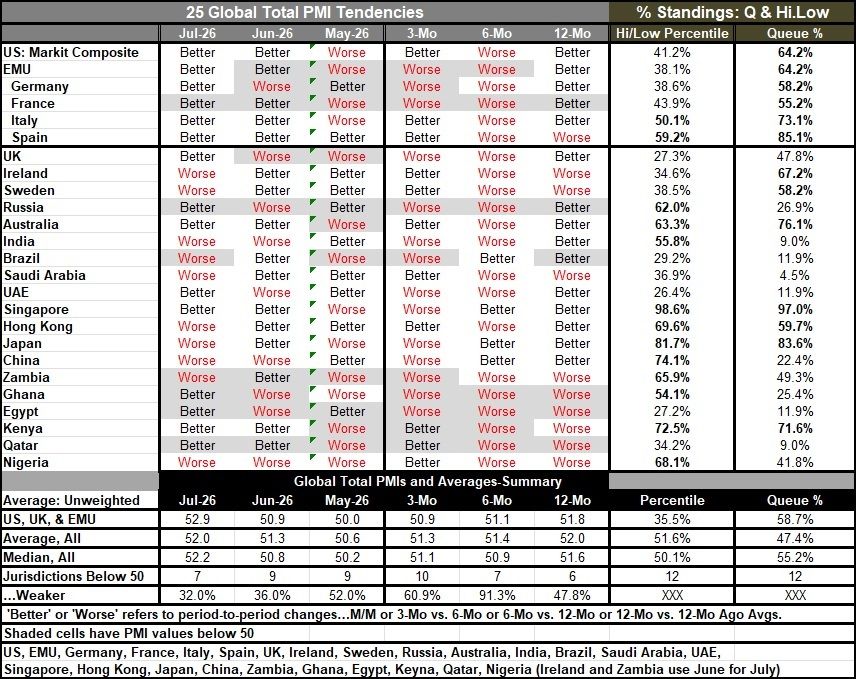
Contraction is mostly avoided, but not rare In July, seven of the reporters showed total PMI gauges below 50, indicating that those economies are contracting. The seven economies with that characteristic are France, Russia, Brazil, Zambia, Ghana, Egypt, and Qatar. For the most part, these are smaller economies. France, of course, is a large European economy; Russia is engaged in its ongoing war with Ukraine, which is taking a toll on its economy; and Brazil is one of the large BRIC economies.
The contracting count worsened, then stopped In June, nine countries had PMIs below 50, the same as in May. Over broader periods, such as three months, 10 countries show PMI values averaging below 50. That compares to seven over six months and six over 12 months. The slippage has actually progressed from 12 months to six months to three months, then improved on monthly data.
Contraction seems more structural than cyclical The shaded parts of the table correspond to PMI values below 50. We see that there's a long string of those readings in France, Russia, Egypt, and Qatar. For those countries, the one-month appearance of a below-50 reading in July was not episodic; it was structural. Germany has had two months in a row and a three-month average below 50; however, Germany turned stronger in July. The European Monetary Union as a whole had two months below 50 as well as very weak three-month and six-month averages, but it also turned higher in July. Zambia has a recent string of ongoing weakness; Ghana has a nearly unbroken streak of values below 50 as well. Brazil’s signal is like a flashing light.
There is good news However, the good news is that only eight of the reporting areas actually got weaker month-to-month in July, compared to nine in June and 11 in May. Over three months, we see 13 areas reporting PMIs that have weakened month-to-month. That compares to 21 that weakened over six months. On year-over-year comparisons, only 11 are weaker period-to-period. The weakening trend is much reduced in the recent monthly data.
Lingering weakness PMIs chronicle a great deal of lingering weakness, although for the most part conditions aren't worsening month-to-month over the past two months. However, there are a number of areas where activity, as designated by the PMI values, is declining. The sequential readings confirm that the growing weakness is a real factor and has only reversed in the last two months, if that result can be durable. How much of this weakness and subsequent rebound is linked to the war in Ukraine and the new deterioration and stalemate in the Middle East; those up-and-down dynamics are going to be hard to puzzle out.
Activity and performance assessments The queue percentile standings show that 12 of the 25 reporting entities have standings below their medians on data back to January 2021. That means nearly half are weaker in July than they have been on readings back to January 2021. On that timeline, conditions have not been strong, with an average diffusion (PMI) reading across the board of 52.3 and a median of 51.4. It has been a low-growth period in general.
The rich get richer? Even if only slowly... The large, developed economies, for the most part, have PMI rankings and queue standings above their 50th percentiles. The exception is the United Kingdom, with a 47.8 percentile standing. The exceptions also include the BRIC countries: Russia having a 26.9 percentile standing, India with an exceptionally low 9.0 percentile standing, Brazil with an 11.9 percentile standing, and China with a 22.4 percentile standing.
The future remains chaotic There's been some flirtation with better numbers and some improved data, especially in manufacturing. The global economy, battling through its recovery from COVID, dealt with an inflation problem that developed. While avoiding a significant recession (just suffering an induced short one), it is still dealing with special factors that have emerged since COVID ended, including U.S. tariffs, war in Ukraine, war in Iran, and the knock-on effects on oil and commodities markets.

Robert Brusca
AuthorMore in Author Profile »Robert A. Brusca is Chief Economist of Fact and Opinion Economics, a consulting firm he founded in Manhattan. He has been an economist on Wall Street for over 25 years. He has visited central banking and large institutional clients in over 30 countries in his career as an economist. Mr. Brusca was a Divisional Research Chief at the Federal Reserve Bank of NY (Chief of the International Financial markets Division), a Fed Watcher at Irving Trust and Chief Economist at Nikko Securities International. He is widely quoted and appears in various media. Mr. Brusca holds an MA and Ph.D. in economics from Michigan State University and a BA in Economics from the University of Michigan. His research pursues his strong interests in non aligned policy economics as well as international economics. FAO Economics’ research targets investors to assist them in making better investment decisions in stocks, bonds and in a variety of international assets. The company does not manage money and has no conflicts in giving economic advice.
More Economy in Brief