Global| Feb 04 2026
S&P Composite PMIs Creep Higher
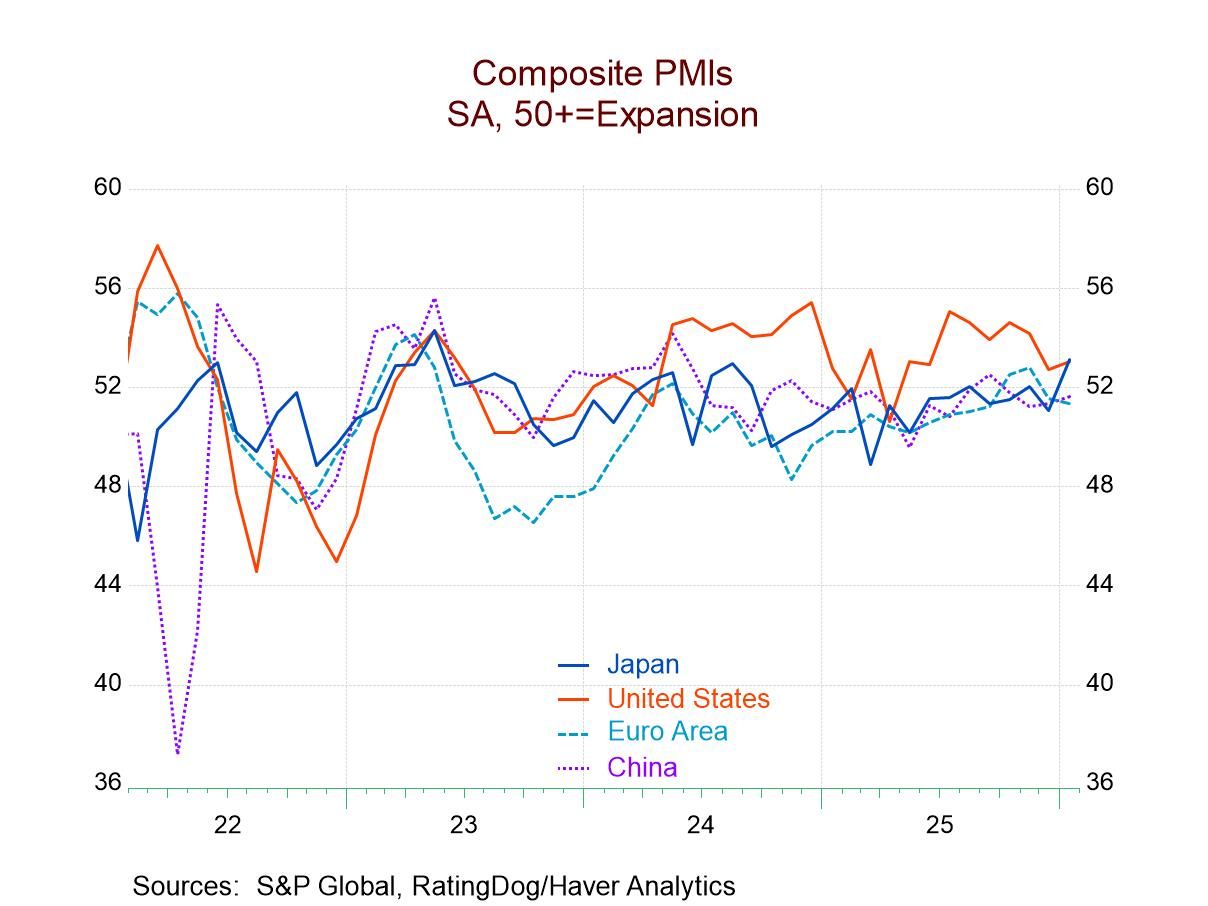
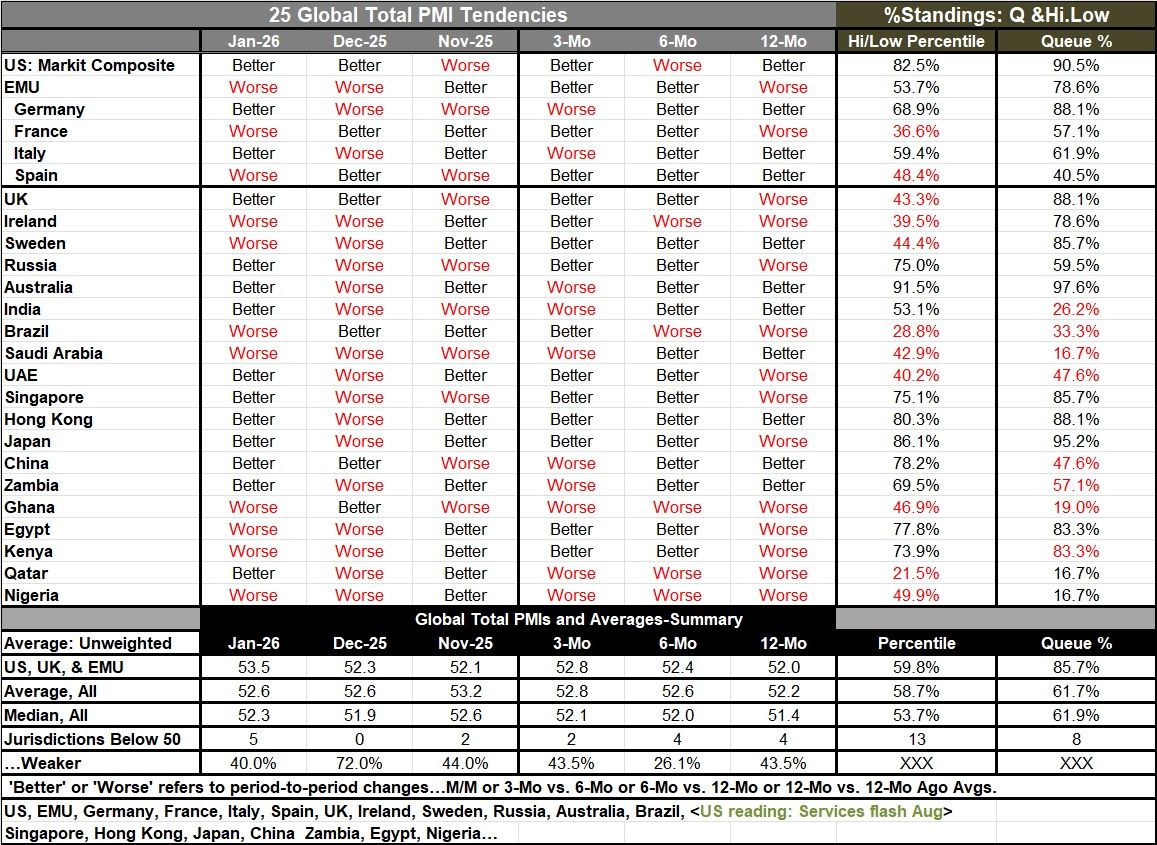
Composite PMIs for January show fewer reporters weakening in January compared to December with only about 40% of the reporters getting weaker month-to-month. The sequential data weakening versus strengthening shows that over 12 months 43.5% of reporters weakened, over six months 26.1% weakened, while over three months 43.5% weakened indicating that over this period, and - in recent months as well - the broad sequential periods are showing improvement as the underlying trend for global composite activity.
In January, 5 of 25 reporters had PMIs below a diffusion reading of 50, indicating contraction, compared to none in December and two in November. Over three, six and 12 months, the number of outright contractions varies between 2 and 4 based on average data. The percentile standing for ranked data over the period back to January 2022 shows a 61.7 percentile standing for the average of all of them, and a 61.9 percentile standing for the pooled data median. There is a stronger 85.7 percentile queue standing for an average of the United States, the United Kingdom, and the European Monetary Union where conditions have been firming although slowly..
The queue percentile standings across these 25 reporters’ composite indexes show that nine of them have rankings below their medians on data back to January 2022. Among all 25 reporters, only in France has 12-month, 6-month and 3-month average PMI readings below 50 in each of those time segments. France also has readings below 50 for its composite diffusion in two of the last three months.
When we look at rankings over a period, we also are interested in knowing what the performance has been over that span where we're creating these rankings. On these data back to 2022, only 6 reporters have average readings below 50, indicating persistent contraction. For the composite that's below 50, those reporters are Germany, France, Zambia, Ghana, Egypt, and Kenya. Only Egypt at 48.9 has an average reading below 49. Clearly the sense of contraction across this set of countries is small, moderate, and short-lived. At the other end of the spectrum, there are readings of 55 or greater for Sweden, India, Saudi Arabia, and the UAE; Singapore logs a reading at 54.4 for diffusion value.
The average and median data show that the readings have very gradually been drifting higher; however it's definitely a very gradual phenomenon. Looking at smoothed data, 12-month averages show 10 countries with readings below their respective 12-month averages of 12-months ago. However, only six of these show a reading that's one diffusion point or more weaker than it was one year ago. The biggest step back is from Brazil with a 4.5-point step back; the next biggest is Russia with a 2.1-point step back and Russian of course is engaged in war. There is a step back of about one point reported by Spain, the U.K., the UAE, Singapore, and Qatar. On the same metric, step ups of two points or more include Germany, Sweden, Zambia, and Nigeria with step ups of one point or more in Kenya, Australia, Ireland, and the U.S.
Over the whole 4-year period, the average country was in contraction for 14 months, a bit more than one year, accounting for 28.6% of the time. Over the last 2 years, the average country was in a state of contraction for 5.2 months or 21% of the time. Over the last year, the average country was in contraction 2.2 months or 18% of the time. The time spent under contraction has steadily fallen across the group. Over four years, three countries dominate the contraction with France, Egypt, and Kenya in contraction more than half the time (Egypt 89% of the time; France 71% of the time). Over 2 years, only Egypt and France were contracting more than half the time (Egypt 79% of the time; France 91% of the time). In the past one year, five countries are in a contractive state more that 50% of the time (France<91%>, Egypt<75%,> Brazil<75%>, Russia<50%> and Hong Kong<50%>). France and Egypt have serious structural issues. Only Saudi Arabia and the UAE have experienced no contractions over these periods (Ireland comes close, Singapore comes close, too). The top three countries dominate the contraction profile; that is France, Egypt, and a roving member, accounting for 29% of the contractions over four years, 40% over two years and 53% over the last year. These are countries with structural issues.
On balance, the composite PMI data are improving. On the chart the uptrend is visible, a definite tendency. These metrics are moving higher, but they are crawling at a very slow pace. It's encouraging that this improvement is also occurring in an environment in which inflation is improving or holding stable.

Robert Brusca
AuthorMore in Author Profile »Robert A. Brusca is Chief Economist of Fact and Opinion Economics, a consulting firm he founded in Manhattan. He has been an economist on Wall Street for over 25 years. He has visited central banking and large institutional clients in over 30 countries in his career as an economist. Mr. Brusca was a Divisional Research Chief at the Federal Reserve Bank of NY (Chief of the International Financial markets Division), a Fed Watcher at Irving Trust and Chief Economist at Nikko Securities International. He is widely quoted and appears in various media. Mr. Brusca holds an MA and Ph.D. in economics from Michigan State University and a BA in Economics from the University of Michigan. His research pursues his strong interests in non aligned policy economics as well as international economics. FAO Economics’ research targets investors to assist them in making better investment decisions in stocks, bonds and in a variety of international assets. The company does not manage money and has no conflicts in giving economic advice.
More Economy in Brief