Japan’s Surveys Mixed in April but Mostly Weak
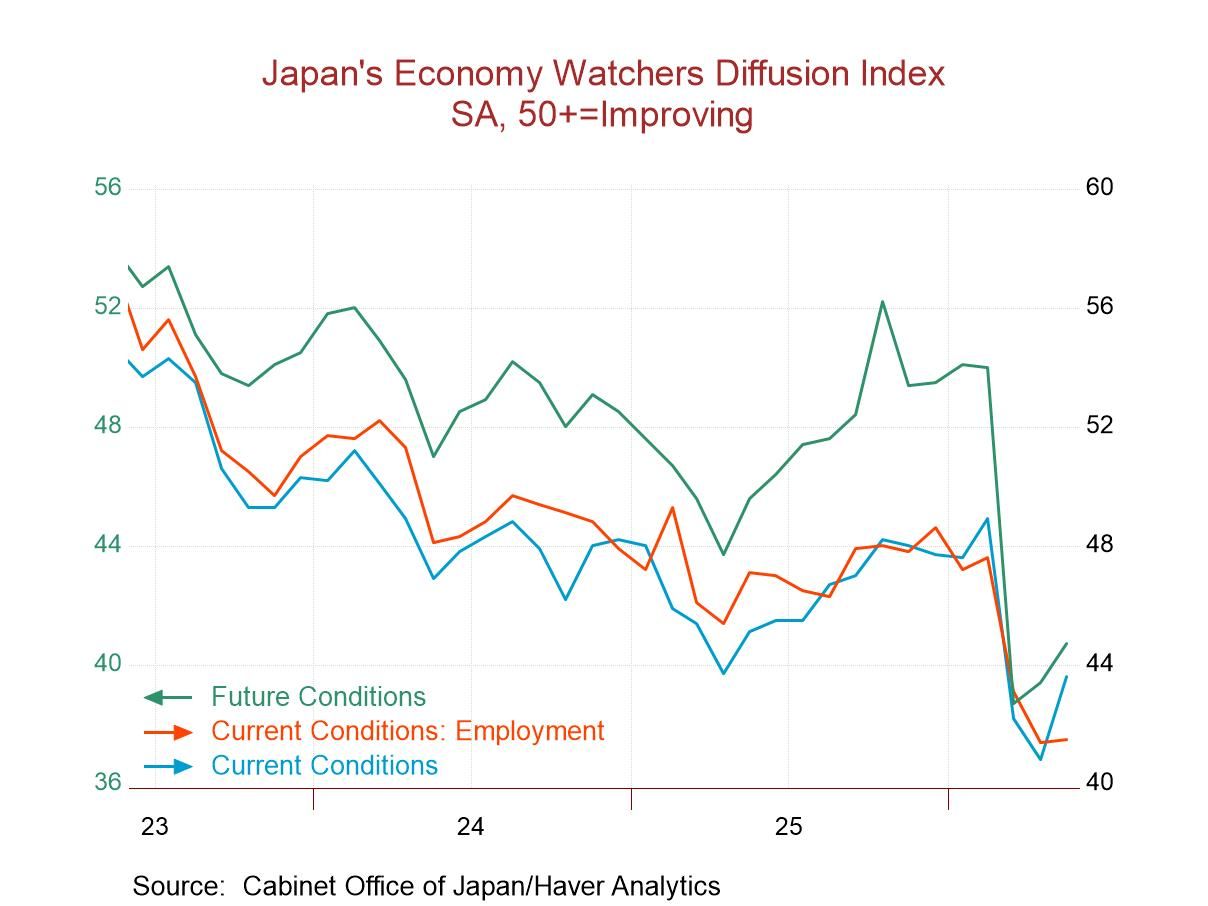
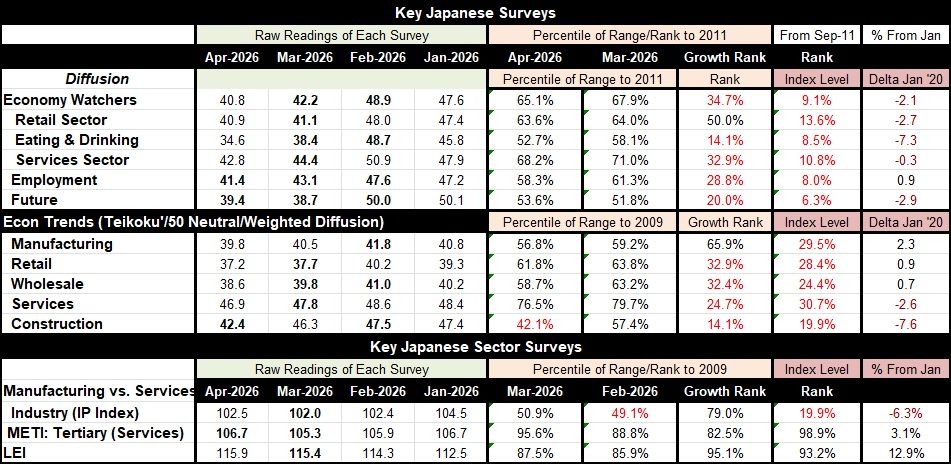
The economy watchers survey, along with other surveys, was doing fine until about March in the wake of the Iran war and the closing of the Strait of Hormuz. With that action, the economy watchers index dove sharply from a level of 48.9 in February to 42.2 in March and slipped further to 40.8 in April. The various sector gauges for the retail sector, eating & drinking places, the service sector, and employment are all lower. The only improvement in April came from the future index, where there was some minor optimism about the potential for conditions to improve ahead. And, of course, over the weekend, there is the announcement of a U.S.-Iran deal to end the hostilities between the two countries. That is expected to be signed on Friday and then will put the war into a pause phase for the next 60 days, with the hope that the two sides can come to agreement on some of the stickier elements, including Iran's access to nuclear materials, which has yet to be hammered out.
That omission makes the announcement of this arrangement as a conflict ending deal hugely speculative. Another sticking point is that Israel is not on board and is still engaged in fighting with Hezbollah.
The Teikoku survey, another survey using diffusion indexes that describes Japanese sectors, weakened sharply in March and weakened across the board again in April. Manufacturing, retailing, wholesaling, services, and construction sectors all are posting weaker numbers in April than in March.
The percentile rankings for the economy watchers survey and the Teikoku surveys are both very weak, with the economy watchers standings in the 10th percentile range or lower; the Teikoku rankings are generally higher, around the 30th percentile or perhaps as low as the 20th percentile, as seen in construction. These are still very weak readings. All the raw diffusion readings are below 50, indicating contraction.
The sector indexes from METI on manufacturing and services, which both weakened in March, rebounded in April; in both cases, the April readings were above the February readings. Standings of these indexes based on growth rates are around the 80th percentile; at the 79th percentile for industry and at the 82.5 percentile for the tertiary or services index. Based on the value of the index itself, the tertiary index has a standing at its 98.9 percentile, which we would expect over time for an index that simply grows, as is the case for the METI indexes that are not diffusion indexes. However, the industrial index for Japan has only a 19.9 percentile standing, indicating the stress that Japan's industrial sector has been through, although the current ranking based on the growth rate shows that there is some recovery in progress. The industry level index is 6.3% below its January 2020 level, while the tertiary index is 3.1% above its January 2020 level.
The leading economic index has continued to rise during all these times. It rose in February compared to January, and it rose again in March compared to February; now in April compared to March, it was up again to 115.9, from the March reading of 115.4. Based on year-over-year growth, the leading economic index has a 95.1 percentile standing, which is relatively strong. Based on the index level, we get another strong reading at the 93.2 percentile mark. The leading index is also up 12.9% from its January 2020 level.
The report of a deal to end the U.S. embargo of Iran and open the Strait of Hormuz without tolls is potentially a real gamechanger for the economic outlook. However, the deal still had pieces to be negotiated, and I, for one, am very wary since we know Iran wants to have nuclear access and the U.S. wants to block it. I just don’t see what a 60-day cooling period for negotiation will do. It will push the U.S. closer to midterm elections and make Trump less willing to engage in conflict with Iran, which is likely to remain intransigent on this issue of nuclear access. I view this as the eye of a hurricane, a period in which there will be calm, with the potential for a reset of confrontation down the road, say 60 days on.

Robert Brusca
AuthorMore in Author Profile »Robert A. Brusca is Chief Economist of Fact and Opinion Economics, a consulting firm he founded in Manhattan. He has been an economist on Wall Street for over 25 years. He has visited central banking and large institutional clients in over 30 countries in his career as an economist. Mr. Brusca was a Divisional Research Chief at the Federal Reserve Bank of NY (Chief of the International Financial markets Division), a Fed Watcher at Irving Trust and Chief Economist at Nikko Securities International. He is widely quoted and appears in various media. Mr. Brusca holds an MA and Ph.D. in economics from Michigan State University and a BA in Economics from the University of Michigan. His research pursues his strong interests in non aligned policy economics as well as international economics. FAO Economics’ research targets investors to assist them in making better investment decisions in stocks, bonds and in a variety of international assets. The company does not manage money and has no conflicts in giving economic advice.
More Economy in Brief
 Global