

EMU HICP Flares After Sag
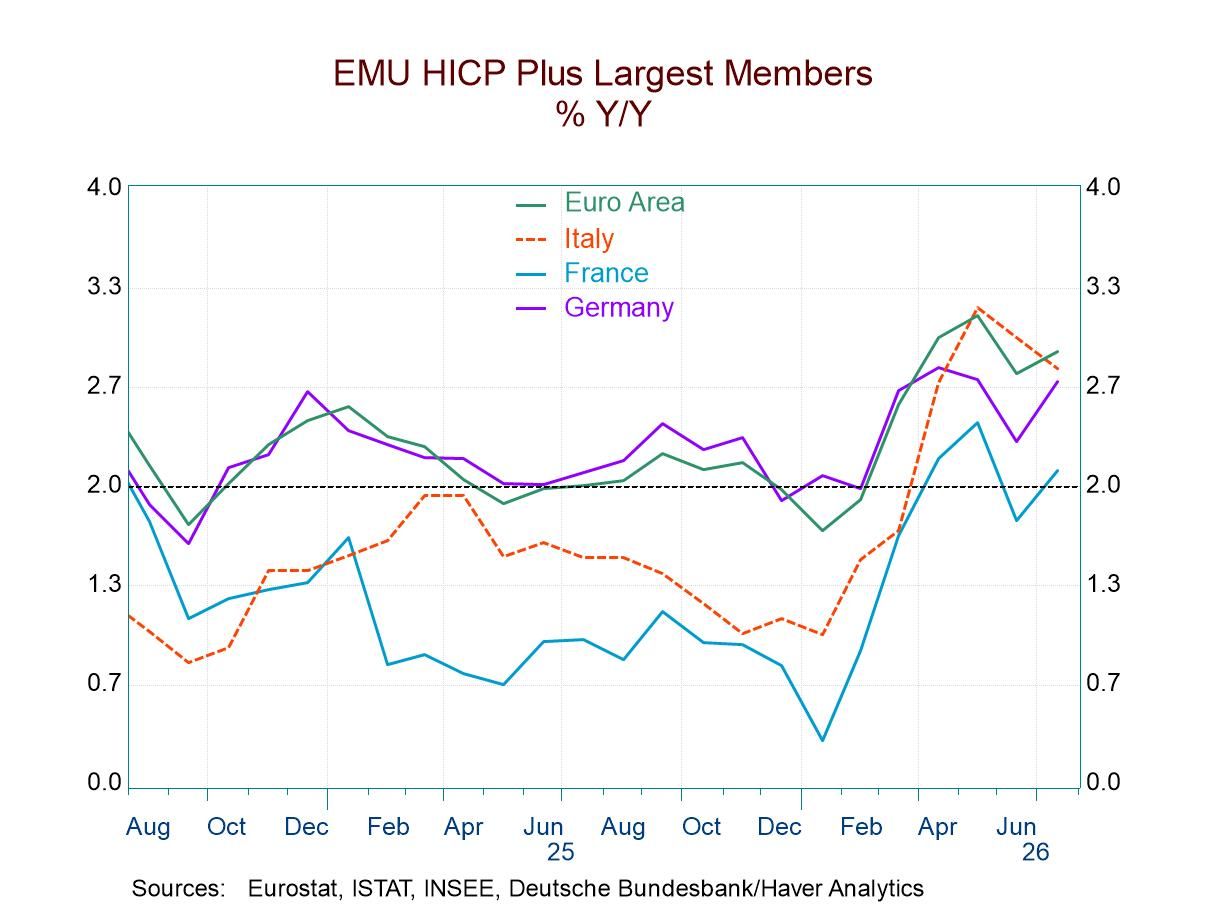
The harmonized index of consumer prices (HICP) for the European Monetary Union (EMU) surged in July, rising by 0.5% after having sagged in June with a -0.1% month-to-month change. The ceasefire that had temporarily been arranged with Iran in June has given way to the reality of ongoing war and ongoing strikes against tanker traffic. While there are some ongoing talks among the combatants, there is not a lot of hope for another ceasefire that's going to last. Both the United States and Iran have their own particular needs to have a ceasefire. But Iran took the last ceasefire as an opportunity to rebuild, recalibrate, apparently strengthen its military capabilities, and then extend its demands for control of the Strait of Hormuz. These were all nonstarters from the U.S. perspective, and I presume from a global perspective as well. The conditions necessary to underpin a ceasefire with some staying power simply do not exist anymore. The U.S. has resorted to hitting Iran harder.
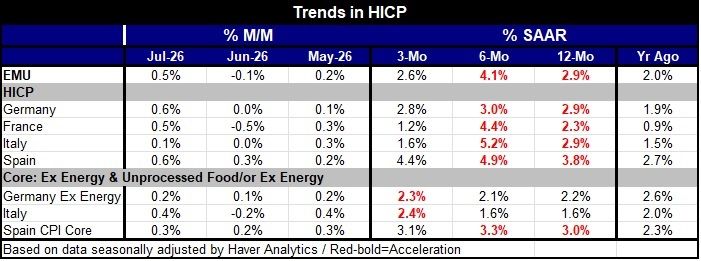
As a result, energy prices have moved back up and inflation in July moved back up in the EMU. Inflation shows a 2.9% rise over 12 months, a 4.1% annual rate of increase over six months, and a 2.6% annual rate of increase over three months. All of these are excessive with respect to the ECB objectives.
Over six months inflation is excessive in the EMU and in its four largest economies: Germany, France, Italy, and Spain. The best (the lowest) inflation performance is in Germany at 3%, while the worst inflation performance is in Italy at 5.2%. These four countries all exceed the ECB’s desired pace of 2% over 12 months as well. Twelve-month Spanish inflation runs at 3.8%, while in France inflation nails down the low side at 2.3%. Over three months, conditions are more varied because we're mixing in this one-month period of very good inflation news with two months of not so good inflation news. Over three months, Spain still logs a 4.4% increase in its HICP at an annual rate, but France logs 1.2% and Italy logs 1.6%; Germany's pace comes in at 2.8%.
We have core inflation or inflation excluding energy metrics (ex-energy in the case of Germany) for three of the four large countries. These metrics for July ranged from a 0.2% increase month-to-month in Germany to a 0.4% increase in core inflation in Italy. The ex-energy or core measures are within reach of the ECB’s target when applied to the core on a country basis. For Germany, the pace is 2.2% over 12 months, on the low side; for Italy, it’s at 1.6%. But excessive inflation persists for Spain where the core measure is at 3%. Over six months, results are highly similar to what we see over 12 months, but over three months we see German inflation at 2.3%, Italy at 2.4%, and Spain at 3.1%. All of these core or ex-energy measures become uncomfortable over three months.
It's clear that the situations in the Middle East—including Iran pressuring traffic through the Strait of Hormuz as well as the crimping of the flows into the Red Sea toward the Suez Canal by the Houthis—are contributing to these uncertainties and to the high short-term inflation rates.
We're talking about central banks now managing shocks, not about creating expectations involving macroeconomic developments. Policymaking has clearly transitioned into a different kind of world where central banks are onlookers and have no way of anticipating, and therefore no way of guiding investors over what to expect in the future because nobody knows.
This state of uncertainty is uncomfortable, but markets can deal with it, and the economies have so far been able to manage it. Although it's not quite the same kind of disruption, the global economy has been dealing with the uncertainties from the Russian attack in Ukraine for quite a bit longer. Currently, that conflict is beginning to turn more in favor of Ukraine as it has discovered a way to strike Russia internally and disrupt its oil production. The beat goes on as the uncertainty ramps up.
Despite the devastation rained on Iran in the attacks from the United States and Israel, Iran continues to surprise with an ability to mount counterattacks in the Strait of Hormuz. It is a fragile enough and an important enough waterway that it has been able to be disrupted by Iran with its remaining missiles and drone resources. All of this simply makes the future much more difficult to assess because it sets the bar extremely high for the kind of dominance the U.S. needs to achieve in order to open the Strait of Hormuz wide with no risk of attack. For now, that objective is a bridge too far. Despite everything the U.S. has done, it still hasn't done enough.

Robert Brusca
AuthorMore in Author Profile »Robert A. Brusca is Chief Economist of Fact and Opinion Economics, a consulting firm he founded in Manhattan. He has been an economist on Wall Street for over 25 years. He has visited central banking and large institutional clients in over 30 countries in his career as an economist. Mr. Brusca was a Divisional Research Chief at the Federal Reserve Bank of NY (Chief of the International Financial markets Division), a Fed Watcher at Irving Trust and Chief Economist at Nikko Securities International. He is widely quoted and appears in various media. Mr. Brusca holds an MA and Ph.D. in economics from Michigan State University and a BA in Economics from the University of Michigan. His research pursues his strong interests in non aligned policy economics as well as international economics. FAO Economics’ research targets investors to assist them in making better investment decisions in stocks, bonds and in a variety of international assets. The company does not manage money and has no conflicts in giving economic advice.
More Economy in Brief
 Asia
Asia
