German Industrial Output Gathers Strength
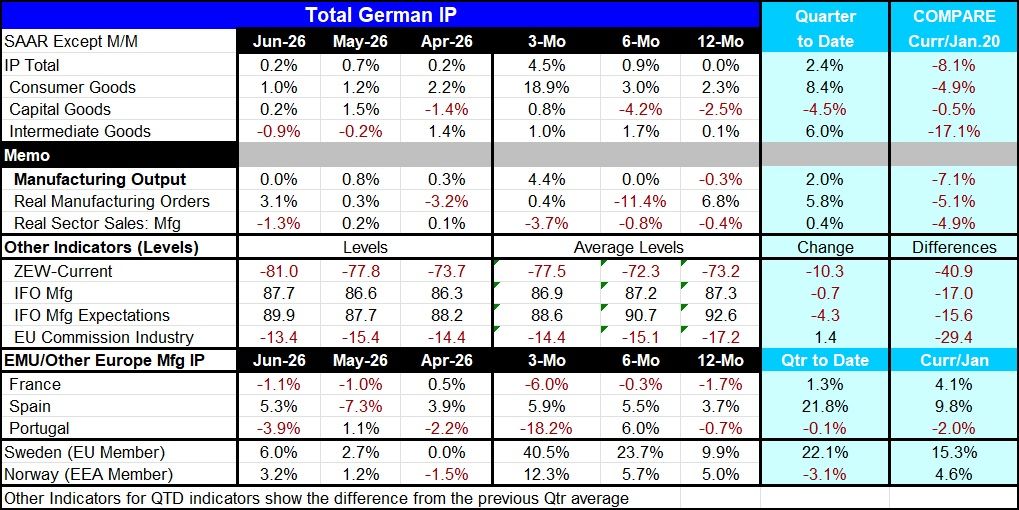
German industrial production rose by 0.2% in June, continuing a string of increases. Production in Germany is on an accelerating path. It is unchanged over 12 months, but it has a 0.9% annual rate increase over six months and a 4.5% annual rate increase over three months, a clear acceleration in the rates of growth over the shorter periods.
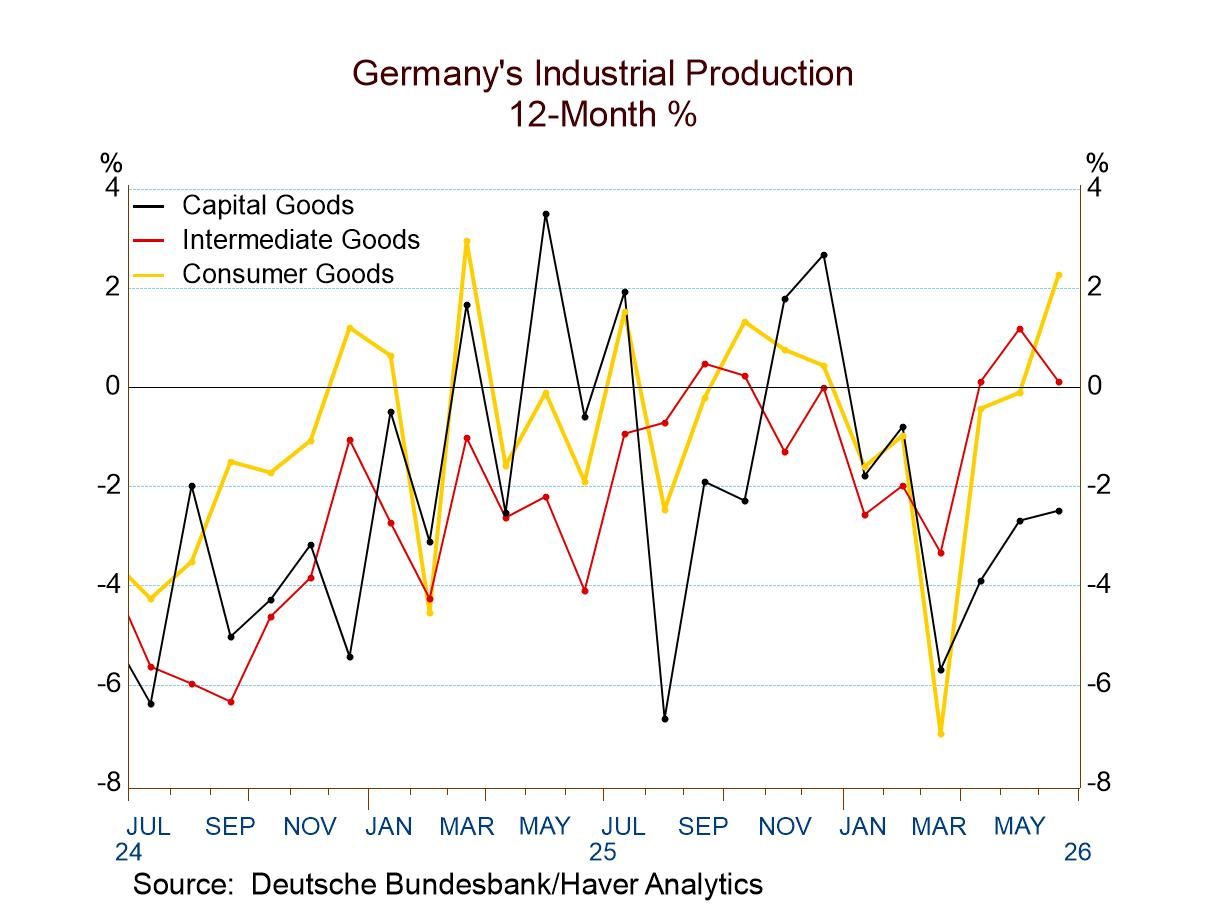
That trend is accentuated by consumer goods that grow 2.3% over 12 months; output then steps up to a 3% annual rate over six months and advances to 18.9% at an annual rate over three months. Capital goods and intermediate goods interrupt the pattern to some extent. For capital goods, output falls 2.5% over 12 months, then weakens further, falling by 4.2% annually over six months, but it rebounds to grow at a 0.8% annual rate over three months. That's not an accelerating pattern, but there is a recovery over three months. Intermediate goods show a 0.1% increase in output over 12 months, rising to 1.7% annually over six months but then stepping back to a 1% growth rate over three months.
Manufacturing alone also shows accelerating growth as growth rates improve from 12 months to six months to three months. Real manufacturing orders have a convoluted growth rate, with positive growth over 12 months, a decline over six months, and then a small recovery over three months. The pace of real sales, as we saw in yesterday's durable goods orders and sales report, is on a shrinking path.
Industrial surveys generally show sequential deterioration for the sector from the ZEW and the IFO. The exception is the EU Commission industrial index that shows some slight improvement sequentially.
Industrial production results are presented for five other European countries that have issued IP data as of June. These data show acceleration sequentially in Spain, Sweden, and Norway. France and Portugal have complex patterns that end with negative three-month growth rates.
On balance, Germany shows some hopeful trends, with some rebound being led to some extent by the consumer sector. The survey data on industry are not encouraging. Although the picture for the rest of Europe shows some tendency for acceleration, there’s still a good deal of lingering weakness.

Robert Brusca
AuthorMore in Author Profile »Robert A. Brusca is Chief Economist of Fact and Opinion Economics, a consulting firm he founded in Manhattan. He has been an economist on Wall Street for over 25 years. He has visited central banking and large institutional clients in over 30 countries in his career as an economist. Mr. Brusca was a Divisional Research Chief at the Federal Reserve Bank of NY (Chief of the International Financial markets Division), a Fed Watcher at Irving Trust and Chief Economist at Nikko Securities International. He is widely quoted and appears in various media. Mr. Brusca holds an MA and Ph.D. in economics from Michigan State University and a BA in Economics from the University of Michigan. His research pursues his strong interests in non aligned policy economics as well as international economics. FAO Economics’ research targets investors to assist them in making better investment decisions in stocks, bonds and in a variety of international assets. The company does not manage money and has no conflicts in giving economic advice.
More Economy in Brief
U.K. Housing Surveys and Consumer Sentiment Support the View of Weak Growth
 Asia
Asia