German, French, and Portuguese IP Fall
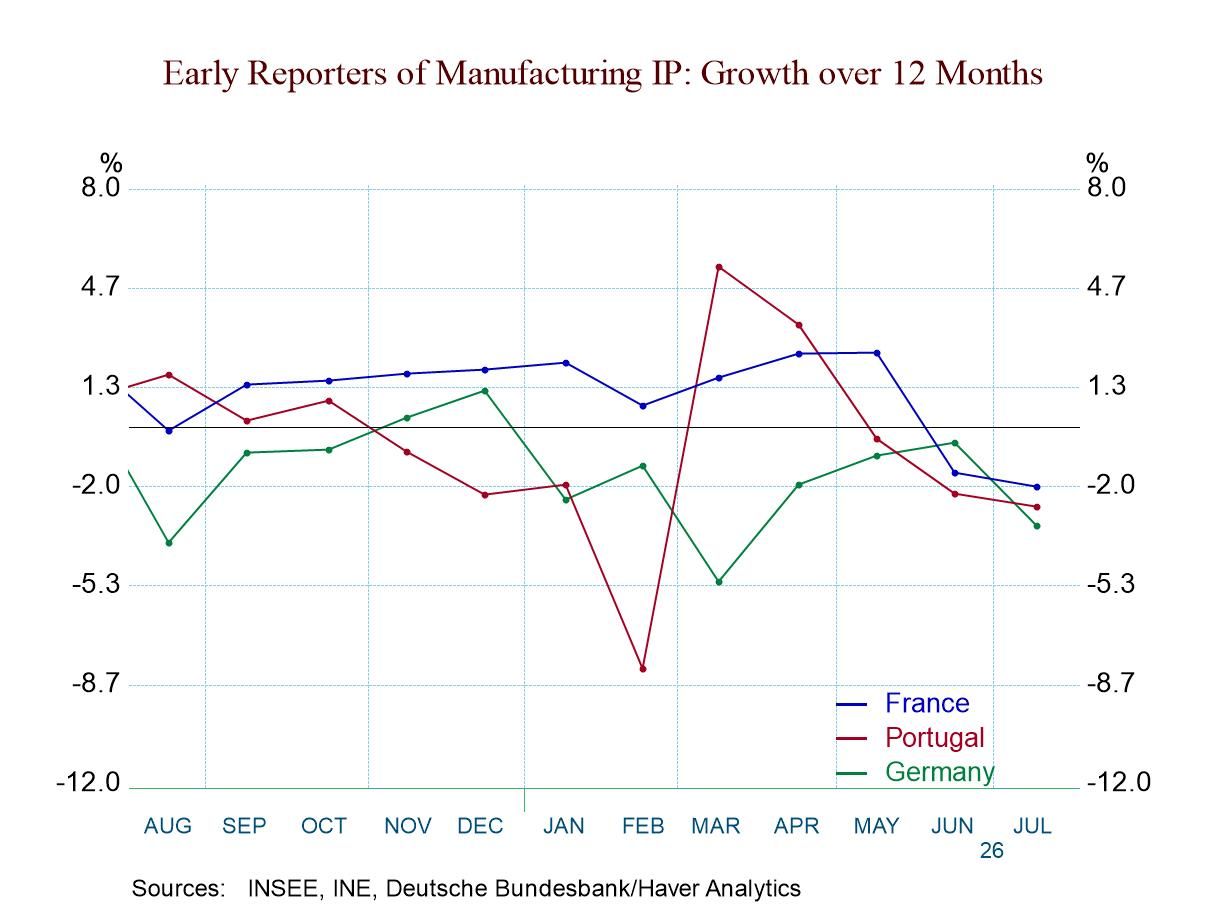
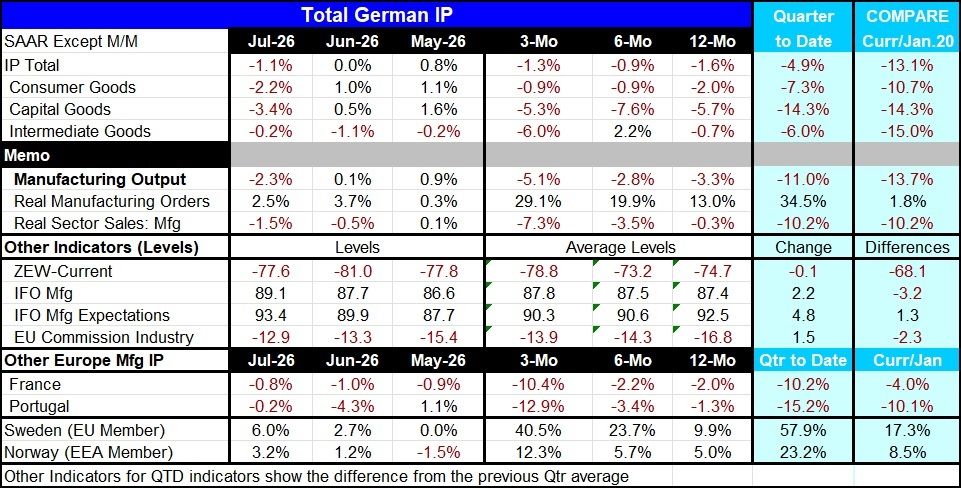
Early reports for industrial production showed declines in Europe, with German industrial production falling 1.1% in July, French output falling 0.8%, and Portuguese output falling 0.2%. Nonmonetary union members Sweden and Norway both showed increases in July. The German IP report was released on Monday during the U.S. holiday; the Portuguese IP was released on September 1, while the French IP was reported today.
German production shows relatively steady declines over 12 months, six months, and three months of around 1% or a little bit more at an annual rate. Outputs of consumer goods and capital goods on all three horizons show declines. Intermediate goods output shows declines over 12 months and three months, with an intervening increase over six months at a 2.2% annual rate.
German manufacturing output fell by 2.3% in July, showing steady declines over 12 months, six months, and three months, the same as headline output. However, German manufacturing orders in real terms increased by 2.5% in July, showing an accelerating pattern from 12 months to six months to three months. Current real manufacturing sales fell by 1.5% in July and may still be holding back output. There is a sequential deceleration in real sales, with sales falling by 0.3% over 12 months, by 3.5% over six months at an annual rate, and by 7.3% over three months at an annual rate. Presumably, that pattern is about to be dominated and reversed by the strength in real orders.
Other German indicators from ZEW, IFO, and the EU Commission showed improvement in July compared to June, although the sequential readings are less reassuring since only the EU Commission index shows persistent improvement.
French industrial output fell by 0.8% in July, showing accelerating output declines from 12 months to six months to three months. Similarly, Portugal showed a 0.2% decline in July, with accelerating output declines from 12 months to six months to three months.
The nonmonetary union members Sweden and Norway not only showed strong output increases in July but also sequential acceleration from 12 months to six months to three months.
The EMU begins the quarter to date with weak results as German, French, and Portuguese outputs show declines, while Sweden and Norway are showing very strong increases. For the European Monetary Union members, it's a poor start to a new quarter.

Robert Brusca
AuthorMore in Author Profile »Robert A. Brusca is Chief Economist of Fact and Opinion Economics, a consulting firm he founded in Manhattan. He has been an economist on Wall Street for over 25 years. He has visited central banking and large institutional clients in over 30 countries in his career as an economist. Mr. Brusca was a Divisional Research Chief at the Federal Reserve Bank of NY (Chief of the International Financial markets Division), a Fed Watcher at Irving Trust and Chief Economist at Nikko Securities International. He is widely quoted and appears in various media. Mr. Brusca holds an MA and Ph.D. in economics from Michigan State University and a BA in Economics from the University of Michigan. His research pursues his strong interests in non aligned policy economics as well as international economics. FAO Economics’ research targets investors to assist them in making better investment decisions in stocks, bonds and in a variety of international assets. The company does not manage money and has no conflicts in giving economic advice.
More Economy in Brief
 Global