French Household Confidence Improves
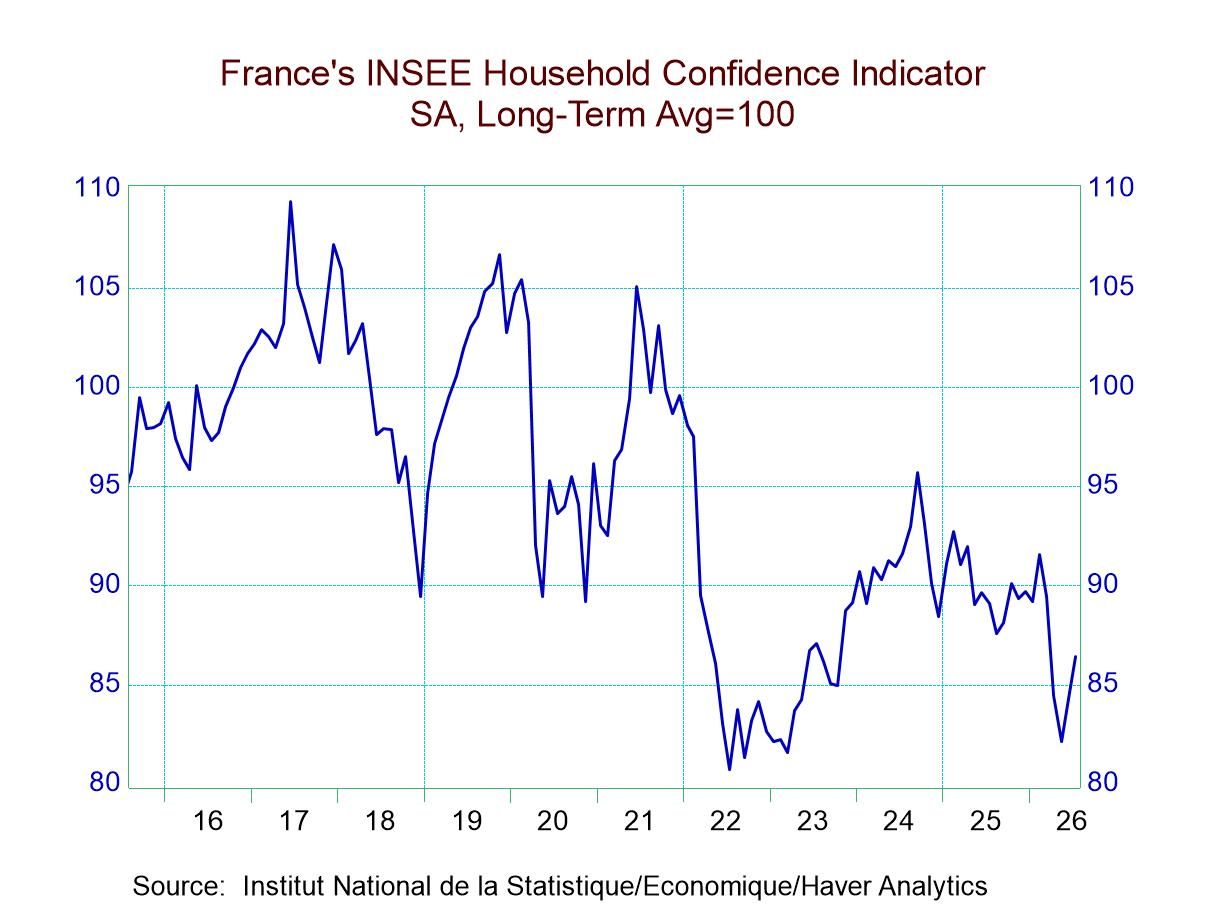
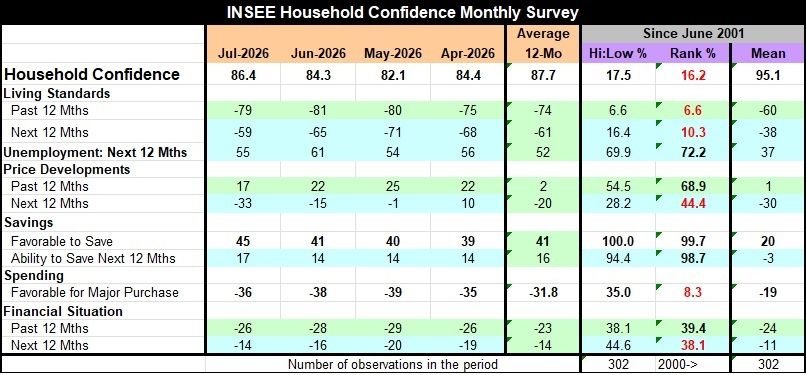
Household confidence in France improved in July, rising to 86.4 from 84.3 in June. Confidence was last higher in March, and the average for confidence over the last 12 months is 87.7. The July value, despite its climb, is still below that average; confidence is still weak in a historic context. According to data back to 2001, the current confidence metric in July has a 16.2 percentile ranking, an extremely weak reading. The mean of confidence readings back to 2001 is 95.1. The July reading is nearly nine points below that.
Weak but improved living standards readings: Living standards in July improved slightly compared to June. The assessment of the last 12 months is -79 compared to -81 previously. However, the 12-month average is a rating of -74; the July reading is still short of that. Looking to the next 12 months, living standards are expected to improve; the reading of -59 in July compares to -65 logged a month ago. It compares to a 12-month average of -61. The expectation for living standards over the next 12 months is higher than it has been on average for the last 12 months, although the reading itself is still quite weak. The standing in its 10th percentile for a current rating at -59 is below its full-period average of -38.
Fewer unemployment worries: Unemployment over the next 12 months is expected to be less of a concern, but the reading in July drops to 55 from 61 in June; however, the July reading is still above the 12-month average of 52. The ranking for unemployment concerns has a 72nd percentile standing, putting it in the top third of its historic range of readings.
Inflation fears drop, comparatively: Price developments show that over the past 12 months inflation has been a concern, with the July reading falling relative to June to 17 from 22, but this reading is much higher than its 12-month average of +2. However, looking to the next 12 months, the July reading is -33 compared to -15 in June, and it compares to -20 on average over the last 12 months. Inflation expectations are for conditions to show weaker inflation pressures. The ranking of the July reading is at its 44th percentile, below its historic median; the medians on rankings occur at a ranking of 50. Of course, all these readings will be dependent on how oil prices evolve.
Saving/spending: Both the favorability and the ability to save improved in July compared to June; both readings in July are above their respective 12-month averages. The rankings of these observations are around their high 90th percentiles; for the favorability to save, the reading is the highest in the whole period back to June 2001. The ability to save is often not a good reading but rather one that reflects consumer defensiveness, and we see that as we move to the next metric, the favorability to make a major purchase. In July, that reading improved to -36 from -38 in June, but it's weaker than its 12-month average of -31.8. In historic context, it's extremely weak and has an 8.3 percentile standing. So, the favorability to make a major purchase is in the lower 10th percentile of all monthly observations back to June 2001, indicating considerable consumer defensiveness.
Financial situation: The financial situations over the past 12 months and projected over the next 12 months show slightly improved readings compared to June. The past 12 months reading is weaker than its 12-month average, while the expectation for the next 12 months is the same as its 12-month average. The rankings of the two financial situations are just below their respective 40th percentiles, placing them about 10 percentile points below their historic medians.
Summing up The consumer in France sees some improvement in July, and conditions remain mixed across these various components. But most of the rankings for the components are quite weak, with the exception being concerns about unemployment and the favorability to save, which was a defensive reading. The weighting scheme for this survey gives us a slightly more positive read on the month, but it's clear that the French consumers are still concerned about economic conditions and the future.

Robert Brusca
AuthorMore in Author Profile »Robert A. Brusca is Chief Economist of Fact and Opinion Economics, a consulting firm he founded in Manhattan. He has been an economist on Wall Street for over 25 years. He has visited central banking and large institutional clients in over 30 countries in his career as an economist. Mr. Brusca was a Divisional Research Chief at the Federal Reserve Bank of NY (Chief of the International Financial markets Division), a Fed Watcher at Irving Trust and Chief Economist at Nikko Securities International. He is widely quoted and appears in various media. Mr. Brusca holds an MA and Ph.D. in economics from Michigan State University and a BA in Economics from the University of Michigan. His research pursues his strong interests in non aligned policy economics as well as international economics. FAO Economics’ research targets investors to assist them in making better investment decisions in stocks, bonds and in a variety of international assets. The company does not manage money and has no conflicts in giving economic advice.
More Economy in Brief
 Asia
Asia