

Even Swiss Inflation Heads North
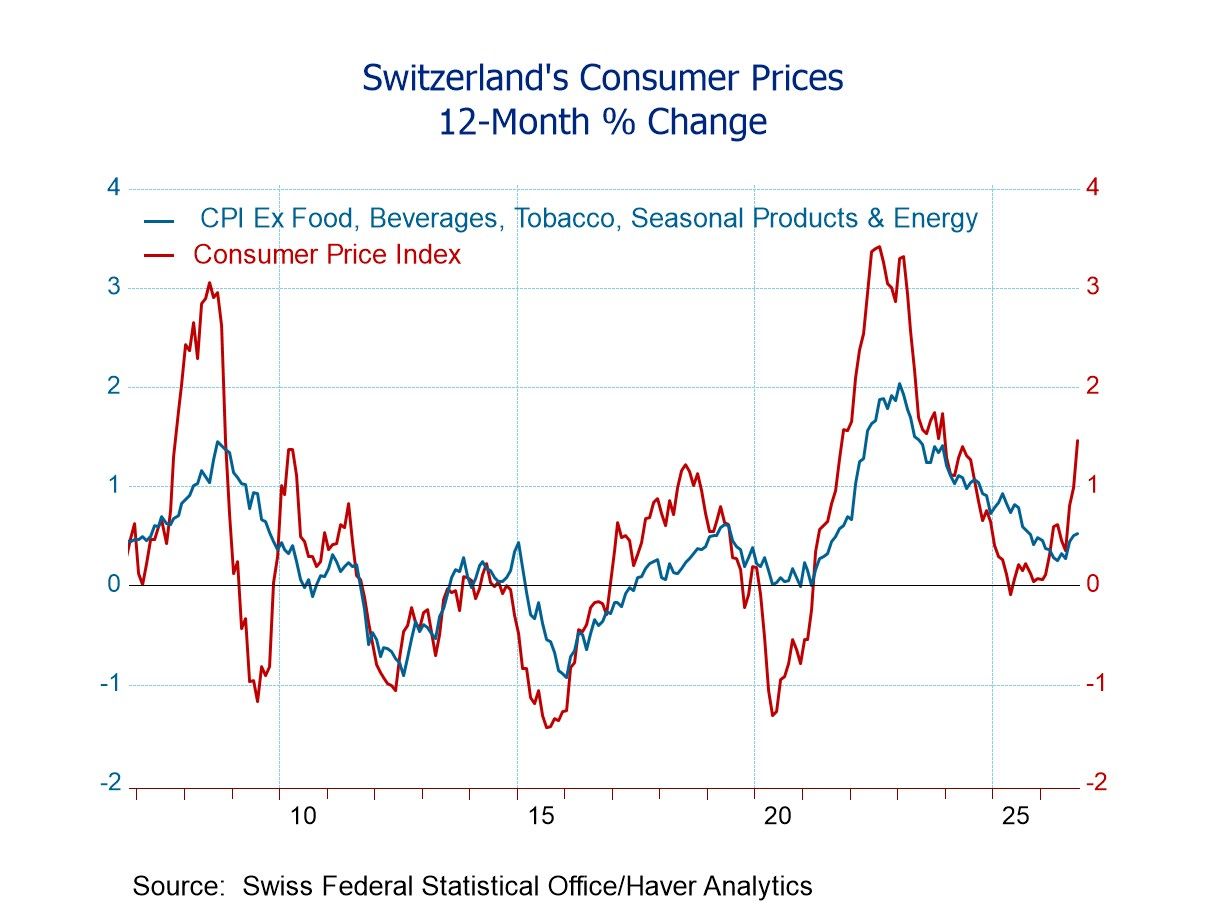
The Swiss inflation rate is the envy of every central banker in the G7 and beyond. Yet, Swiss inflation has turned north in October, with the headline HICP rate gaining 0.4% in October, the Swiss domestic headline metric rising by 0.4% on the month, and the Swiss domestic core inflation rate remaining flat at a 0% change on the month.
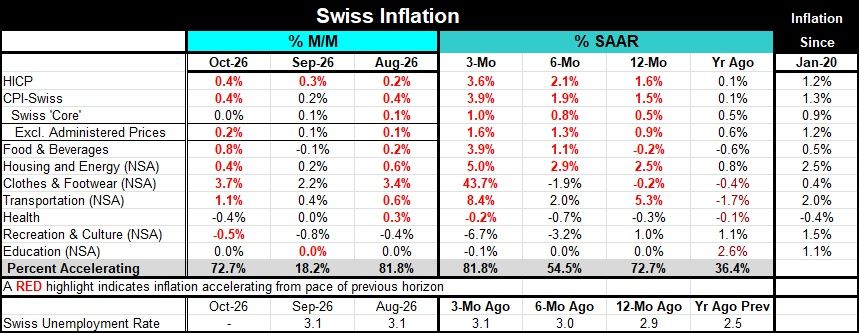
Inflation breadth is gaining In October, Swiss inflation showed acceleration in 72.7% of the categories, a sharp increase from September when inflation accelerated in only 18.2% of the categories. However, in August, inflation month-to-month had accelerated in 81.8% of the categories.
Pressure is evident in all measures Switzerland is dealing with real inflation pressures. The 12-month inflation rate has hit a recent high at 1.6%, still an enviably low pace on the HICP measure. The Swiss domestic headline inflation rate is at 1.5%, while the Swiss core rate continues to be mild at a 0.5% increase over 12 months.
Acceleration is also real Turning to the sequential numbers, the HICP inflation rate moves up from 1.6% over 12 months to a 2.1% annual rate over six months to a 3.6% annual rate over three months, a clear pattern of acceleration. The Swiss domestic headline inflation rate is at 1.5% over 12 months, moves up to 1.9% over six months, and elevates to a 3.9% annual rate over three months. The Swiss core inflation rate, which is only 0.5% over 12 months, rises to 0.8% over six months and to 1% over three months, all expressed at annual rates.
Controlling for administered prices A lot of prices in Switzerland face administrative conditions, and there is a separate index for prices excluding administered prices. However, those also show inflation is moving up in October. The index excluding administered prices rose by 0.2% in October after rising 0.1% in September. The sequential move in the index excluding administered prices is up by 0.9% over 12 months; it’s up to a 1.3% annual rate over six months and to 1.6% at an annual rate over three months.
Broad acceleration identified by diffusion gauges Looking at the detailed Swiss categories, inflation accelerates in 81.8% of the categories over three months compared to six months, and in 54.5% of the categories over six months compared to 12 months. Then, 72.7% of the categories over 12 months show acceleration compared to the pace of 12 months ago. Inflation, on all these horizons, clearly is accelerating in more categories than it is decelerating. The tendency for acceleration appears to be moving higher based on the three-month diffusion reading of 81.8%.
Monetary policy remains on hold Despite the rising pressures and a rising inflation rate, the Swiss National Bank (SNB) has kept policy steady, with the policy rate unchanged at 0% at its last meeting in late September. The SNB recognizes that markets have moved interest rates up and that there's a focus on events in the Middle East. But thus far, it has chosen to keep interest rates at its unchanged low levels. At the time of the last meeting, there had been an increase in market rates and some deterioration in the Swiss franc exchange rate in some sense offsetting one another. The bank's policy deliberations noted that inflation expectations remained well anchored.
The next monetary policy meeting for Switzerland will come on December 10. Switzerland has been the clear inflation success globally since COVID, the war, oil, and other supply shocks have struck. While it clearly is experiencing some inflation transmission from the global economy, and while some of that has even crept into its core rate, the core remains quite stable and low.

Robert Brusca
AuthorMore in Author Profile »Robert A. Brusca is Chief Economist of Fact and Opinion Economics, a consulting firm he founded in Manhattan. He has been an economist on Wall Street for over 25 years. He has visited central banking and large institutional clients in over 30 countries in his career as an economist. Mr. Brusca was a Divisional Research Chief at the Federal Reserve Bank of NY (Chief of the International Financial markets Division), a Fed Watcher at Irving Trust and Chief Economist at Nikko Securities International. He is widely quoted and appears in various media. Mr. Brusca holds an MA and Ph.D. in economics from Michigan State University and a BA in Economics from the University of Michigan. His research pursues his strong interests in non aligned policy economics as well as international economics. FAO Economics’ research targets investors to assist them in making better investment decisions in stocks, bonds and in a variety of international assets. The company does not manage money and has no conflicts in giving economic advice.
More Economy in Brief
 Global