EMU Unemployment Remains Low
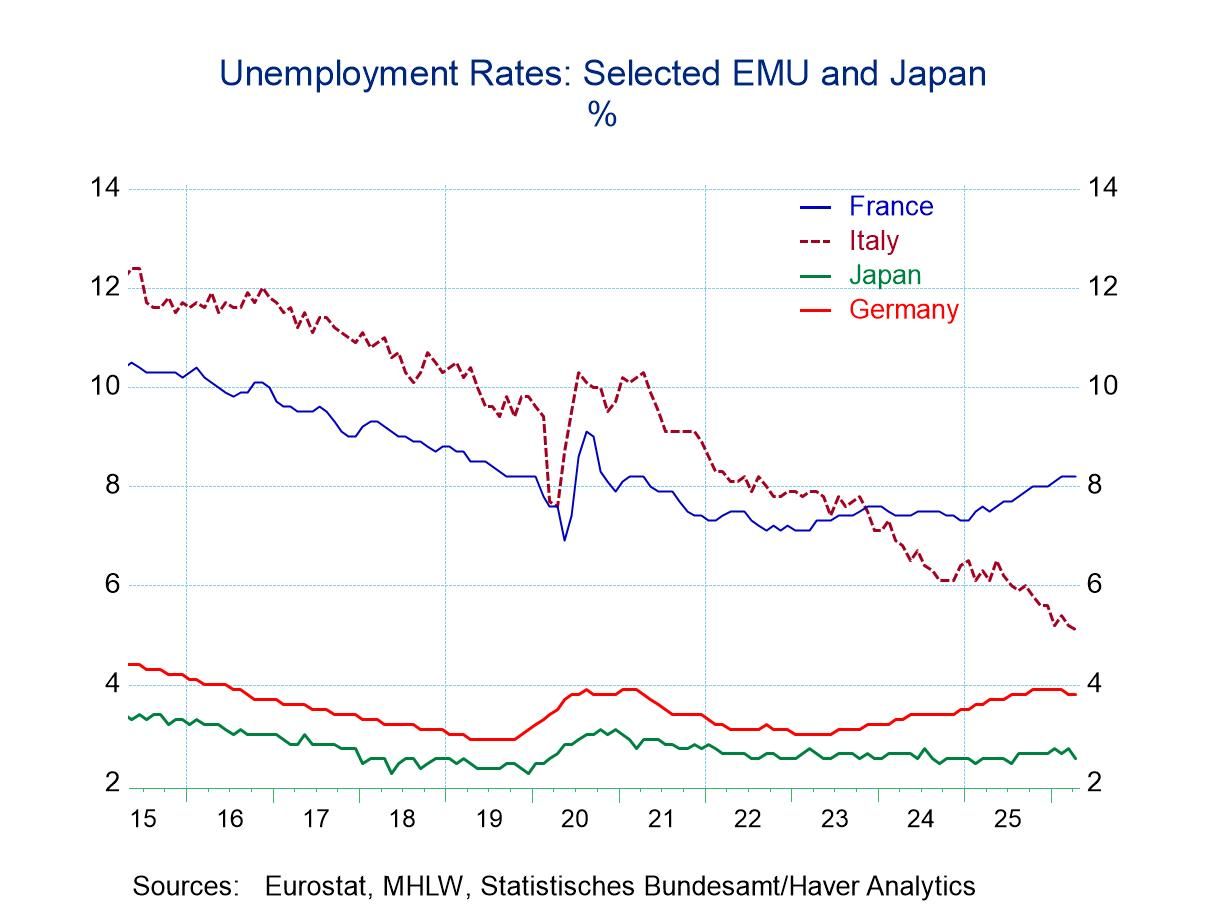
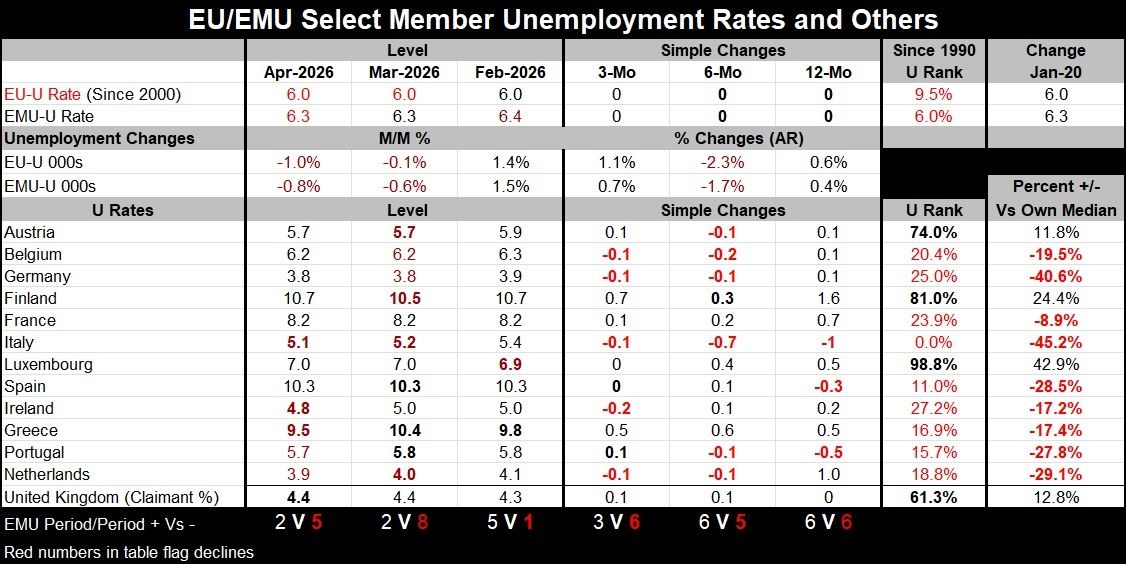
Unemployment in the European Monetary Union stayed at 6.3% in April, just a tick above its all-time low. In the more inclusive EU, the unemployment rate hovered at 6%, just two tenths of a percentage point above its all-time low. Unemployment conditions in the monetary union remain low without many signs of acceleration.
The unemployment rate in April fell in Italy, Ireland, Greece, Portugal, and the Netherlands. The unemployment rate increased month-to-month in Finland.
In March, the unemployment rate declined in Austria, Belgium, Germany, Finland, Italy, and the Netherlands. It rose month-to-month in Greece and Luxembourg.
Over three months, the unemployment rate in these 12-early reporting monetary union members fell in five countries: Belgium, Germany, Italy, Ireland, and the Netherlands. In contrast, unemployment rose in five countries: Portugal, Greece, France, Finland, and Austria.
Over six months, unemployment rates fell in six countries: the Netherlands, Portugal, Italy, Germany, Belgium, and Austria. This was against increases in six countries: Greece, Finland, France, Luxembourg, Spain, and Ireland.
Year over year, the degree of inflation progress is much thinner, with the unemployment rates falling in only three countries Italy, Spain, and Portugal with increases in unemployment for all the other countries in the table.
Unemployment rates continue to rank low in the monetary union, with only three monetary union countries having their unemployment rates ranked above 50%, putting them above their respective medians on data back to the year 2000. Those three countries are Luxembourg, Finland, and Austria. For the remaining countries, the rankings of their unemployment rates over this period are not even as high as their 30th percentiles. Italy, at present, is experiencing its lowest unemployment rate of the period.
Unemployment conditions in the monetary union remain solid. The past two weeks were significant for monetary policy and global economics, with the ECB raising rates, Japan raising rates, and the United States keeping rates unchanged but moving away from an easing bias in policy that had been in effect for quite a number of months. Today the Bank of England, after experiencing some significant inflation progress, decided to keep its policy on hold for another session. An agreement between the U.S. and Iran securing an opening of the Strait of Hormuz was signed, paving the way for potentially improved oil flows, lower inflation, and less uncertainty in the period ahead.

Robert Brusca
AuthorMore in Author Profile »Robert A. Brusca is Chief Economist of Fact and Opinion Economics, a consulting firm he founded in Manhattan. He has been an economist on Wall Street for over 25 years. He has visited central banking and large institutional clients in over 30 countries in his career as an economist. Mr. Brusca was a Divisional Research Chief at the Federal Reserve Bank of NY (Chief of the International Financial markets Division), a Fed Watcher at Irving Trust and Chief Economist at Nikko Securities International. He is widely quoted and appears in various media. Mr. Brusca holds an MA and Ph.D. in economics from Michigan State University and a BA in Economics from the University of Michigan. His research pursues his strong interests in non aligned policy economics as well as international economics. FAO Economics’ research targets investors to assist them in making better investment decisions in stocks, bonds and in a variety of international assets. The company does not manage money and has no conflicts in giving economic advice.
More Economy in Brief
 Global