EMU Unemployment Rate Ticks Up; Still Near All-Time Low
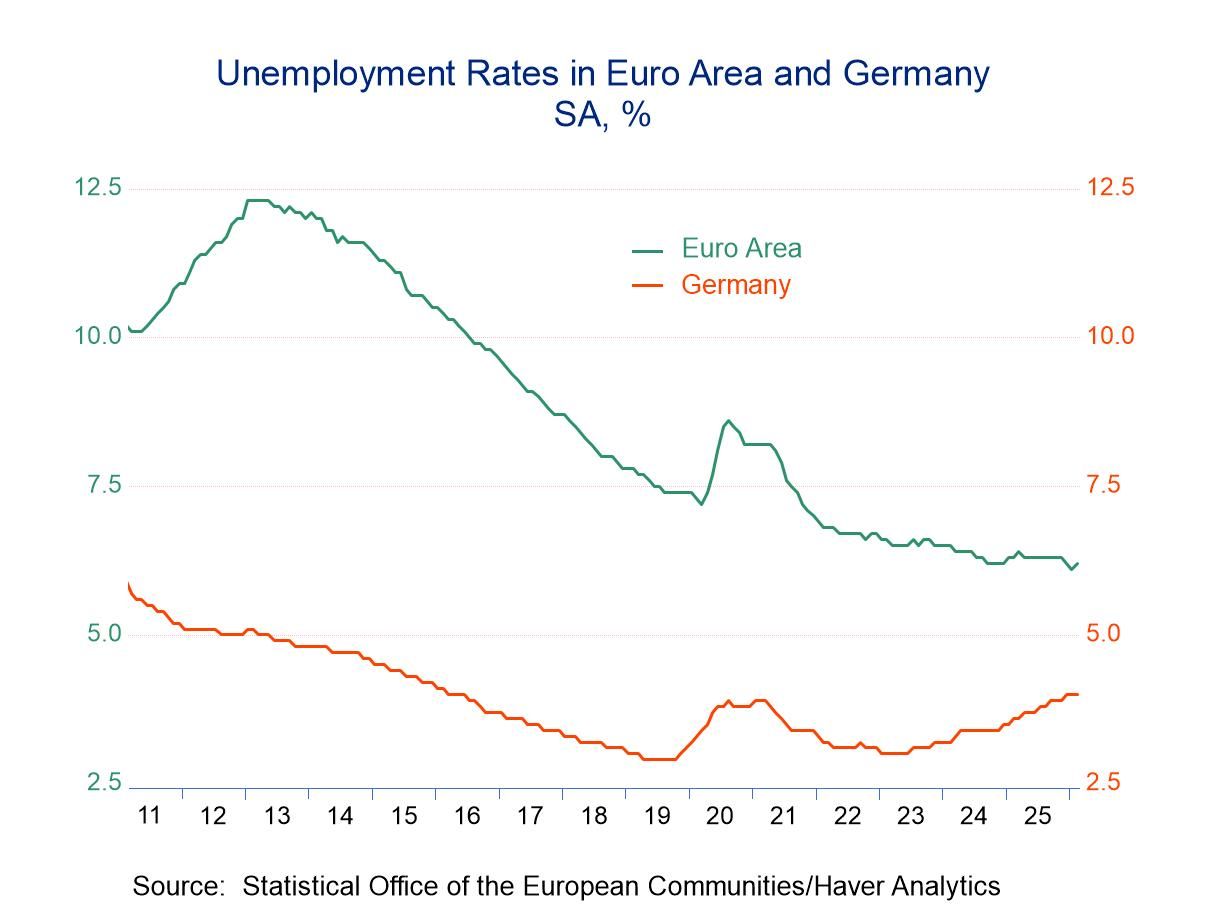
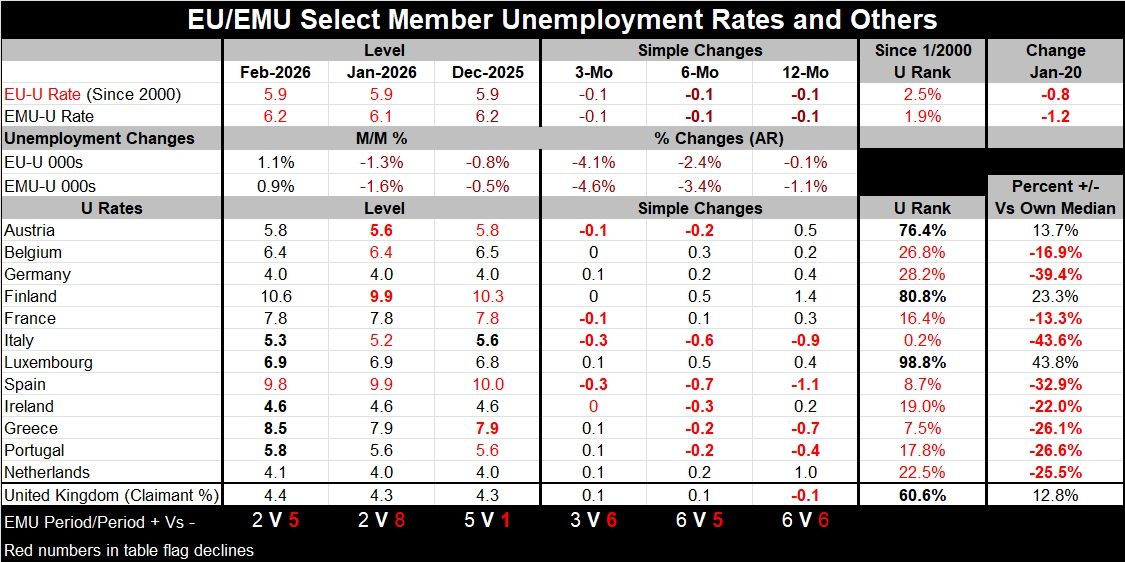
The unemployment rate in the European monetary union picked up to 6.2% in February from 6.1% in January, when it had declined from 6.2% in December. The 6.1% reading is the all-time low, so at 6.2% the unemployment rate remains extremely low in the monetary union.
The number of unemployed in February rose by about 1% in both the EU and the monetary union; however, over broader spans of three months, six months, and 12 months, the number of unemployed is still falling.
February is a low month for the number of reporters on the table showing a decline in the unemployment rate. Among the 12 member reporters listed in the table, only Spain had a lower unemployment rate in February than in January, and Spain continues to show declines in unemployment as it also saw its unemployment rate drop in January and December, as well as on balance over three months, six months, and 12 months. Spain is the only country in the monetary union showing this kind of ongoing progress in reducing unemployment.
For the most part, unemployment rates seem to be stuck at relatively low levels among these 12 monetary union reporters. Four show net declines over 12 months, while six show declines over six months and four show declines over three months. Only three—Austria, Finland, and Luxembourg—report unemployment rates that rank above their respective medians, above a ranking of 50% on data back to 2000.
Although the EMU unemployment rate ticked up in February, it remains exceptionally low. Unemployment in Italy also ticked higher and has the exceptionally low ranking of 0.2%, having just moved up from its all-time low. Country-reported unemployment rates are in the bottom 10 percentile of their range over this period in Spain and Greece. You will remember these as the countries with the structurally highest unemployment rates typically in double digits prior to the formation of the European Union; now the Greek unemployment rate is 8.5% and the Spanish unemployment rate is 9.8%, and they are gradually folding into the community norms.
Despite the uptick in the unemployment rate, it's another excellent unemployment report for the monetary union, with unemployment rates below the medians up and down the line with few exceptions and with both countries brandishing unemployment rates that are substantially below their historic medians. Inflation rate in the monetary union remains broadly controlled, and the progress on the unemployment rate has been spectacular. Despite the other problems that the monetary union has encountered, these are true successes of the formation of the monetary union.

Robert Brusca
AuthorMore in Author Profile »Robert A. Brusca is Chief Economist of Fact and Opinion Economics, a consulting firm he founded in Manhattan. He has been an economist on Wall Street for over 25 years. He has visited central banking and large institutional clients in over 30 countries in his career as an economist. Mr. Brusca was a Divisional Research Chief at the Federal Reserve Bank of NY (Chief of the International Financial markets Division), a Fed Watcher at Irving Trust and Chief Economist at Nikko Securities International. He is widely quoted and appears in various media. Mr. Brusca holds an MA and Ph.D. in economics from Michigan State University and a BA in Economics from the University of Michigan. His research pursues his strong interests in non aligned policy economics as well as international economics. FAO Economics’ research targets investors to assist them in making better investment decisions in stocks, bonds and in a variety of international assets. The company does not manage money and has no conflicts in giving economic advice.
More Economy in Brief
 Asia
Asia